4,068 posters, 219 videos, 101 topics, 69 sessions, 14,365 authors, 6,128 institutions
ePostersLive by SciGen Technologies S.A. All rights reserved.
Alzheimer's Association International Conference 2026
July 12-15, 2026 | London, United Kingdom, and Online

10766
Case Report: Early Onset Alzheimer’s Disease With A Strong Family History Of Dementia Found To Have A PSEN1 C.836a>T (p.asn279Ile) Variant
Poster Presenter
Part of Topic
BACKGROUND: Early onset Alzheimer’s disease (AD) is significantly more likely to be caused by a single gene mutation. Increased genetic testing for possible autosomal dominant causes of early onset AD is leading to increased identification of potential pathogenic mutations.
CASE HISTORY:
Brief HPI: A 48-year-old woman was seen in the Memory Disorders Clinic reporting approximately 18 months of initially mild word finding difficulty with progression to dementia. Cognitive symptoms included using less specific or portions of words and having frequent circumlocutions. She was admitted from clinic for an expedited rapidly progressive dementia work-up
Medical history:
- Past Medical/Surgical: asthma, migraine, cesarean x4
- Social: No tobacco, alcohol, or illicit drug use
Educational/baseline functional history:
- College Degree in Elementary Education
Positive Neurological Exam Findings:
- Paratonia in L > R
- Slight parietal list in the LUE
- No asymmetric cortical sensory deficit
- Fine and high frequency tremor BUE
Neurobehavioral Assessment:
- Orientation: Alert and oriented to person, place, and situation.
- Memory: Generally intact to recent and remote events (confirmed via collateral), but missing details and exact dates.
- Attention: Not distracted, attentive throughout visit.
- Language: Slowed spontaneous speech with circumlocutions, word-finding difficulty, frequent paraphasic errors (ex: “hunder” for “under”), and restricted phonemic loop with repetition; BNT 13/15.
- Executive/Planning: Difficulty with overlapping pentagons.
- Visuospatial: Overlapping and Navon figures intact.
Work-up:
- Blood labs unrevealing (TSH/T4, TG/TPO, vitamin B12, HIV, Treponema antibodies, ceruloplasmin, copper, heavy metals, ESR/CRP, serum Mayo AIE panel, ANA, RF, ANCA)
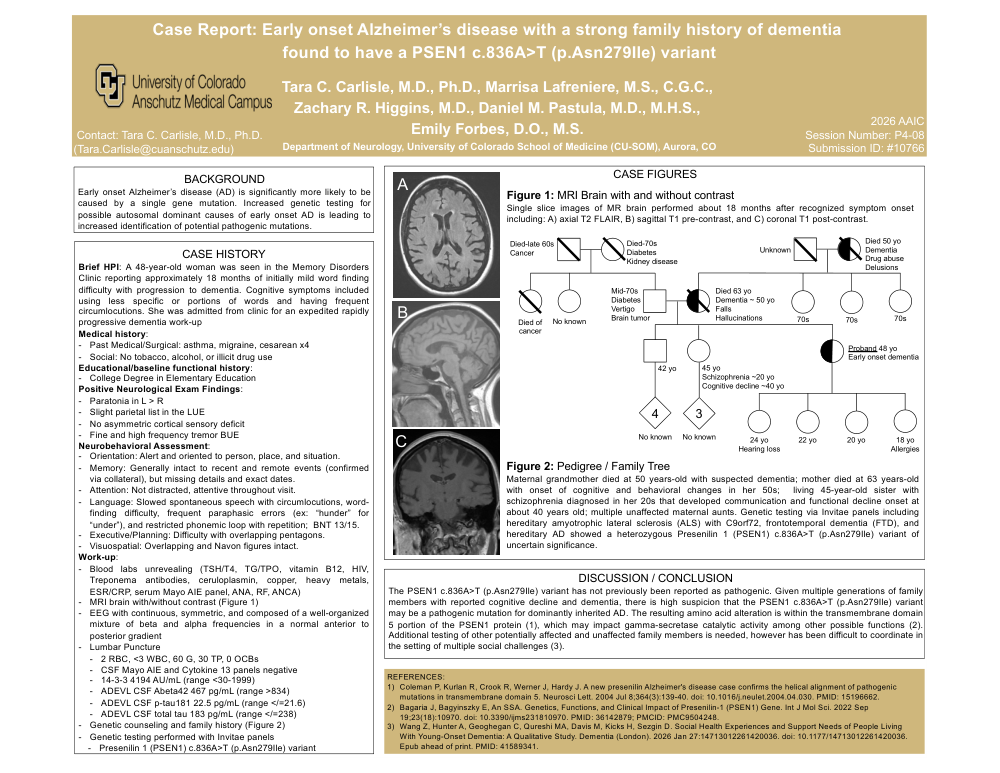
- MRI brain with/without contrast (Figure 1)
- EEG with continuous, symmetric, and composed of a well-organized mixture of beta and alpha frequencies in a normal anterior toposterior gradient
- Lumbar Puncture: 2 RBC, <3 WBC, 60 G, 30 TP, 0 OCBs, CSF Mayo AIE and Cytokine 13 panels negative, 14-3-3 4194 AU/mL (range <30-1999), ADEVL CSF Abeta42 467 pg/mL (range >834), ADEVL CSF p-tau181 22.5 pg/mL (range </=21.6), ADEVL CSF total tau 183 pg/mL (range </=238)
- Genetic counseling and family history (Figure 2)
- Genetic testing performed with Invitae panels: Presenilin 1 (PSEN1) c.836A>T (p.Asn279Ile) variant
CASE FIGURES:
Figure 1: MRI Brain with and without contrast - Single slice images of MR brain performed about 18 months after recognized symptom onset including: A) axial T2 FLAIR, B) sagittal T1 pre-contrast, and C) coronal T1 post-contrast.
Figure 2: Pedigree / Family Tree - Maternal grandmother died at 50 years-old with suspected dementia; mother died at 63 years-old with onset of cognitive and behavioral changes in her 50s; living 45-year-old sister with schizophrenia diagnosed in her 20s that developed communication and functional decline onset at about 40 years old; multiple unaffected maternal aunts. Genetic testing via Invitae panels including hereditary amyotrophic lateral sclerosis (ALS) with C9orf72, frontotemporal dementia (FTD), and hereditary AD showed a heterozygous Presenilin 1 (PSEN1) c.836A>T (p.Asn279Ile) variant of uncertain significance.
DISCUSSION / CONCLUSION: The PSEN1 c.836A>T (p.Asn279Ile) variant has not previously been reported as pathogenic. Given multiple generations of family members with reported cognitive decline and dementia, there is high suspicion that the PSEN1 c.836A>T (p.Asn279Ile) variant may be a pathogenic mutation for dominantly inherited AD. The resulting amino acid alteration is within the transmembrane domain 5 portion of the PSEN1 protein (1), which may impact gamma-secretase catalytic activity among other possible functions (2). Additional testing of other potentially affected and unaffected family members is needed, however has been difficult to coordinate in the setting of multiple social challenges (3).
Comments
Email is required but is not shown publicly.
Loading comments...