4,068 posters, 219 videos, 101 topics, 69 sessions, 14,365 authors, 6,128 institutions
ePostersLive by SciGen Technologies S.A. All rights reserved.
Alzheimer's Association International Conference 2026
July 12-15, 2026 | London, United Kingdom, and Online

9367
Sodium-glucose Cotransporter-2 Inhibitors And Dementia Risk In Individuals With Psychiatric Conditions
Poster Presenter
Authors
Tianshe He, David Liebers, Rebecca Betensky, Chunlei Zheng, Kaitlin Swinnerton, Paola Gilsanz, Mary Brophy, Nhan Do, Ricardo Osorio, Nunzio Pomara, Antonio Convit, Donald Goff, Dan Iosifescu, Nathanael Fillmore, Jaime Ramos Cejudo
Affiliations
Department of Psychiatry, New York University (NYU) Grossman School of Medicine, New York, NY., Department of Biostatistics, NYU School of Global Public Health, New York, NY., VA Boston Cooperative Studies Program, MAVERIC, VA Boston Healthcare System, Boston, MA, Division of Research, Kaiser Permanente Northern California, Pleasanton, California, USA
Part of Topic
BACKGROUND
SGLT2 inhibitors are diabetes drugs linked to a lower risk of dementia in large population studies.¹
They produce ketones (unlike other diabetes drugs) and have also been linked to a lower risk of depression.²
Lab studies show they improve mitochondrial function and reduce oxidative stress in neurons. People with psychiatric illness face higher dementia risk—2–3× higher in mood disorders, and up to 10× higher in schizophrenia.³
OBJECTIVE
We tested whether SGLT2 inhibitors are associated with lower rates of dementia and markers of psychiatric severity in people with psychiatric disorders, using a target trial emulation design.⁴
SAMPLE
Veterans Health Administration (VA) patients with:
Major depressive disorder (MDD)
Bipolar disorder (BIP)
Schizophrenia spectrum disorders (SCZ)
Eligibility conditions in Figure 1.
METHODS
Exposure: SGLT2-inhibitor use, either initiation (Intention to treat: ITT) or adherence (per-protocol: PP)
Outcomes:
I. All-cause dementia: Alzheimer's Disease (AD), AD-related dementias (RD), or non-specific dementias (NSD)
II. Psychiatric Emergency Department visit (PED), with primary psychiatric symptoms as the cause of admission
III. Psychiatric-related hospitalization (PHS), either admission or transfer.
Statistical Analysis: Marginal structural models for person-period level data. Each patient is represented as a sequence of 3-month periods. Time-varying covariates (Table 1) were adjusted per period. Inverse probability weights for treatment (IPTW) and censoring (IPCW) were used towards a pooled logistic regression towards outcome.
PP analysis focused on participants who continuously adhered to their initial treatment assignment throughout the follow-up period. ITT analyzed patients according to their initial treatment assignment regardless of subsequent changes.
RESULTS
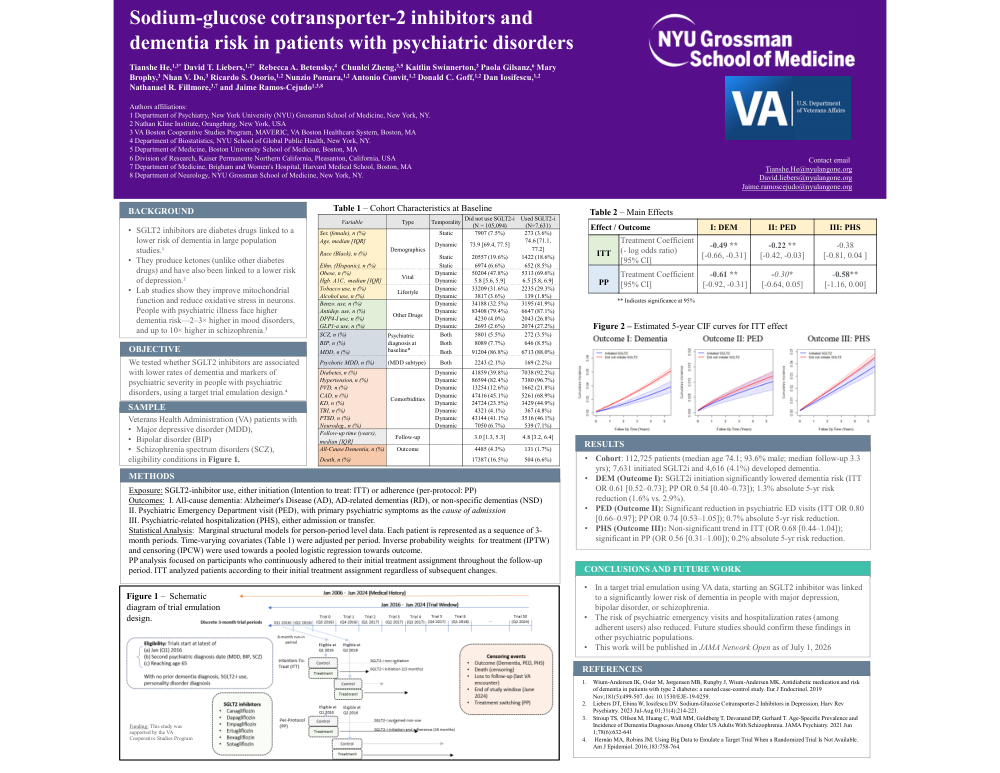
Cohort: 112,725 patients (median age 74.1; 93.6% male; median follow-up 3.3 yrs); 7,631 initiated SGLT2i and 4,616 (4.1%) developed dementia.
DEM (Outcome I): SGLT2i initiation significantly lowered dementia risk (ITT OR 0.61 [0.52–0.73]; PP OR 0.54 [0.40–0.73]); 1.3% absolute 5-yr risk reduction (1.6% vs. 2.9%).
PED (Outcome II): Significant reduction in psychiatric ED visits (ITT OR 0.80 [0.66–0.97]; PP OR 0.74 [0.53–1.05]); 0.7% absolute 5-yr risk reduction.
PHS (Outcome III): Non-significant trend in ITT (OR 0.68 [0.44–1.04]); significant in PP (OR 0.56 [0.31–1.00]); 0.2% absolute 5-yr risk reduction.
CONCLUSIONS AND FUTURE WORK
In a target trial emulation using VA data, starting an SGLT2 inhibitor was linked to a significantly lower risk of dementia in people with major depression, bipolar disorder, or schizophrenia.
The risk of psychiatric emergency visits and hospitalization rates (among adherent users) also reduced. Future studies should confirm these findings in other psychiatric populations.
This work will be published iin JAMA Network Open as of July 1, 2026
Table 1 – Cohort Characteristics at Baseline
|
Variable |
Type |
Temporality |
Did not use SGLT2-i (N=105,094) |
Used SGLT2-i (N=7,631) |
|
Sex (female), n (%) |
Demographics |
Static |
7907 (7.5%) |
273 (3.6%) |
|
Age, median [IQR] |
Demographics |
Dynamic |
73.9 [69.4, 77.5] |
74.6 [71.1, 77.2] |
|
Race (Black), n (%) |
Demographics |
Static |
20557 (19.6%) |
1422 (18.6%) |
|
Ethn. (Hispanic), n (%) |
Demographics |
Static |
6974 (6.6%) |
652 (8.5%) |
|
Obese, n (%) |
Vital |
Dynamic |
50204 (47.8%) |
5313 (69.6%) |
|
Hgb. A1C, median [IQR] |
Vital |
Dynamic |
5.8 [5.6, 5.9] |
6.5 [5.8, 6.9] |
|
Tobacco use, n (%) |
Lifestyle |
Dynamic |
33209 (31.6%) |
2235 (29.3%) |
|
Alcohol use, n (%) |
Lifestyle |
Dynamic |
3817 (3.6%) |
139 (1.8%) |
|
Benzo. use, n (%) |
Other Drugs |
Dynamic |
34188 (32.5%) |
3195 (41.9%) |
|
Antidep. use, n (%) |
Other Drugs |
Dynamic |
83408 (79.4%) |
6647 (87.1%) |
|
DPP4-I use, n (%) |
Other Drugs |
Dynamic |
4230 (4.0%) |
2043 (26.8%) |
|
GLP1-a use, n (%) |
Other Drugs |
Dynamic |
2693 (2.6%) |
2074 (27.2%) |
|
SCZ, n (%) |
Psychiatric dx at baseline |
Both |
5801 (5.5%) |
272 (3.5%) |
|
BIP, n (%) |
Psychiatric dx at baseline |
Both |
8089 (7.7%) |
646 (8.5%) |
|
MDD, n (%) |
Psychiatric dx at baseline |
Both |
91204 (86.8%) |
6713 (88.0%) |
|
Psychotic MDD, n (%) |
(MDD subtype) |
Both |
2243 (2.1%) |
169 (2.2%) |
|
Diabetes, n (%) |
Comorbidities |
Dynamic |
41859 (39.8%) |
7038 (92.2%) |
|
Hypertension, n (%) |
Comorbidities |
Dynamic |
86594 (82.4%) |
7380 (96.7%) |
|
PVD, n (%) |
Comorbidities |
Dynamic |
13254 (12.6%) |
1662 (21.8%) |
|
CAD, n (%) |
Comorbidities |
Dynamic |
47416 (45.1%) |
5261 (68.9%) |
|
KD, n (%) |
Comorbidities |
Dynamic |
24724 (23.5%) |
3429 (44.9%) |
|
TBI, n (%) |
Comorbidities |
Dynamic |
4321 (4.1%) |
367 (4.8%) |
|
PTSD, n (%) |
Comorbidities |
Dynamic |
43144 (41.1%) |
3516 (46.1%) |
|
Neurodeg., n (%) |
Comorbidities |
Dynamic |
7050 (6.7%) |
539 (7.1%) |
|
Follow-up time (years), median [IQR] |
Follow-up |
— |
3.0 [1.3, 5.3] |
4.8 [3.2, 6.4] |
|
All-Cause Dementia, n (%) |
Outcome |
— |
4485 (4.3%) |
131 (1.7%) |
|
Death, n (%) |
— |
— |
17387 (16.5%) |
504 (6.6% |
Figure 1 – Schematic diagram of trial emulation design
Jan 2006 – Jun 2024: Medical History
Jan 2016 – Jun 2024: Trial Window
Discrete 3-month trial periods: Trial 0 (Q3 2016), Trial 1 (Q4 2016), Trial 2 (Q1 2017), ... Trial 30 (Q2 2024)
6-month run-in period
Eligible at Q1 2016 / Q2 2016
Eligibility: Trials start at latest of:
(a) Jan (Q1) 2016
(b) Second psychiatric diagnosis date (MDD, BIP, SCZ)
(c) Reaching age 65
With no prior dementia diagnosis, SGLT2-i use, personality disorder diagnosis.
Intention-To-Treat (ITT): Control (SGLT2-i non-initiation) vs. Treatment (SGLT2-i initiation, ≥3 months)
Per-Protocol (PP): Control (SGLT2-i sustained non-use) vs. Treatment (SGLT2-i initiation and adherence, ≥6 months)
SGLT2 inhibitors: Canagliflozin, Dapagliflozin, Empagliflozin, Ertugliflozin, Bexagliflozin, Sotagliflozin
Censoring events:
Outcome (Dementia, PED, PHS)
Death (censoring)
Loss to follow-up (last VA encounter)
End of study window (June 2024)
Treatment switching (PP)
Funding: This study was supported by the VA Cooperative Studies Program
Table 2 – Main Effects
|
Effect / Outcome |
I: DEM |
II: PED |
III: PHS |
|
ITT — Treatment Coefficient (− log odds ratio) [95% CI] |
−0.49 ** [−0.66, −0.31] |
−0.22 ** [−0.42, −0.03] |
−0.38 [−0.81, 0.04] |
|
PP — Treatment Coefficient [95% CI] |
−0.61 ** [−0.92, −0.31] |
−0.30* [−0.64, 0.05] |
−0.58 ** [−1.16, 0.00] |
** Indicates significance at 95%
Figure 2 – Estimated 5-year CIF curves for ITT effect
Outcome I: Dementia – Cumulative incidence ~0.06 at 5 years; Initiated SGLT2 (blue) lower than Did not initiate SGLT2 (red)
Outcome II: PED – Cumulative incidence ~0.02 at 5 years; Initiated SGLT2 lower than Did not initiate
Outcome III: PHS – Cumulative incidence ~0.04 at 5 years; Initiated SGLT2 lower than Did not initiate
All curves over Follow Up Time (Years) 0–5.
REFERENCES
1. Wium-Andersen IK, Osler M, Jørgensen MB, Rungby J, Wium-Andersen MK. Antidiabetic medication and risk of dementia in patients with type 2 diabetes: a nested case-control study. Eur J Endocrinol. 2019 Nov;181(5):499-507. doi: 10.1530/EJE-19-0259.
2. Liebers DT, Ebina W, Iosifescu DV. Sodium-Glucose Cotransporter-2 Inhibitors in Depression. Harv Rev Psychiatry. 2023 Jul-Aug 01;31(4):214-221.
3. Stroup TS, Olfson M, Huang C, Wall MM, Goldberg T, Devanand DP, Gerhard T. Age-Specific Prevalence and Incidence of Dementia Diagnoses Among Older US Adults With Schizophrenia. JAMA Psychiatry. 2021 Jun 1;78(6):632-641.
4. Hernán MA, Robins JM. Using Big Data to Emulate a Target Trial When a Randomized Trial Is Not Available. Am J Epidemiol. 2016;183:758-764.
Comments
Email is required but is not shown publicly.
Loading comments...