4,068 posters, 219 videos, 101 topics, 69 sessions, 14,365 authors, 6,128 institutions
ePostersLive by SciGen Technologies S.A. All rights reserved.
Alzheimer's Association International Conference 2026
July 12-15, 2026 | London, United Kingdom, and Online

3118
From UK Biobank To The Memory Clinic: Lifecourse Multimorbidity Profiles And Associations With Neuroimaging
Poster Presenter
Authors
Grace Gillis, Jasmine Blane, Raihaan Patel, Sarah Fynes-Clinton, Inga Farafontova, Dansheela Makan, Gaurav Bhalerao, Lola Martos, Vanessa Raymont, Sana Suri, Ludovica Griffanti, Clare Mackay
Affiliations
University of Oxford, Department of Psychiatry, Oxford, UK; Oxford Health NHS Foundation Trust, Oxford, UK, University of Oxford, Department of Psychiatry, Oxford, UK, Oxford Health NHS Foundation Trust, Oxford, UK, University of Oxford, Nuffield Department of Clinical Neurosciences, Oxford, UK
Part of Topic
FROM UK BIOBANK TO THE MEMORY CLINIC: LIFECOURSE MUL TIMORBIDITY PROFILES & ASSOCIATIONS WITH NEUROIMAGING
Grace Gillis, J Blane, R Patel, S Fynes-Clinton, I Farafontova, D Makan, G Bhalerao, L Martos, V Raymont, S Suri, L Griffanti, C Mackay
University of Oxford, Psychiatry Dept & Nuffield Dept of Clinical Neurosciences; Oxford Health NHS Foundation Trust
Objectives
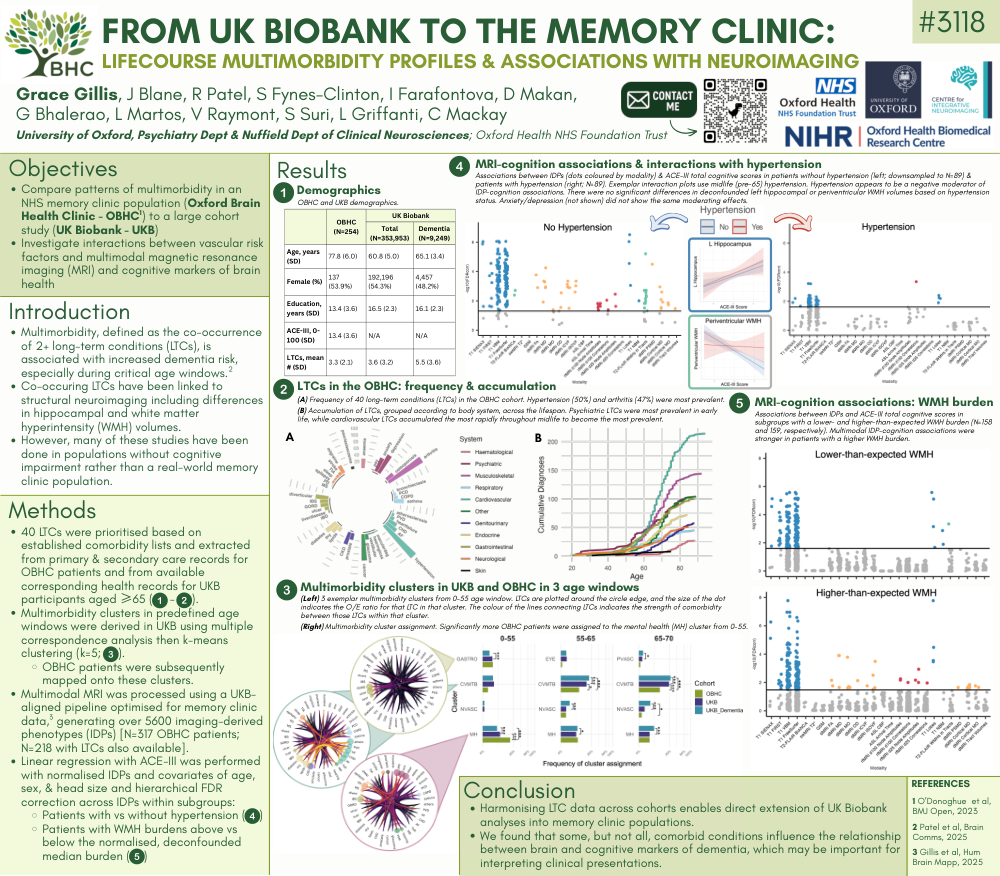
• Compare patterns of multimorbidity in an NHS memory clinic population (Oxford Brain Health Clinic - OBHC) to a large cohort study (UK Biobank - UKB)
• Investigate interactions between vascular risk factors and multimodal magnetic resonance imaging (MRI) and cognitive markers of brain health
Introduction
• Multimorbidity, defined as the co-occurrence of 2+ long-term conditions (L TCs), is associated with increased dementia risk, especially during critical age windows.
• Co-occuring L TCs have been linked to structural neuroimaging including differences in hippocampal and white matter hyperintensity (WMH) volumes.
• However, many of these studies have been done in populations without cognitive impairment rather than a real-world memory clinic population.
Methods
• 40 L TCs were prioritised based on established comorbidity lists and extracted from primary & secondary care records for OBHC patients and from available corresponding health records for UKB participants aged ≥65.
• Multimorbidity clusters in predefined age windows were derived in UKB using multiple correspondence analysis then k-means clustering (k=5).
• OBHC patients were subsequently mapped onto these clusters.
• Multimodal MRI was processed using a UKB-aligned pipeline optimised for memory clinic data, generating over 5600 imaging-derived phenotypes (IDPs) [N=317 OBHC patients; N=218 with L TCs also available].
• Linear regression with ACE-III was performed with normalised IDPs and covariates of age, sex, & head size and hierarchical FDR correction across IDPs within subgroups:
• Patients with vs without hypertension
• Patients with WMH burdens above vs below the normalised, deconfounded median burden
Results
|
Demographics OBHC and UKB demographics. |
|||
|
|
UK Biobank OBHC |
|
|
|
(N=254) |
Total (N=353,953) |
Dementia (N=9,249) |
|
|
Age, years (SD) |
77.8 (6.0) |
60.8 (5.0) |
65.1 (3.4) |
|
Female (%) |
137 (53.9%) |
192,196 (54.3%) |
4,457 (48.2%) |
|
Education, years (SD) |
13.4 (3.6) |
16.5 (2.3) |
16.1 (2.3) |
|
ACE-III, 0- 100 (SD) |
13.4 (3.6) |
N/A |
N/A |
|
LTCs, mean |
# (SD) 3.3 (2.1) 3.6 (3.2) 5.5 (3.6) |
|
|
LTCs in the OBHC: frequency & accumulation
(A) Frequency of 40 long-term conditions (LTCs) in the OBHC cohort. Hypertension (50%) and arthritis (47%) were most prevalent.
(B) Accumulation of LTCs, grouped according to body system, across the lifespan. Psychiatric LTCs were most prevalent in early life, while cardiovascular LTCs accumulated the most rapidly throughout midlife to become the most prevalent.
Multimorbidity clusters in UKB and OBHC in 3 age windows
(Left) 3 exemplar multimorbidity clusters from 0-55 age window. L TCs are plotted around the circle edge, and the size of the dot indicates the O/E ratio for that LTC in that cluster. The colour of the lines connecting L TCs indicates the strength of comorbidity between those LTCs within that cluster.
(Right) Multimorbidity cluster assignment. Significantly more OBHC patients were assigned to the mental health (MH) cluster from 0-55.
MRI-cognition associations & interactions with hypertension
Associations between IDPs (dots coloured by modality) & ACE-III total cognitive scores in patients without hypertension (left; downsampled to N=89) & patients with hypertension (right; N=89). Exemplar interaction plots use midlife (pre-65) hypertension. Hypertension appears to be a negative moderator of IDP-cognition associations. There were no significant differences in deconfounded left hippocampal or periventricular WMH volumes based on hypertension status. Anxiety/depression (not shown) did not show the same moderating effects.
MRI-cognition associations: WMH burden
Associations between IDPs and ACE-III total cognitive scores in subgroups with a lower- and higher-than-expected WMH burden (N=158 and 159, respectively). Multimodal IDP-cognition associations were stronger in patients with a higher WMH burden.
Conclusion
• Harmonising L TC data across cohorts enables direct extension of UK Biobank analyses into memory clinic populations.
• We found that some, but not all, comorbid conditions influence the relationship between brain and cognitive markers of dementia, which may be important for interpreting clinical presentations.
REFERENCES
1 O’Donoghue et al, BMJ Open, 2023
2 Patel et al, Brain Comms, 2025
3 Gillis et al, Hum Brain Mapp, 2025
Comments
Email is required but is not shown publicly.
Loading comments...