4,068 posters, 219 videos, 101 topics, 69 sessions, 14,365 authors, 6,128 institutions
ePostersLive by SciGen Technologies S.A. All rights reserved.
Alzheimer's Association International Conference 2026
July 12-15, 2026 | London, United Kingdom, and Online

8647
In Vivo Metabolic Signature Of Alzheimer’S Pathology In Corticobasal Syndrome Using Multimodal Amyloid And FDG-PET Imaging
Poster Presenter
Authors
Affiliations
Part of Topic
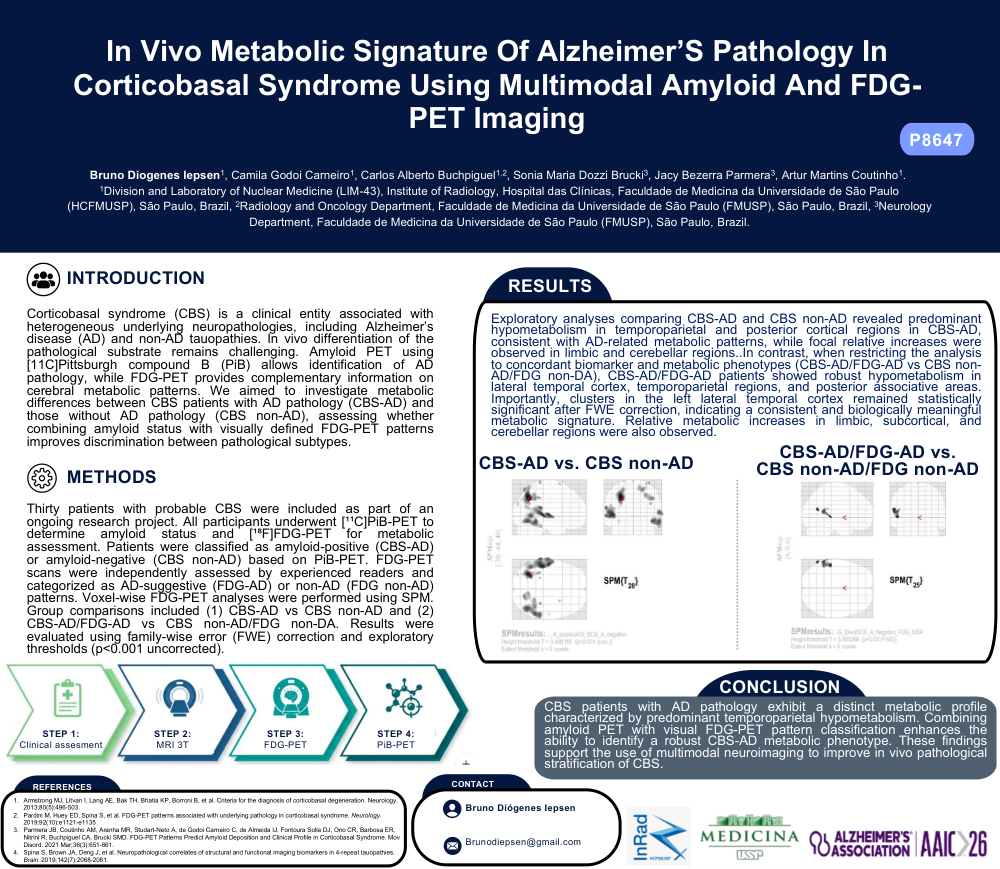
Background: Corticobasal syndrome (CBS) is a clinical entity associated with heterogeneous underlying neuropathologies, including Alzheimer’s disease (AD) and non-AD tauopathies. In vivo differentiation of the pathological substrate remains challenging. Amyloid PET using [11C]Pittsburgh compound B (PiB) allows identification of AD pathology, while FDG-PET provides complementary information on cerebral metabolic patterns. We aimed to investigate metabolic differences between CBS patients with AD pathology (CBS-AD) and those without AD pathology (CBS non-AD), assessing whether combining amyloid status with visually defined FDG-PET patterns improves discrimination between pathological subtypes.
Methods: Thirty patients with probable CBS were included as part of an ongoing research project. All participants underwent [¹¹C]PiB-PET to determine amyloid status and [¹⁸F]FDG-PET for metabolic assessment. Patients were classified as amyloid-positive (CBS-AD) or amyloid-negative (CBS non-AD) based on PiB-PET. FDG-PET scans were independently assessed by experienced readers and categorized as AD-suggestive (FDG-AD) or non-AD (FDG non-AD) patterns. Voxel-wise FDG-PET analyses were performed using SPM. Group comparisons included (1) CBS-AD vs CBS non-AD and (2) CBS-AD/FDG-AD vs CBS non-AD/FDG non-DA. Results were evaluated using family-wise error (FWE) correction and exploratory thresholds (p<0.001 uncorrected).
Results: Exploratory analyses comparing CBS-AD and CBS non-AD revealed predominant hypometabolism in temporoparietal and posterior cortical regions in CBS-AD, consistent with AD-related metabolic patterns, while focal relative increases were observed in limbic and cerebellar regions..In contrast, when restricting the analysis to concordant biomarker and metabolic phenotypes (CBS-AD/FDG-AD vs CBS non-AD/FDG non-DA), CBS-AD/FDG-AD patients showed robust hypometabolism in lateral temporal cortex, temporoparietal regions, and posterior associative areas. Importantly, clusters in the left lateral temporal cortex remained statistically significant after FWE correction, indicating a consistent and biologically meaningful metabolic signature. Relative metabolic increases in limbic, subcortical, and cerebellar regions were also observed.
Conclusion: CBS patients with AD pathology exhibit a distinct metabolic profile characterized by predominant temporoparietal hypometabolism. Combining amyloid PET with visual FDG-PET pattern classification enhances the ability to identify a robust CBS-AD metabolic phenotype. These findings support the use of multimodal neuroimaging to improve in vivo pathological stratification of CBS.
Comments
Email is required but is not shown publicly.
Loading comments...