4,068 posters, 219 videos, 101 topics, 69 sessions, 14,365 authors, 6,128 institutions
ePostersLive by SciGen Technologies S.A. All rights reserved.
Alzheimer's Association International Conference 2026
July 12-15, 2026 | London, United Kingdom, and Online

3127
Learning To Fuse: A Hybrid Cnn-mlp Model For Multiclass Dementia Diagnosis From MRI
Poster Presenter
Part of Topic
Background: Dementia is a major cause of disability, and its increasing prevalence demands efficient diagnostic and monitoring methods. Structural MRI is widely used to detect brain changes associated with neurodegenerative diseases. AI models, particularly convolutional neural networks (CNNs) and multilayer perceptrons (MLPs), have shown strong performance in MRI-based diagnosis of Alzheimer’s disease. However, most approaches rely on single-scale information, limiting their ability to capture complex brain patterns. To address this, we propose a feature-fusion framework combining CNN and MLP models for multiclass dementia classification.
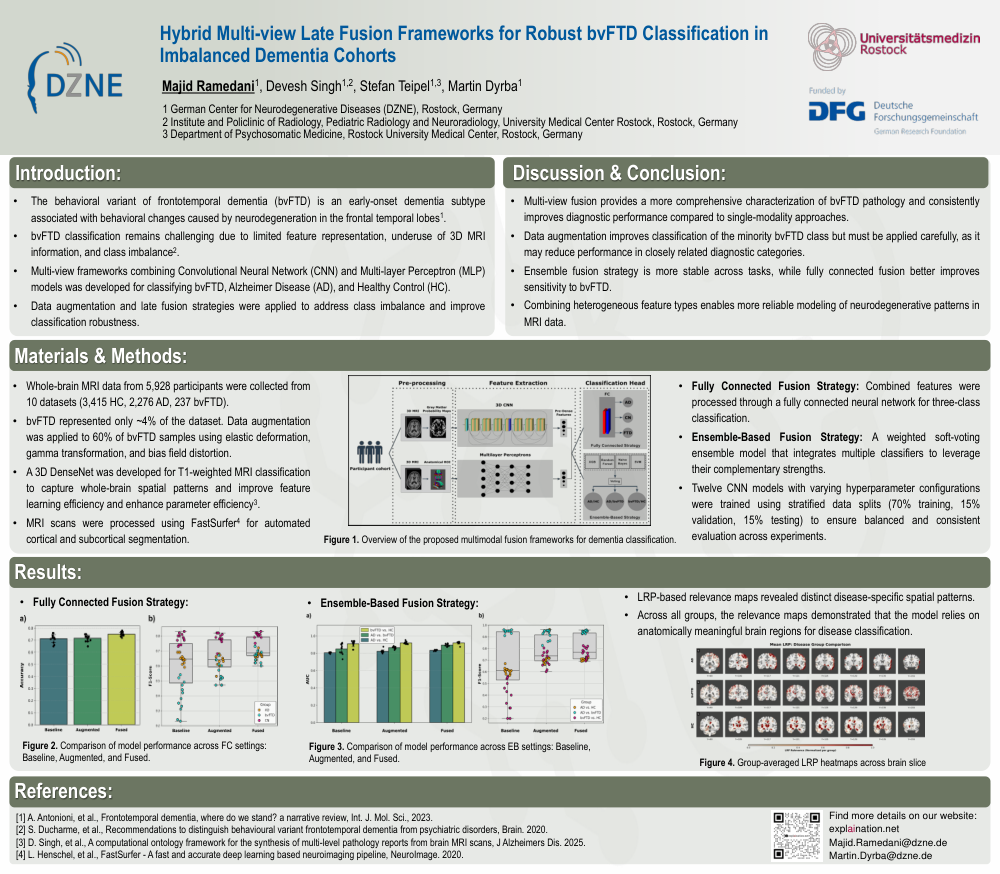
Methods: MRI data from 5,543 patients were retrospectively analyzed using T1-weighted structural scans. Scans across the dementia spectrum, specifically, participants with Alzheimer’s disease (AD), cognitively normal (CN), and behavioral frontotemporal dementia (bvFTD) disease diagnosis were included. We used MLP and 3D CNN models to capture multi-scale information. FastSurfer was applied to segment the brain into 100 regions of interest and to estimate regional brain volumes and cortical thickness. These features, along with age and sex, were used as tabular input to the MLP. CNN was based on 3D DenseNet architecture. A three-class model was developed to distinguish CN, AD (including amnestic MCI), and bvFTD. Features from both models were fused and passed to a fully connected layer for final classification, as illustrated in Figure 1.
Results: On the held-out test set, the proposed multi-view feature fusion framework achieved an accuracy of 83.5%, with macro-averaged recall of 75.6%, precision of 83.2%, F1-score of 77.4%, and a macro-AUC of 87% (SD: 83-95%), demonstrating robust performance despite class imbalance. Class-wise F1-scores ranged from 73% to 86%, indicating stable discrimination across dementia subtypes. Compared with models using 3D CNN features alone, the fusion approach improved overall accuracy by ~14% and macro F1-score by ~10%, while consistently increasing recall, reflecting enhanced sensitivity to disease-related patterns.
Conclusion: We present a hybrid CNN-MLP feature fusion framework that integrates voxel-level and 3D CNN features to improve multiclass Dementia subtypes classification. By combining multi-scale information, the method overcomes limitations of single-scale approaches and better captures disease-related brain changes. The results demonstrate its effectiveness and potential to support reliable MRI-based clinical decision-making in neurodegenerative disease assessment.
Comments
Email is required but is not shown publicly.
Loading comments...