4,068 posters, 219 videos, 101 topics, 69 sessions, 14,365 authors, 6,128 institutions
ePostersLive by SciGen Technologies S.A. All rights reserved.
Alzheimer's Association International Conference 2026
July 12-15, 2026 | London, United Kingdom, and Online

3166
Exploring Individual Brain Heterogeneity In A Failed Disease-modifying Drug Trial To Treat AD
Poster Presenter
Authors
Part of Topic
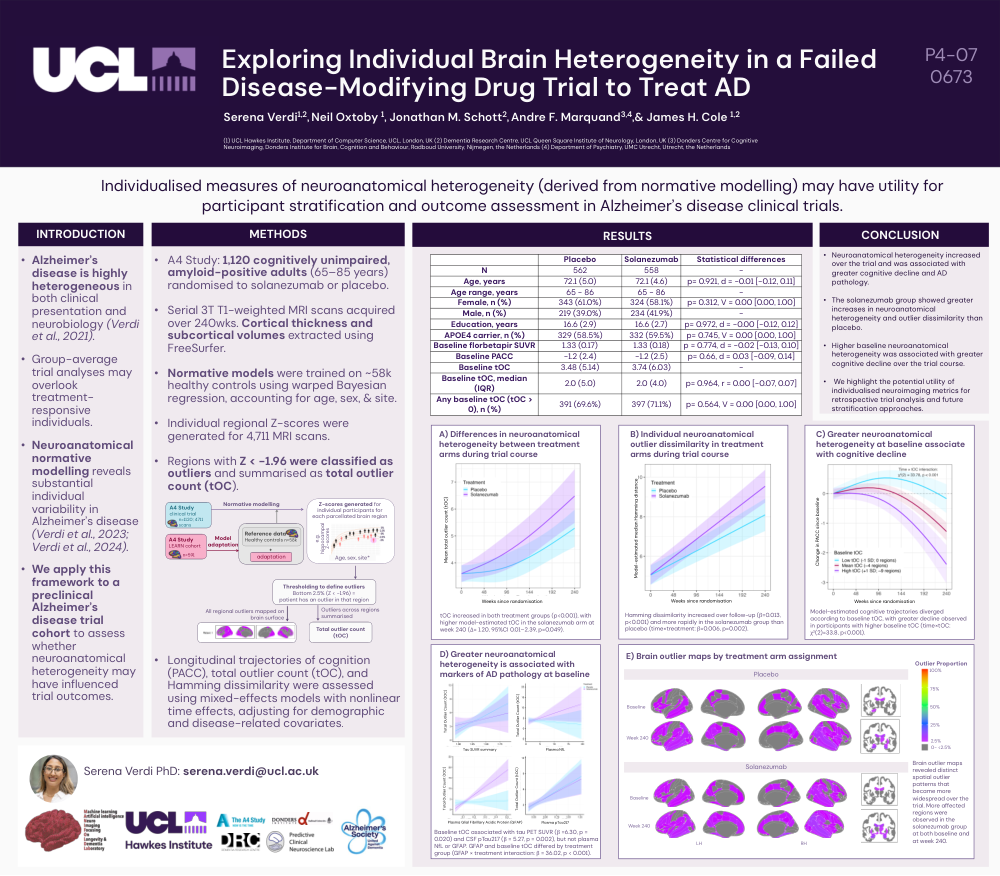
Exploring Individual Brain Heterogeneity in a Failed Disease-Modifying Drug Trial to Treat Alzheimer's Disease
Serena Verdi¹², Neil Oxtoby¹, Jonathan M. Schott², Andre F. Marquand³⁴, James H. Cole¹²
¹ UCL Hawkes Institute, Department of Computer Science, University College London, UK
² Dementia Research Centre, UCL Queen Square Institute of Neurology, London, UK
³ Donders Centre for Cognitive Neuroimaging, Radboud University Medical Centre, Nijmegen, The Netherlands
⁴ Department of Psychiatry, UMC Utrecht, Utrecht, The Netherlands
Background: Alzheimer's disease (AD) is characterised by heterogeneity that is often obscured by conventional group-average analyses. Neuroanatomical normative modelling enables quantification of individual deviations from healthy brain charts, providing personalised measures of neuroanatomical heterogeneity.
Methods: We applied neuroanatomical normative modelling to longitudinal MRI from 1,120 cognitively unimpaired, amyloid-positive participants enrolled in the A4 Study, a phase III trial of solanezumab. Regional cortical thickness and subcortical volumes were compared with a large normative reference cohort (~58k healthy individuals) to generate regional Z-scores. Regions with Z < −1.96 were classified as outliers and summarised as total outlier count (tOC). Longitudinal changes in tOC, inter-individual Hamming dissimilarity, and cognition (PACC) were analysed using mixed-effects and spline-based generalised least squares models, adjusting for relevant demographic and clinical covariates.
Results: Total outlier count increased significantly in both treatment groups over follow-up and was greater in the solanezumab arm at Week 240 (ΔtOC = 1.20, 95% CI 0.01–2.39, p = 0.049). Neuroanatomical outlier patterns became increasingly dissimilar between individuals over follow-up (β = 0.0127, p < 0.001), with a greater increase in the solanezumab group than placebo (time × treatment interaction: β = 0.0059, p = 0.002). Higher baseline neuroanatomical heterogeneity was associated with steeper cognitive decline over follow-up (time × tOC interaction: χ²(2) = 33.8, p < 0.001), and inclusion of baseline tOC significantly improved the longitudinal PACC model (likelihood ratio χ²(3) = 102.4, p < 0.001). Baseline neuroanatomical heterogeneity was also positively associated with tau PET SUVR (β = 6.30, p = 0.020) and CSF pTau217 (β = 5.27, p = 0.002), while no significant associations were observed with plasma NfL or GFAP.
Conclusions: Neuroanatomical heterogeneity increased throughout the trial, was associated with greater cognitive decline and Alzheimer's disease pathology, and differed between treatment groups. Normative modelling provides biologically meaningful, individual-level measures of disease heterogeneity that may improve participant stratification and provide sensitive outcome measures for future Alzheimer's disease clinical trials.
Comments
Email is required but is not shown publicly.
Loading comments...