4,068 posters, 219 videos, 101 topics, 69 sessions, 14,365 authors, 6,128 institutions
ePostersLive by SciGen Technologies S.A. All rights reserved.
Alzheimer's Association International Conference 2026
July 12-15, 2026 | London, United Kingdom, and Online

10872
PET-CT Provides Equivalent Regional Tau PET Quantification To MRI-based Processing
Poster Presenter
Authors
Guilherme Povala, Livia Amaral, Bruna Bellaver, Firoza Z. Lussier, Guilherme Bauer-Negrini, Pamela C.L. Ferreira, Douglas T. Leffa, Raphael de Luca e Tuma, Alvaro de Oliveira Franco, Cécile Tissot, Quentin Finn, João Pedro Ferrar-Souza, Eduardo R. Zimmer, Dana L. Tudorascu, Joseph C. Masdeu, Juan Fortea, David Soleimani-Meigooni, Val Lowe, Hwamee Oh, Brian Gordon, Belen Pascual, Pedro Rosa-Neto, Suzanne Baker, Tharick A. Pascoal
Affiliations
University of Pittsburgh, Department of Psychiatry, PA, United States of America, Lawrence Berkeley National Laboratory, Berkeley, CA, United States of America, Translational Neuroimaging Laboratory, McGill University Research Centre for Studies in Aging, Douglas Research Institute, Montréal, QC, Canada, Houston Methodist Research Institute, Department of Neurology, Houston, TX, United States of America, Brown University, Department of Psychiatry and Human Behavior, Providence, RI, United States of America, Mayo Clinic, Department of Radiology, Rochester, MN, United States of America, Washington University in St. Louis, Department of Radiology, St. Louis, MO, United States of America, Hospital de la Santa Creu i Sant Pau, Sant Pau Memory Unit, Department of Neurology, Barcelona, Spain, University of California San Francisco, Memory and Aging Center, San Francisco, CA, United States of America
Part of Topic
Background:
Tau PET quantification typically requires structural MRI for reference-region definition, normalization, and segmentation, which imposes a logistical and operational burden. In this study, we evaluated whether low-dose CT can serve as a reliable MRI alternative for tau PET quantification when MRI is unavailable.
Methods:
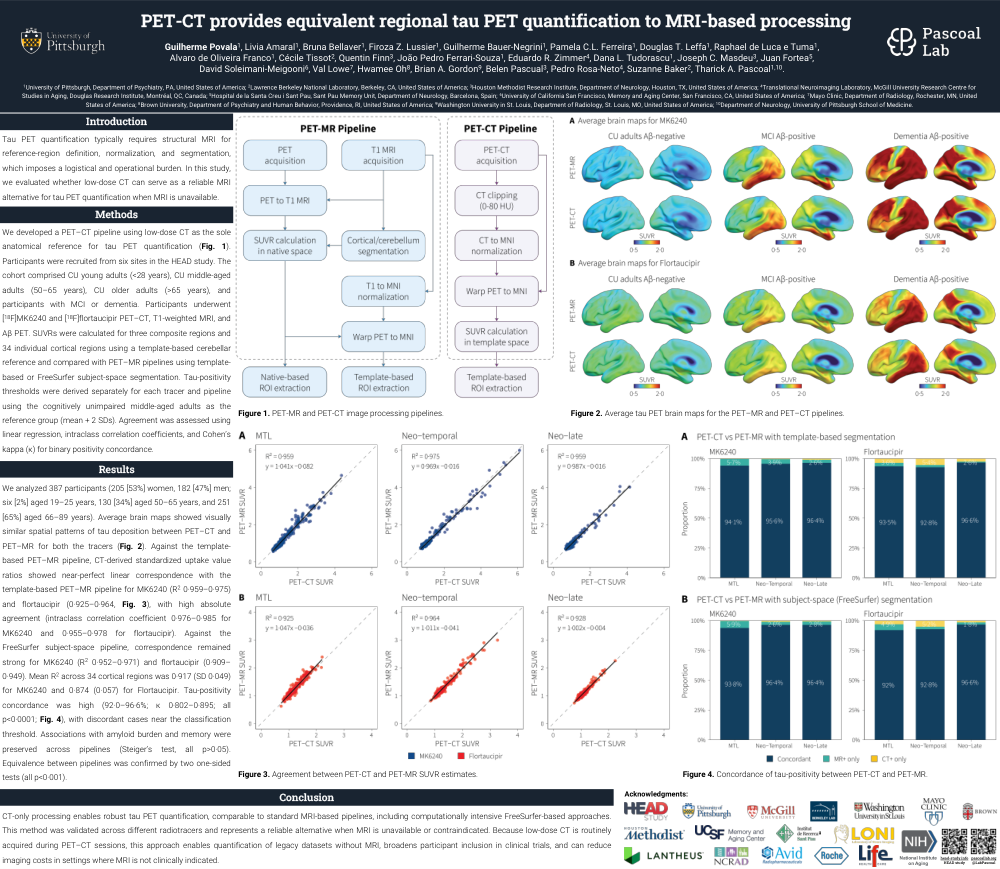
We developed a PET–CT pipeline using low-dose CT as the sole anatomical reference for tau PET quantification (Fig. 1). Participants were recruited from six sites in the HEAD study. The cohort comprised CU young adults (<28 years), CU middle-aged adults (50–65 years), CU older adults (>65 years), and participants with MCI or dementia. Participants underwent [18F]MK6240 and [18F]flortaucipir PET–CT, T1-weighted MRI, and Aβ PET. SUVRs were calculated for three composite regions and 34 individual cortical regions using a template-based cerebellar reference and compared with PET–MR pipelines using template-based or FreeSurfer subject-space segmentation. Tau-positivity thresholds were derived separately for each tracer and pipeline using the cognitively unimpaired middle-aged adults as the reference group (mean + 2 SDs). Agreement was assessed using linear regression, intraclass correlation coefficients, and Cohen’s kappa (κ) for binary positivity concordance.
Findings:
We analyzed 387 participants (205 [53%] women, 182 [47%] men; six [2%] aged 19–25 years, 130 [34%] aged 50–65 years, and 251 [65%] aged 66–89 years). Average brain maps showed visually similar spatial patterns of tau deposition between PET–CT and PET–MR for both the tracers (Fig. 2). Against the template-based PET–MR pipeline, CT-derived standardized uptake value ratios showed near-perfect linear correspondence with the template-based PET–MR pipeline for MK6240 (R20·959–0·975) and flortaucipir (0·925–0·964, Fig. 3), with high absolute agreement (intraclass correlation coefficient 0·976–0·985 for MK6240 and 0·955–0·978 for flortaucipir). Against the FreeSurfer subject-space pipeline, correspondence remained strong for MK6240 (R2 0·952–0·971) and flortaucipir (0·909–0·949). Mean R2 across 34 cortical regions was 0·917 (SD 0·049) for MK6240 and 0·874 (0·057) for Flortaucipir. Tau-positivity concordance was high (92·0–96·6%; κ 0·802–0·895; all p<0·0001; Fig. 4), with discordant cases near the classification threshold. Associations with amyloid burden and memory were preserved across pipelines (Steiger’s test, all p>0·05). Equivalence between pipelines was confirmed by two one-sided tests (all p<0·001).
Conclusion:
CT-only processing enables robust tau PET quantification, comparable to standard MRI-based pipelines, including computationally intensive FreeSurfer-based approaches. This method was validated across different radiotracers and represents a reliable alternative when MRI is unavailable or contraindicated. Because low-dose CT is routinely acquired during PET–CT sessions, this approach enables quantification of legacy datasets without MRI, broadens participant inclusion in clinical trials, and can reduce imaging costs in settings where MRI is not clinically indicated.
Comments
Email is required but is not shown publicly.
Loading comments...