4,068 posters, 219 videos, 101 topics, 69 sessions, 14,365 authors, 6,128 institutions
ePostersLive by SciGen Technologies S.A. All rights reserved.
Alzheimer's Association International Conference 2026
July 12-15, 2026 | London, United Kingdom, and Online

10173
Neuronetflow:a Matlab Framework For Integrated Analysis Of Csf Dynamics And Cardiorespiratory Physiology Using Phase-contrast Mri
Poster Presenter
Authors
Affiliations
Part of Topic
Background:
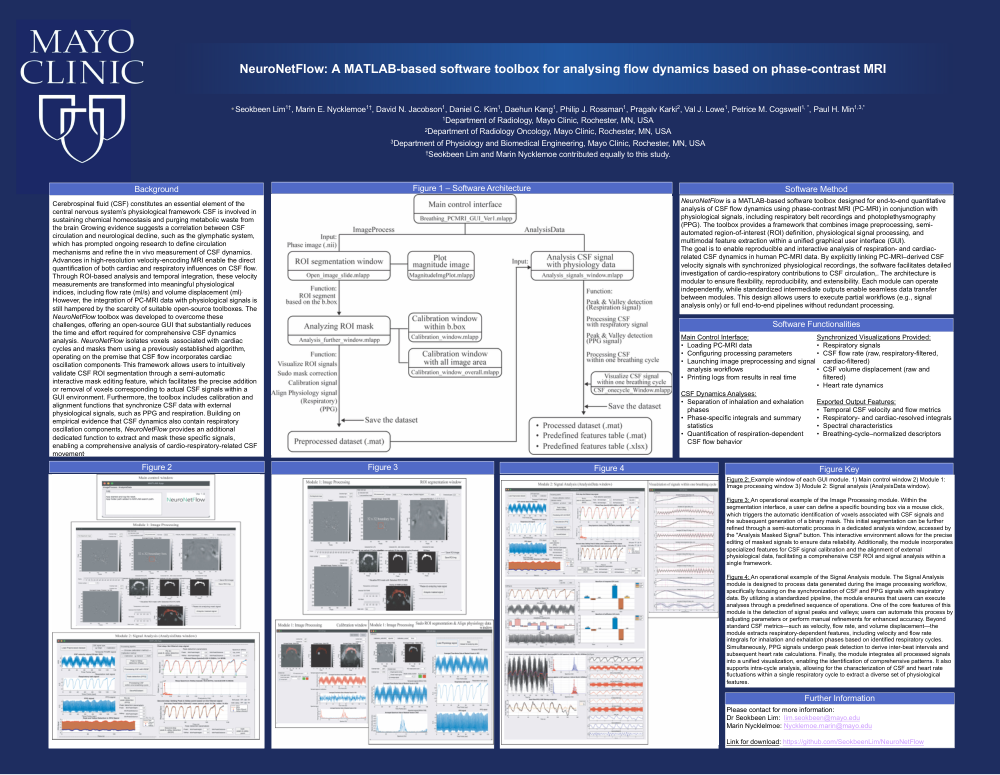
Cerebrospinal fluid (CSF) constitutes an essential element of the central nervous system’s physiological framework. CSF is involved in sustaining chemical homeostasis and purging metabolic waste from the brain Growing evidence suggests a correlation between CSF circulation and neurological decline, such as the glymphatic system, which has prompted ongoing research to define circulation mechanisms and refine the in vivo measurement of CSF dynamics. Advances in high-resolution velocity-encoding MRI enable the direct quantification of both cardiac and respiratory influences on CSF flow. Through ROI-based analysis and temporal integration, these velocity measurements are transformed into meaningful physiological indices, including flow rate (ml/s) and volume displacement (ml). However, the integration of PC-MRI data with physiological signals is still hampered by the scarcity of suitable open-source toolboxes. The NeuroNetFlow toolbox was developed to overcome these challenges, offering an open-source GUI that substantially reduces the time and effort required for comprehensive CSF dynamics analysis. NeuroNetFlow isolates voxels associated with cardiac cycles and masks them using a previously established algorithm, operating on the premise that CSF flow incorporates cardiac oscillation components. This framework allows users to intuitively validate CSF ROI segmentation through a semi-automatic interactive mask editing feature, which facilitates the precise addition or removal of voxels corresponding to actual CSF signals within a GUI environment. Furthermore, the toolbox includes calibration and alignment functions that synchronize CSF data with external physiological signals, such as PPG and respiration. Building on empirical evidence that CSF dynamics also contain respiratory oscillation components, NeuroNetFlow provides an additional dedicated function to extract and mask these specific signals, enabling a comprehensive analysis of cardio-respiratory-related CSF movement.
Software Method:
NeuroNetFlow is a MATLAB-based software toolbox designed for end-to-end quantitative analysis of CSF flow dynamics using phase-contrast MRI (PC-MRI) in conjunction with physiological signals, including respiratory belt recordings and photoplethysmography (PPG). The toolbox provides a framework that combines image preprocessing, semi-automated region-of-interest (ROI) definition, physiological signal processing, and multimodal feature extraction within a unified graphical user interface (GUI).
The goal is to enable reproducible and interactive analysis of respiration- and cardiac-related CSF dynamics in human PC-MRI data. By explicitly linking PC-MRI–derived CSF velocity signals with synchronized physiological recordings, the software facilitates detailed investigation of cardio-respiratory contributions to CSF circulation,. The architecture is modular to ensure flexibility, reproducibility, and extensibility. Each module can operate independently, while standardized intermediate outputs enable seamless data transfer between modules. This design allows users to execute partial workflows (e.g., signal analysis only) or full end-to-end pipelines without redundant processing.
Software Functionalities:
Main Control Interface:
CSF Dynamics Analyses:
Synchronized Visualizations Provided:
Exported Output Features:
Figure 2: Example window of each GUI module. 1) Main control window 2) Module 1: Image processing window 3) Module 2: Signal analysis (AnalysisData window).
Figure 3: An operational example of the Image Processing module. Within the segmentation interface, a user can define a specific bounding box via a mouse click, which triggers the automatic identification of voxels associated with CSF signals and the subsequent generation of a binary mask. This initial segmentation can be further refined through a semi-automatic process in a dedicated analysis window, accessed by the "Analysis Masked Signal" button. This interactive environment allows for the precise editing of masked signals to ensure data reliability. Additionally, the module incorporates specialized features for CSF signal calibration and the alignment of external physiological data, facilitating a comprehensive CSF ROI and signal analysis within a single framework.
Figure 4: An operational example of the Signal Analysis module. The Signal Analysis module is designed to process data generated during the image processing workflow, specifically focusing on the synchronization of CSF and PPG signals with respiratory data. By utilizing a standardized pipeline, the module ensures that users can execute analyses through a predefined sequence of operations. One of the core features of this module is the detection of signal peaks and valleys; users can automate this process by adjusting parameters or perform manual refinements for enhanced accuracy. Beyond standard CSF metrics—such as velocity, flow rate, and volume displacement—the module extracts respiratory-dependent features, including velocity and flow rate integrals for inhalation and exhalation phases based on identified respiratory cycles. Simultaneously, PPG signals undergo peak detection to derive inter-beat intervals and subsequent heart rate calculations. Finally, the module integrates all processed signals into a unified visualization, enabling the identification of comprehensive patterns. It also supports intra-cycle analysis, allowing for the characterization of CSF and heart rate fluctuations within a single respiratory cycle to extract a diverse set of physiological features.
Futher Information:
Please contact for more information:
Dr Seokbeen Lim: lim.seokbeen@mayo.edu
Marin Nycklelmoe: Nycklemoe.marin@mayo.edu
Link for download: https://github.com/SeokbeenLim/NeuroNetFlow
Comments
Email is required but is not shown publicly.
Loading comments...