4,068 posters, 219 videos, 101 topics, 69 sessions, 14,365 authors, 6,128 institutions
ePostersLive by SciGen Technologies S.A. All rights reserved.
Alzheimer's Association International Conference 2026
July 12-15, 2026 | London, United Kingdom, and Online

9634
Baseline Amyloid And Tau PET Characteristics In Early Alzheimer's Disease: Results From The TRAILRUNNER-ALZ 3 PET Addendum
Poster Presenter
Part of Topic
Abstract:
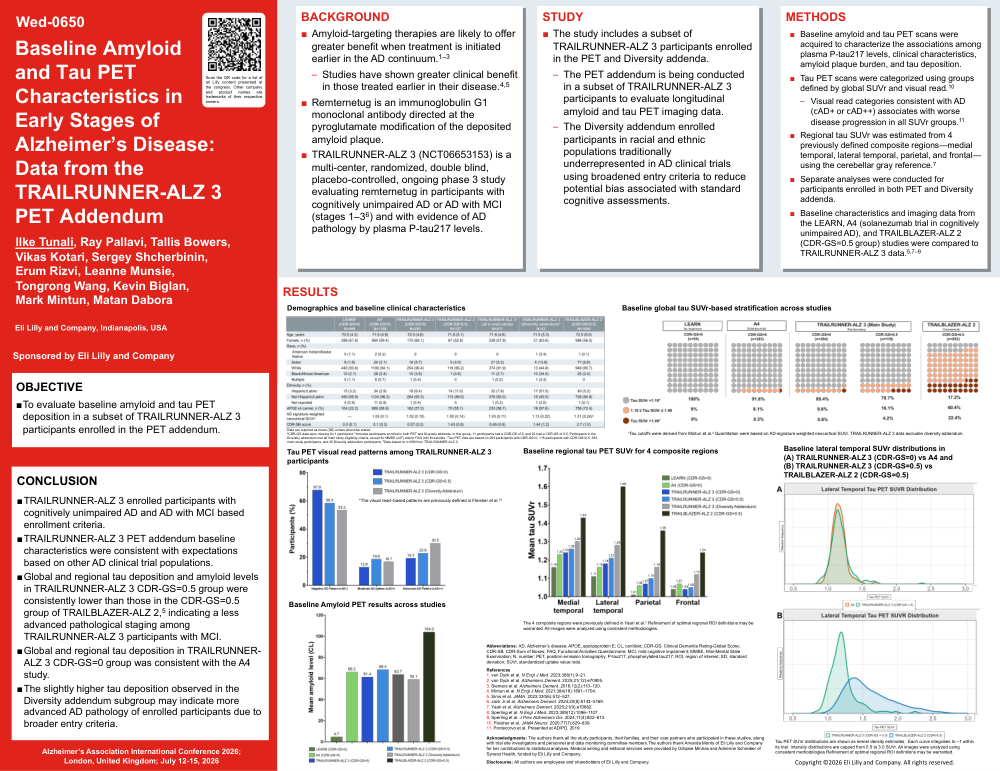
Background: Targeting amyloid pathology is likely to offer greater benefit when initiated earlier in the Alzheimer’s disease (AD) continuum. TRAILRUNNER-ALZ3 (NCT06653153) is an ongoing study evaluating remternetug, an antibody directed at the pyroglutamate modification of the β-amyloid peptide (N3pG) - a form present only in deposited amyloid plaques - in participants with early AD (Stages 1-3, Jack et al., 2024). Baseline amyloid and tau PET deposition were examined in a sub-study of TRAILRUNNER-ALZ3 participants.
Methods: TRAILRUNNER-ALZ3 is a multicenter, randomized, double-blind, placebo-controlled Phase 3 study assessing the efficacy and safety of remternetug in early AD. Amyloid pathology was confirmed using plasma phosphorylated(P)-tau217. In a PET sub-study, baseline amyloid and tau PET scans were acquired from a subset of main study and diversity addendum participants to characterize the association between plasma P-tau217 levels, clinical characteristics, amyloid plaque burden, and neurofibrillary tangle burden. Regional and global tau PET standardized uptake value ratio (SUVr) and amyloid PET centiloid (CL) measures were captured for descriptive analysis.
Results: A total of 444 (n=411 main study and n=33 diversity addendum) participants enrolled in the PET sub-study (Table 1). For main study participants, mean amyloid levels were 63.7CL and slightly higher for those with a baseline Clinical Dementia Rating (CDR)-Global score (CDR-G) of 0.5 (68.4CL) compared to CDR-G=0 (61.4CL). Mean AD-signature weighted neocortical tau global SUVr was 1.03 and similar between CDR-G groups. Tau PET positivity of main study participants based on a quantitation plus visual read method and visual read-based categorization was 22.7% and 35.2%, respectively. Participants with baseline CDR-G=0.5 exhibited higher tau PET positivity than participants with CDR-G=0 (Fig.1A). Mean regional SUVr was highest in medial temporal lobe compared to lateral temporal, parietal, and frontal regions (Fig.1B). In comparison, the diversity addendum participants had slightly lower amyloid levels, but higher global and regional tau deposition (Table 1, Figure 1).
Conclusion: TRAILRUNNER-ALZ3 enrolled participants with early pathological AD, as demonstrated in an amyloid and tau PET sub-study. Regional tau distribution followed expected AD progression. Slightly higher tau deposition observed in diversity addendum participants may reflect the more advanced cognitive stages enrolled. Additional analyses will be presented.
Comments
Email is required but is not shown publicly.
Loading comments...