4,068 posters, 219 videos, 101 topics, 69 sessions, 14,365 authors, 6,128 institutions
ePostersLive by SciGen Technologies S.A. All rights reserved.
Alzheimer's Association International Conference 2026
July 12-15, 2026 | London, United Kingdom, and Online

3618
Basal Forebrain Structure In Autosomal-dominant Alzheimer’s Disease: A Cross-sectional Analysis From The Dian Cohort
Poster Presenter
Authors
Part of Topic
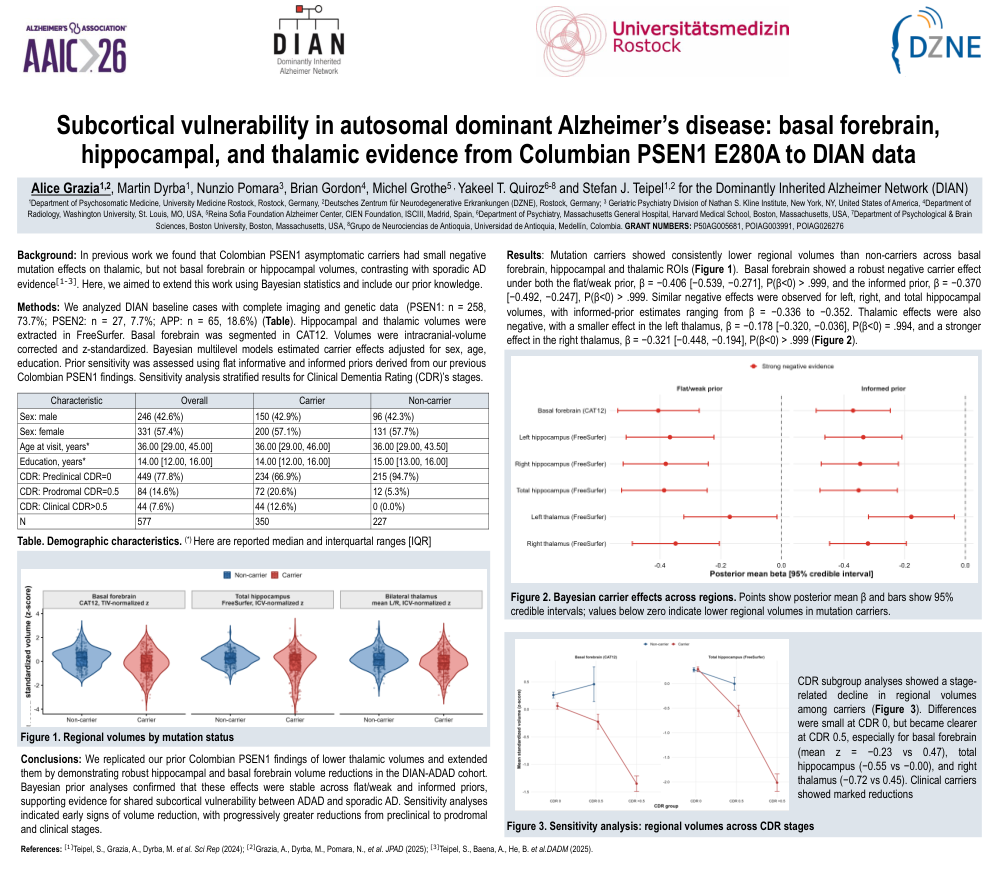
Subcortical vulnerability in autosomal dominant Alzheimer’s disease: basal forebrain, hippocampal, and thalamic evidence from Columbian PSEN1 E280A to DIAN data
Alice Grazia1,2, Martin Dyrba1, Nunzio Pomara3, Brian Gordon4, Michel Grothe5 , Yakeel T. Quiroz6-8 and Stefan J. Teipel1,2 for the Dominantly Inherited Alzheimer Network (DIAN) 1Department of Psychosomatic Medicine, University Medicine Rostock, Rostock, Germany, 2Deutsches Zentrum für Neurodegenerative Erkrankungen (DZNE), Rostock, Germany; 3 Geriatric Psychiatry Division of Nathan S. Kline Institute, New York, NY, United States of America, 4Department of Radiology, Washington University, St. Louis, MO, USA, 5Reina Sofia Foundation Alzheimer Center, CIEN Foundation, ISCIII, Madrid, Spain, 6Department of Psychiatry, Massachusetts General Hospital, Harvard Medical School, Boston, Massachusetts, USA, 7Department of Psychological & Brain Sciences, Boston University, Boston, Massachusetts, USA, 8Grupo de Neurociencias de Antioquia, Universidad de Antioquia, Medellín, Colombia. GRANT NUMBERS: P50AG005681, POIAG003991, POIAG026276
Background: In previous work we found that Colombian PSEN1 asymptomatic carriers had small negative mutation effects on thalamic, but not basal forebrain or hippocampal volumes, contrasting with sporadic AD evidence[1-3]. Here, we aimed to extend this work using Bayesian statistics and include our prior knowledge.
Methods: We analyzed DIAN baseline cases with complete imaging and genetic data (PSEN1: n = 258, 73.7%; PSEN2: n = 27, 7.7%; APP: n = 65, 18.6%) (Table). Hippocampal and thalamic volumes were extracted in FreeSurfer. Basal forebrain was segmented in CAT12. Volumes were intracranial-volume corrected and z-standardized. Bayesian multilevel models estimated carrier effects adjusted for sex, age, education. Prior sensitivity was assessed using flat informative and informed priors derived from our previous Colombian PSEN1 findings. Sensitivity analysis stratified results for Clinical Dementia Rating (CDR)’s stages.
Results: Mutation carriers showed consistently lower regional volumes than non-carriers across basal forebrain, hippocampal and thalamic ROIs (Figure 1). Basal forebrain showed a robust negative carrier effect under both the flat/weak prior, β = −0.406 [−0.539, −0.271], P(β<0) > .999, and the informed prior, β = −0.370 [−0.492, −0.247], P(β<0) > .999. Similar negative effects were observed for left, right, and total hippocampal volumes, with informed-prior estimates ranging from β = −0.336 to −0.352. Thalamic effects were also negative, with a smaller effect in the left thalamus, β = −0.178 [−0.320, −0.036], P(β<0) = .994, and a stronger effect in the right thalamus, β = −0.321 [−0.448, −0.194], P(β<0) > .999 (Figure 2). CDR subgroup analyses showed a stage-related decline in regional volumes among carriers (Figure 3). Differences were small at CDR 0, but became clearer at CDR 0.5, especially for basal forebrain (mean z = −0.23 vs 0.47), total hippocampus (−0.55 vs −0.00), and right thalamus (−0.72 vs 0.45). Clinical carriers showed marked reductions
Conclusions: We replicated our prior Colombian PSEN1 findings of lower thalamic volumes and extended them by demonstrating robust hippocampal and basal forebrain volume reductions in the DIAN-ADAD cohort. Bayesian prior analyses confirmed that these effects were stable across flat/weak and informed priors, supporting evidence for shared subcortical vulnerability between ADAD and sporadic AD. Sensitivity analyses indicated early signs of volume reduction, with progressively greater reductions from preclinical to prodromal and clinical stages.
References: [1]Teipel, S., Grazia, A., Dyrba, M. et al. Sci Rep (2024); [2]Grazia, A., Dyrba, M., Pomara, N., et al. JPAD (2025); [3]Teipel, S., Baena, A., He, B. et al.DADM (2025).
Comments
Email is required but is not shown publicly.
Loading comments...