4,068 posters, 219 videos, 101 topics, 69 sessions, 14,365 authors, 6,128 institutions
ePostersLive by SciGen Technologies S.A. All rights reserved.
Alzheimer's Association International Conference 2026
July 12-15, 2026 | London, United Kingdom, and Online

3709
Application Of Machine Learning Stratification For Clinical Trial Cohort Enrichment In The A4 Study
Poster Presenter
Authors
Braden Yang, Tom Earnest, Murat Bilgel, Marilyn Albert, Sterling Johnson, Colin Masters, Michael Miller, Arnold Bakker, John Morris, Tammie Benzinger, Brian Gordon, Aristeidis Sotiras
Affiliations
Mallinckrodt Institute of Radiology, Washington University School of Medicine in St. Louis, St. Louis, MO, USA 63110, Laboratory of Behavioral Neuroscience, National Institute on Aging Intramural Research Program, National Institutes of Health, Baltimore, MD, USA 21224, Department of Neurology, Johns Hopkins University School of Medicine, Baltimore, MD, USA 21205, Wisconsin Alzheimer’s Disease Research Center, University of Wisconsin-Madison School of Medicine and Public Health, Madison, WI, USA 53726, Florey Institute of Neuroscience and Mental Health, Parkville, VIC, Australia 3052, Center of Imaging Science and Department of Biomedical Engineering, Johns Hopkins University, Baltimore, Maryland, USA 21218, Department of Psychiatry and Behavioral Sciences, Johns Hopkins University School of Medicine, Baltimore, MD, USA 21205, Department of Neurology, Washington University School of Medicine in St. Louis, St. Louis, MO, USA 63110, Department of Radiology, Perelman School of Medicine, University of Pennsylvania, Philadelphia, PA, USA 19104
Part of Topic
Background
In clinical trials for Alzheimer’s disease (AD), stratification and selective enrollment of candidates by known risk factors is commonly employed to potentially improve the likelihood of observing a treatment effect.
Recent studies have suggested that machine learning (ML) stratification may provide greater benefits to clinical trial operations than single-biomarker stratification, albeit in a simulated setting.
Here, we evaluated ML stratification for cohort enrichment on real-world data from the A4 study, a placebo-controlled clinical trial targeting preclinical AD patients.
Methods
351 cognitively-unimpaired, amyloid-positive participants were selected across six independent datasets: ADNI, AIBL, BLSA, HABS, MCSA, OASIS.
Of 351 preclinical AD participants, 215 were cognitively stable over five years and 136 progressed to CDR > 0 within five years.
Baseline amyloid PET and T1w MRI were preprocessed to extract imaging features from 125 regions-of-interest.
Support vector machines were trained on baseline PET, MRI and non-imaging features (age, sex, APOE4) to predict conversion to CDR > 0 within a fixed time window (varied from one to five years).
Trained SVMs were applied to 848 participants from the A4 study to predict future cognitive impairment.
Retroactive cohort enrichment was performed by retaining only predicted progressors.
Treatment effect size in Preclinical Alzheimer’s Cognitive Composite (PACC) and rate of amyloid PET signal change after the 240-week placebo-controlled period was assessed before and after cohort enrichment.
Power to detect a treatment effect in amyloid PET was estimated across different sample sizes via a repeated subsampling bootstrap analysis.
Results
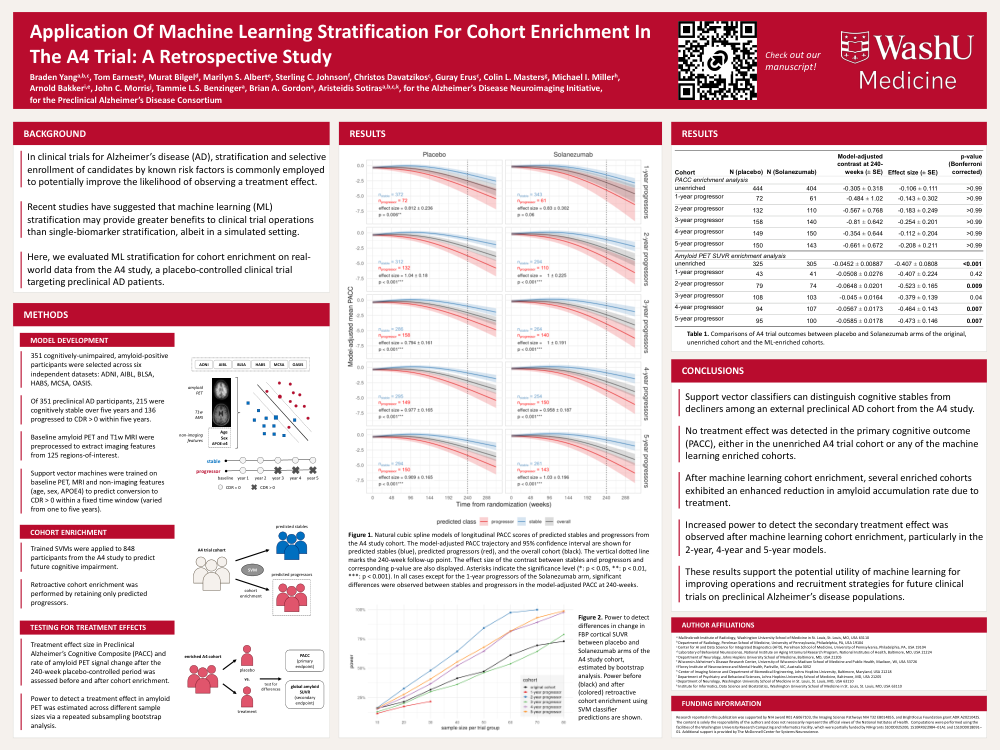
Figure 1. Natural cubic spline models of longitudinal PACC scores of predicted stables and progressors from the A4 study cohort. The model-adjusted PACC trajectory and 95% confidence interval are shown for predicted stables (blue), predicted progressors (red), and the overall cohort (black). The vertical dotted line marks the 240-week follow-up point. The effect size of the contrast between stables and progressors and corresponding p-value are also displayed. Asterisks indicate the significance level (*: p < 0.05, **: p < 0.01, ***: p < 0.001). In all cases except for the 1-year progressors of the Solanezumab arm, significant differences were observed between stables and progressors in the model-adjusted PACC at 240-weeks.
Figure 2. Power to detect differences in change in FBP cortical SUVR between placebo and Solanezumab arms of the A4 study cohort, estimated by bootstrap analysis. Power before (black) and after (colored) retroactive cohort enrichment using SVM classifier predictions are shown.
Table 1. Comparisons of A4 trial outcomes between placebo and Solanezumab arms of the original, unenriched cohort and the ML-enriched cohorts.
Conclusions
Support vector classifiers can distinguish cognitive stables from decliners among an external preclinical AD cohort from the A4 study.
No treatment effect was detected in the primary cognitive outcome (PACC), either in the unenriched A4 trial cohort or any of the machine learning enriched cohorts.
After machine learning cohort enrichment, several enriched cohorts exhibited an enhanced reduction in amyloid accumulation rate due to treatment.
Increased power to detect the secondary treatment effect was observed after machine learning cohort enrichment, particularly in the 2-year, 4-year and 5-year models.
These results support the potential utility of machine learning for improving operations and recruitment strategies for future clinical trials on preclinical Alzheimer’s disease populations.
Comments
Email is required but is not shown publicly.
Loading comments...