Loading...

4,068 posters, 219 videos, 101 topics, 69 sessions, 14,365 authors, 6,128 institutions

ePostersLive by SciGen Technologies S.A. All rights reserved.

Alzheimer's Association International Conference 2026

July 12-15, 2026 | London, United Kingdom, and Online

Alzheimer's Association International Conference 2026 banner

5248

Investigating The Impact Of Cardiovascular Risk Factors And Alzheimer’s Disease Biomarkers On White Matter Microstructural Changes
Poster Presenter

Thomas Brown

Authors

Thomas Brown, Sarah-Naomi James, Jennifer Nicholas, Ian Malone, William Coath, Heidi Murray-Smith, David Cash, Frederik Barkhof, Marcus Richards, Jonathan Schott, Josephine Barnes, Carole Sudre

Affiliations

Dementia Research Centre, Queen Square Institute of Neurology, University College London, London, UK, Dementia Research Centre, Queen Square Institute of Neurology, University College London, London, UK; Unit for Lifelong Health and Ageing, Department of Population Science and Experimental Medicine, University College London, London, UK, Dementia Research Centre, Queen Square Institute of Neurology, University College London, London, UK; School of Medicine and Public Health, University of Wisconsin-Madison, Madison, USA, Dementia Research Centre, Queen Square Institute of Neurology, University College London, London, UK; UK Dementia Research Institute at UCL, University College London, London, UK, Dementia Research Centre, Queen Square Institute of Neurology, University College London, London, UK; Department of Radiology & Nuclear Medicine, Amsterdam UMC, Vrije Universiteit, the Netherlands; Hawkes Institute, Department of Medical Physics and Biomedical Engineering, University College London, London, UK, Unit for Lifelong Health and Ageing, Department of Population Science and Experimental Medicine, University College London, London, UK, Dementia Research Centre, Queen Square Institute of Neurology, University College London, London, UK; Department of Medical Statistics, London School of Hygiene and Tropical Medicine, London, UK, Dementia Research Centre, Queen Square Institute of Neurology, University College London, London, UK; Unit for Lifelong Health and Ageing, Department of Population Science and Experimental Medicine, University College London, London, UK; Hawkes Institute, Department of Medical Physics and Biomedical Engineering, University College London, London, UK; School of Biomedical Engineering and Imaging Sciences, King's College London, London, UK

Part of Topic

Investigating the impact of cardiovascular risk factors and Alzheimer’s disease biomarkers on white matter microstructural changes


Background:

-Diffusion weighted imaging (DWI) measures white matter (WM) microstructure (WMMS).
-Poorer WMMS integrity is seen in Alzheimer’s disease (AD).
-Aims: determine how blood pressure (BP), beta-Amyloid (Aβ) and apolipoprotein-E (APOE) -e4 status influence changes in WMMS between ages ~70-73 in “stable” normal-appearing WM (NAWM) that remained NAWM at age ~73 and “converting WM” (NAWM that converted to WM hyperintensity (WMH) between ages ~70 and ~73). 
 
Methods: 
-Cohort: Insight46 participants without neurological conditions born in the same week of 1946 in Great Britain and studied throughout life.
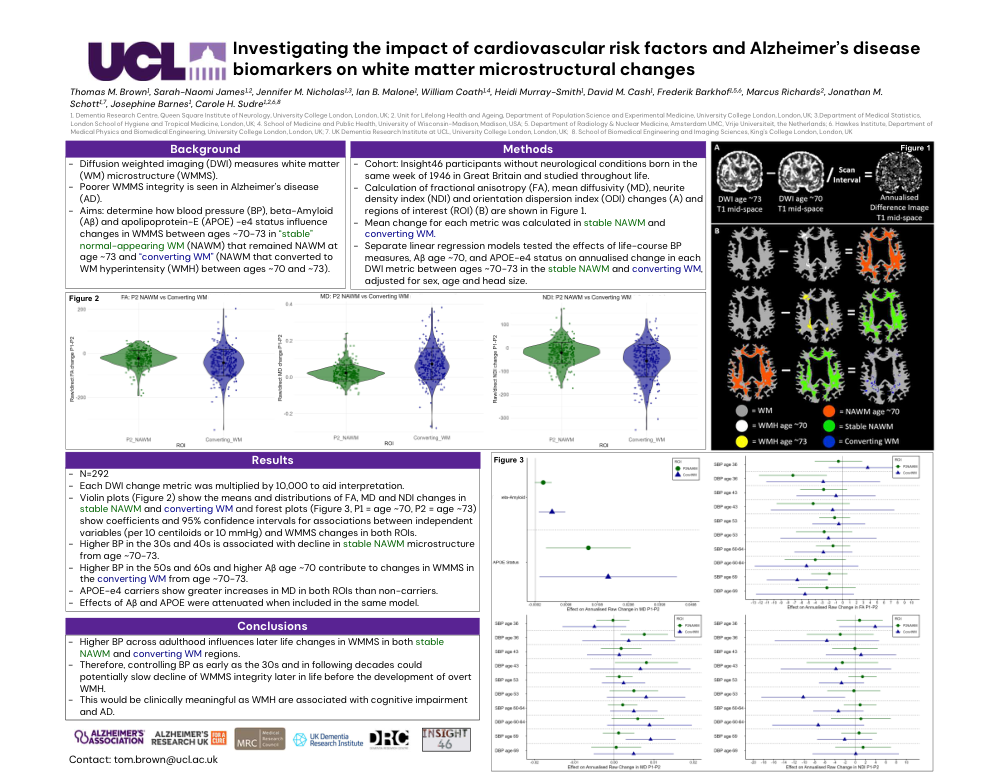
-Calculation of fractional anisotropy (FA), mean diffusivity (MD), neurite density index (NDI) and orientation dispersion index (ODI) changes (A) and regions of interest (ROI) (B) are shown in Figure 1.
-Mean change for each metric was calculated in stable NAWM and converting WM.
-Separate linear regression models tested the effects of life-course BP measures, Aβ age ~70, and APOE-e4 status on annualised change in each DWI metric between ages ~70-73 in the stable NAWM and converting WM, adjusted for sex, age and head size.
 
Results: 
-N=292
-Each DWI change metric was multiplied by 10,000 to aid interpretation.
-Violin plots (Figure 2) show the means and distributions of FA, MD and NDI changes in stable NAWM and converting WM and forest plots (Figure 3, P1 = age ~70, P2 = age ~73) show coefficients and 95% confidence intervals for associations between independent variables (per 10 centiloids or 10 mmHg) and WMMS changes in both ROIs.
-Higher BP in the 30s and 40s is associated with decline in stable NAWM microstructure from age ~70-73.
-Higher BP in the 50s and 60s and higher Aβ age ~70 contribute to changes in WMMS in the converting WM from age ~70-73.
-APOE-e4 carriers show greater increases in MD in both ROIs than non-carriers.
-Effects of Aβ and APOE were attenuated when included in the same model.
 
Conclusions: 
-Higher BP across adulthood influences later life changes in WMMS in both stable NAWM and converting WM regions.
-Therefore, controlling BP as early as the 30s and in following decades could potentially slow decline of WMMS integrity later in life before the development of overt WMH.
-This would be clinically meaningful as WMH are associated with cognitive impairment and AD.

Comments

Email is required but is not shown publicly.

Loading comments...

aaic2026 banner
Copyright © 2015-2026, ePostersLive® SciGen is a registered trademark of SciGen Technologies S.A. Patent pending.

This website and third-party tools we use rely on cookies for the best user experience. By selecting "I agree", you agree to cookie usage as described in our Privacy Policy.