4,068 posters, 219 videos, 101 topics, 69 sessions, 14,365 authors, 6,128 institutions
ePostersLive by SciGen Technologies S.A. All rights reserved.
Alzheimer's Association International Conference 2026
July 12-15, 2026 | London, United Kingdom, and Online

4941
Dissociable Network Topologies Are Associated With Cognitive And Hippocampal Resilience In Ageing And Preclinical Alzheimer’s Disease
Poster Presenter
Authors
Maria Pujol-Torrens, Michalis Kassinopoulos, Giada Damiani, Gonzalo Sánchez-Benavides, Oriol Grau-Rivera, Marc Suárez-Calvet, David Vállez-García, Jordi Huguet, Juan Domingo Gispert, Gemma Salvadó, Roser Sala-Llonch, Gustavo Deco, Raffaele Cacciaglia
Affiliations
BarcelonaBeta Brain Research Center, Barcelona, Spain, Department of Biomedicine, Universitat de Barcelona, Barcelona, Spain, Center for Brain and Cognition, Universitat Pompeu Fabra, Barcelona, Spain
Part of Topic
BACKGROUND
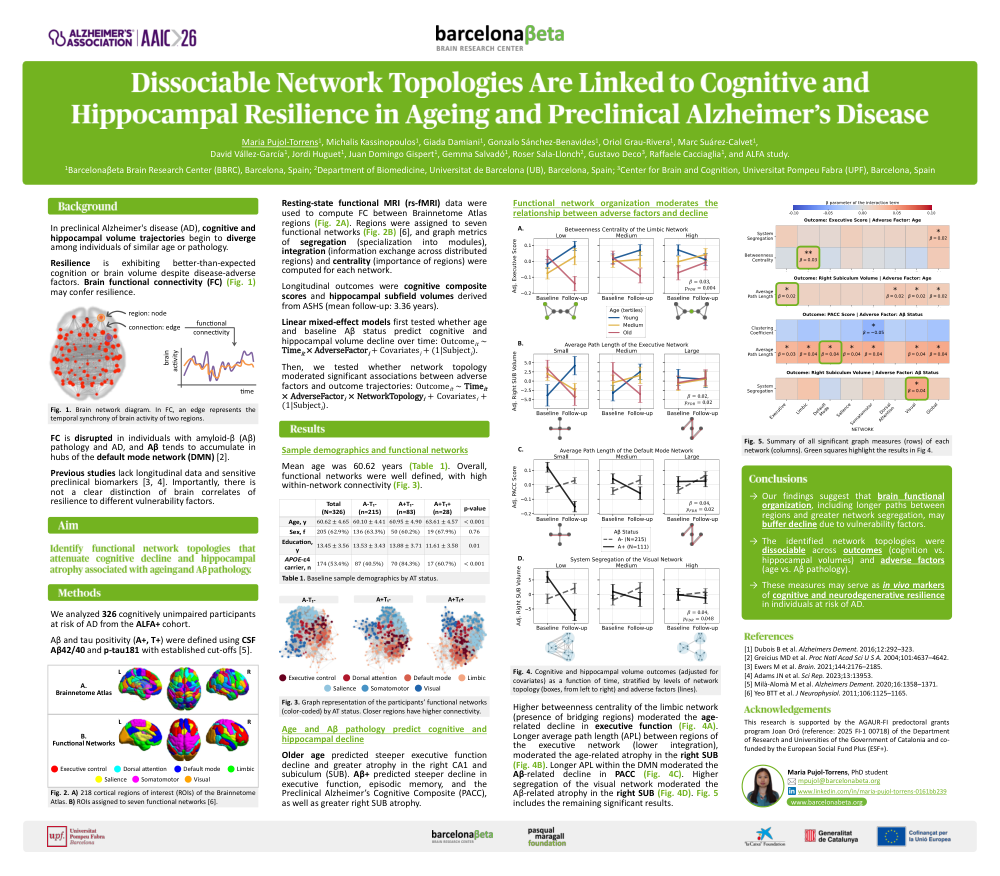
In preclinical Alzheimer's disease (AD), cognitive and hippocampal volume trajectories begin to diverge among individuals of similar age or pathology. Resilience is exhibiting better-than-expected cognition or brain volume despite disease-adverse factors. Brain functional connectivity (FC) (Fig. 1) may confer resilience. FC is disrupted in individuals with amyloid-β (Aβ) pathology and AD, and Aβ tends to accumulate in hubs of the default mode network (DMN) [2]. Previous studies lack longitudinal data and sensitive preclinical biomarkers [3, 4]. Importantly, there is not a clear distinction of brain correlates of resilience to different vulnerability factors.
AIM
Identify functional network topologies that attenuate cognitive decline and hippocampal atrophy associated with ageing and Aβ pathology.
METHODS
We analyzed 326 cognitively unimpaired participants at risk of AD from the ALFA+ cohort. Aβ and tau positivity (A+, T+) were defined using CSF Aβ42/40 and p-tau181 with established cut-offs [5]. Resting-state functional MRI (rs-fMRI) data were used to compute FC between Brainnetome Atlas regions (Fig. 2A). Regions were assigned to seven functional networks (Fig. 2B) [6], and graph metrics of segregation (specialization into modules), integration (information exchange across distributed regions) and centrality (importance of regions) were computed for each network. Longitudinal outcomes were cognitive composite scores and hippocampal subfield volumes derived from ASHS (mean follow-up: 3.36 years). Linear mixed-effect models first tested whether age and baseline Aβ status predict cognitive and hippocampal volume decline over time: Outcomeit ~ Timeit × AdverseFactori + Covariatesi + (1|Subjecti). Then, we tested whether network topology moderated significant associations between adverse factors and outcome trajectories: Outcomeit ~ Timeit × AdverseFactori × NetworkTopologyi + Covariatesi + (1|Subjecti).
RESULTS
Sample demographics and functional networks. Mean age was 60.62 years (Table 1). Overall, functional networks were well defined, with high within-network connectivity (Fig. 3).
Age and Aβ pathology predict cognitive and hippocampal decline. Older age predicted steeper executive function decline and greater atrophy in the right CA1 and subiculum (SUB). Aβ+ predicted steeper decline in executive function, episodic memory, and the Preclinical Alzheimer’s Cognitive Composite (PACC), as well as greater right SUB atrophy.
Functional network organization moderates the relationship between adverse factors and decline. Higher betweenness centrality of the limbic network (presence of bridging regions) moderated the age-related decline in executive function (Fig. 4A). Longer average path length (APL) between regions of the executive network (lower integration), moderated the age-related atrophy in the right SUB (Fig. 4B). Longer APL within the DMN moderated the Aβ-related decline in PACC (Fig. 4C). Higher segregation of the visual network moderated the Aβ-related atrophy in the right SUB (Fig. 4D). Fig. 5 includes the remaining significant results.
CONCLUSIONS
Our findings suggest that brain functional organization, including longer paths between regions and greater network segregation, may buffer decline due to vulnerability factors. The identified network topologies were dissociable across outcomes (cognition vs. hippocampal volumes) and adverse factors (age vs. Aβ pathology). These measures may serve as in vivo markers of cognitive and neurodegenerative resilience in individuals at risk of AD.
Comments
Email is required but is not shown publicly.
Loading comments...