4,068 posters, 219 videos, 101 topics, 69 sessions, 14,365 authors, 6,128 institutions
ePostersLive by SciGen Technologies S.A. All rights reserved.
Alzheimer's Association International Conference 2026
July 12-15, 2026 | London, United Kingdom, and Online

3954
Clonal Hematopoiesis Shapes Alzheimer’S Disease Trajectory: Cognitive Resilience And Altered Neurodegenerative Biomarkers In DELCODE
Poster Presenter
Authors
Part of Topic
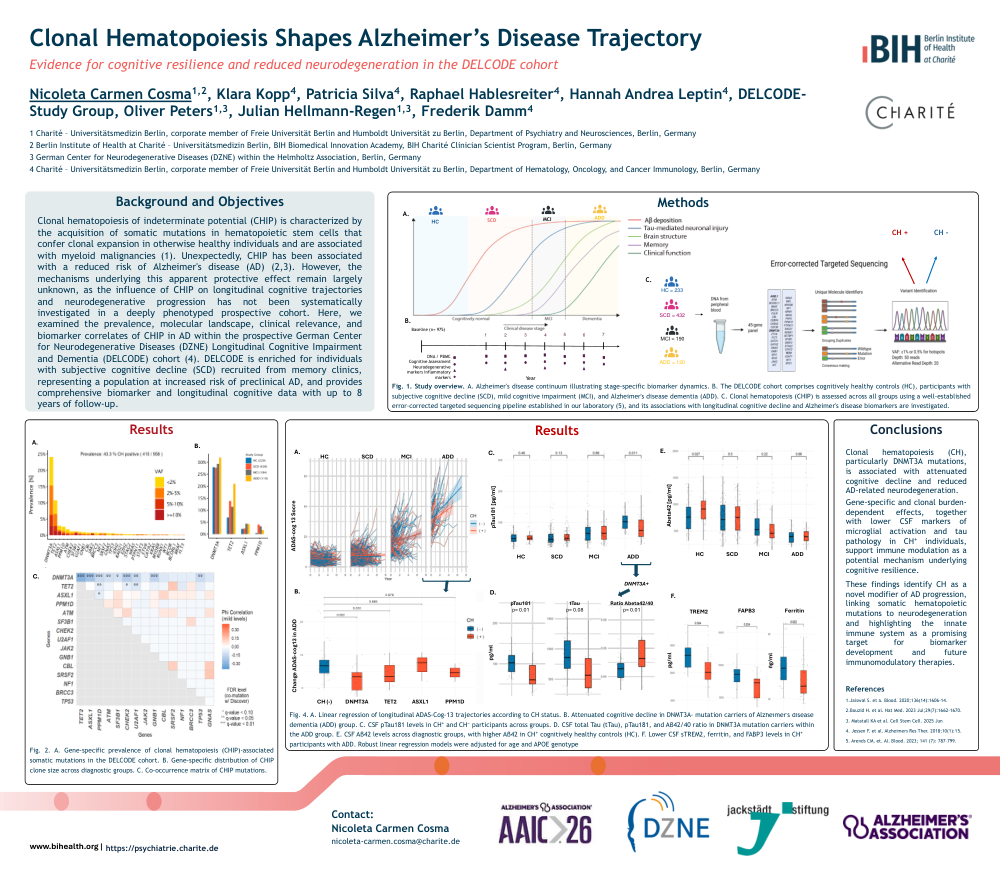
CLONAL HEMATOPOESIS SHAPES ALZHEIMER’S DISEASE TRAJECTORY: EVIDENCE FOR COGNITIVE RESILIENCE AND REDUCED NEURODEGENERATION FROM THE DELCODE COHORT
Nicoleta Carmen Cosma, Klara Kopp, Patricia Silva, Raphael Hablesreiter, Hannah Andrea Leptin, Julian Hellmann-Regen, DELCODE-Study Group, Oliver Peters, Frederik Damm
Objectives: Clonal Hematopoiesis (CH), a phenomenon marked by the occurrence of somatic mutations in hematopoietic cells, has been unexpectedly associated with reduced Alzheimer’s disease (AD) risk. However, the influence of CH in clinically well-characterized cohorts designed to assess cognitive and neurodegenerative progression remains largely unexplored. This study investigates the prevalence, molecular landscape, clinical relevance and biomarker associations of CH in AD to gain mechanistic insights into this putative protection.
Methods: Targeted error-corrected DNA sequencing of 45 CH-associated genes was performed on 957 blood samples from individuals without hematologic malignancies collected within the prospective DELCODE cohort (German Center for Neurodegenerative Diseases). Participants were stratified into four diagnostic groups: healthy controls (HC), subjective cognitive decline (SCD), mild cognitive impairment (MCI), and AD dementia (ADD). To assess neurodegenerative and immune correlates we analyzed longitudinal cognitive assessments as well as biomarkers in cerebrospinal fluid (CSF) and blood spanning for up to 8 years follow-up.
Results: CH mutations were detected in 43.3% of participants (CH+), with DNMT3A, TET2, and ASXL1 being most frequent. CH+ individuals exhibited significantly slower cognitive decline, most pronounced in the ADD group. When looking at single CH genes, DNMT3A mutations correlated with slower cognitive decline in the HC, MCI and ADD groups. Assessing biomarkers regularly determined in CSF (n = 516) revealed lower pTau181 and total-Tau in CH+ ADD individuals, particularly in DNMT3A-mutation carriers, alongside with higher Aβ42 in healthy CH+ controls. CH+ ADD participants exhibited reduced CSF levels of TREM2, ferritin, and FABP3, suggesting diminished microglial activation and neuronal injury in CH+ individuals.
Conclusions: CH-mutations, especially in DNMT3A, may confer resilience against AD-related cognitive decline and pathology. These findings support a novel link between somatic hematopoietic mutations and neurodegeneration, with implications for immune-modulatory therapeutic strategies.
Comments
Email is required but is not shown publicly.
Loading comments...