4,068 posters, 219 videos, 101 topics, 69 sessions, 14,365 authors, 6,128 institutions
ePostersLive by SciGen Technologies S.A. All rights reserved.
Alzheimer's Association International Conference 2026
July 12-15, 2026 | London, United Kingdom, and Online

2276
The effect of hormone replacement therapy on brain structure, neurovascular function and cognition
Poster Presenter
Authors
Axel AS Laurell, Jaegyoung B Kim, Hala Al-Haboubi, Aoibhe De Burca, Sarah Gregory, Katie Bridgeman, Maria-Eleni Dounavi, Audrey Low, Graciela Muniz-Terrera, Benjamin R Underwood, Eef Hogervorst, Ivan Koychev, Brian A Lawlor, Paresh Malhotra, Lorina Naci, Craig W Ritchie, John T O’Brien
Affiliations
Department of Psychiatry, University of Cambridge, Addenbrooke's Hospital, Hills Road, Cambridge, CB2 2QQ, United Kingdom., Department of Radiology, Mayo Clinic, Rochester, USA., Ohio University Heritage College of Osteopathic Medicine, Ohio University, Athens, OH 45701, USA, Department of Psychiatry, University of Oxford, Warneford Hospital, Oxford, OX3 7JX, United Kingdom., Trinity College Dublin, Dublin, D02 X9W9, Ireland., Department of Brain Sciences, Imperial College London, Burlington Danes, The Hammersmith Hospital, Du Cane Road, London, W12 0NN, United Kingdom., University of St Andrews, St Andrews, KY16 9AJ, UK., Scottish Brain Sciences, Edinburgh, EH12 9DQ, UK, Loughborough University, Loughborough, LE11 3TU, UK.
Part of Topic
Background
Studies examining the cognitive effects of hormone replacement therapy (HRT) for menopausal symptoms have produced mixed results, with some suggesting that HRT increases dementia risk. Our aim was to assess the effect of HRT on brain structure, neurovascular function and cognition using data from the PREVENT-Dementia cohort study.
Methods
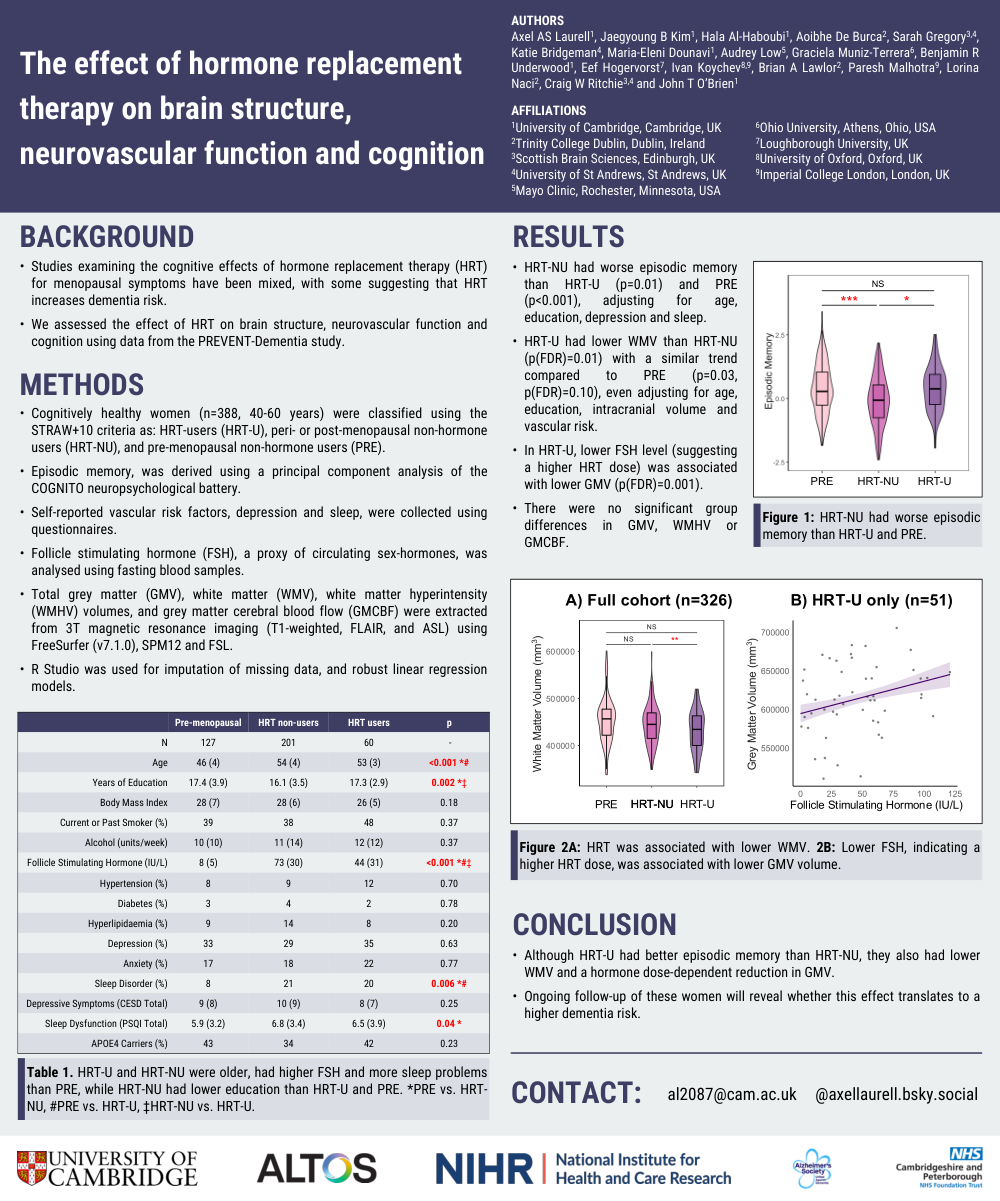
Cognitively healthy women (n=388, 40-60 years) were classified using the gold-standard STRAW+10 criteria as: HRT-users (HRT-U,n=60), peri- or post-menopausal non-hormone users (HRT-NU,n=201), and pre-menopausal non-hormone users (PRE,n=127). Episodic memory (EM), affected early in Alzheimer’s dementia and thought to be sensitive to HRT, was derived using principal component analysis of the COGNITO battery. Covariates including vascular risk factors (hypertension, hyperlipidemia, diabetes), depressive symptoms and sleep, were collected using questionnaires (Center for Epidemiological Studies Depression scale, Pittsburgh Sleep Quality Index). Follicle stimulating hormone (FSH), a proxy of circulating sex-hormones, was analysed using fasting blood samples. Total grey matter (GMV), white matter (WMV), white matter hyperintensity (TWMH) volumes, and grey matter cerebral blood flow (GMCBF) were extracted from magnetic resonance imaging sequences (T1-weighted, fluid-attenuated inversion recovery, and arterial spin labelling) using FreeSurfer (v7.1.0), SPM12 and FSL. R Studio was used for imputation of missing questionnaire and FSH data (mice package), and multivariate robust linear regression models.
Results
HRT-U and HRT-NU were older, had higher FSH levels and higher prevalence of sleep disorders than PRE, while HRT-NU had lower education than HRT-U and PRE. HRT-NU had worse EM than HRT-U (B:-0.36[0.14],p=0.01) and PRE (B:-0.52[0.16],p<0.001), correcting for age, education, depressive symptoms and sleep. HRT-U had lower WMV than HRT-NU (B:-13205[4350]mm3,p(FDR)=0.01,n=326) with a similar trend compared to PRE (B:-12645[5650]mm3,p=0.03,p(FDR)=0.10), even correcting for age, education, intracranial volume and vascular risk factors. There were no significant differences in GMV, WMHs or GMCBF. In HRT-U, lower FSH level (suggesting a higher HRT dose) was associated with lower GMV (B:418[108]mm3/unit,p(FDR)=0.001), but not other imaging measures.
Conclusions
Although HRT-U had better episodic memory, there was a hormone dose-dependent reduction in GMV. WMV was also lower in HRT-U, while there was no association with neurovascular function. Ongoing follow-up of these women will reveal whether this effect translates to a higher dementia risk.
Comments
Email is required but is not shown publicly.
Loading comments...