4,068 posters, 219 videos, 101 topics, 69 sessions, 14,365 authors, 6,128 institutions
ePostersLive by SciGen Technologies S.A. All rights reserved.
Alzheimer's Association International Conference 2026
July 12-15, 2026 | London, United Kingdom, and Online

5156
Brain Activity During Verbal Fluency Tasks In Monolinguals And Bilinguals: A HD-DOT Investigation
Poster Presenter
Part of Topic
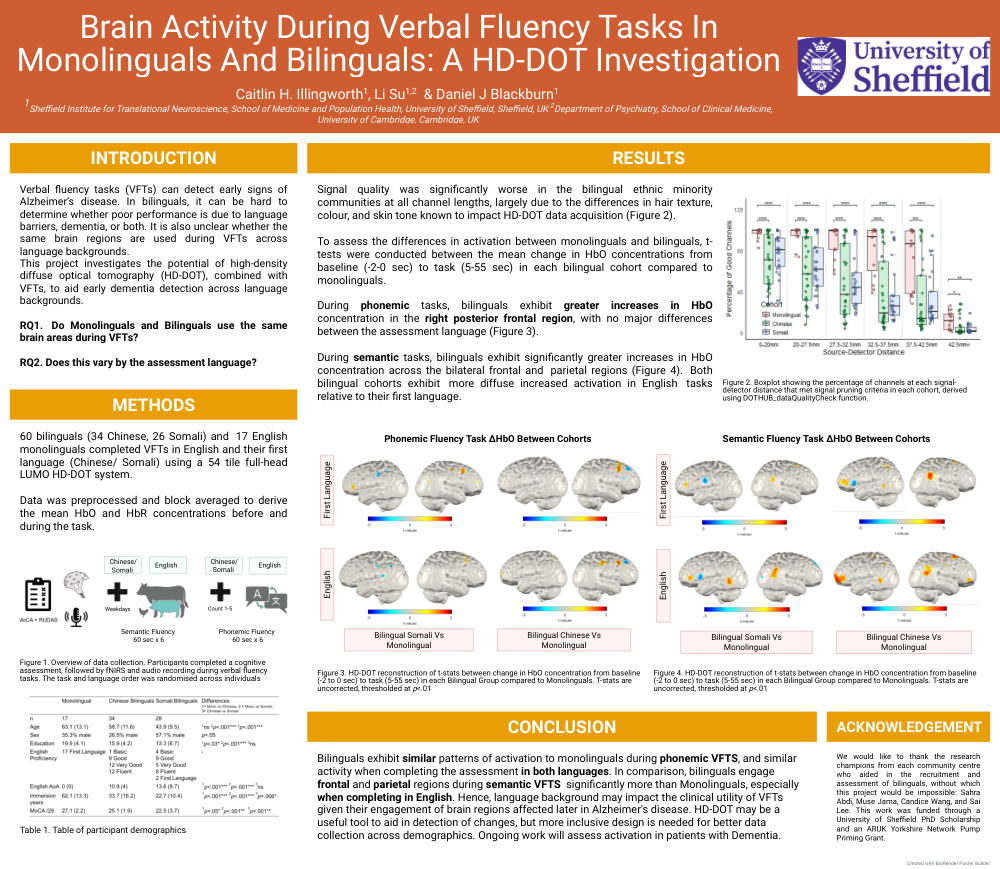
Introduction: Verbal fluency tasks (VFTs) can detect early signs of Alzheimer’s disease. In bilinguals, it can be hard to determine whether poor performance is due to language barriers, dementia, or both. It is also unclear whether the same brain regions are used during VFTs across language backgrounds. This project investigates the potential of high-density diffuse optical tomography (HD-DOT), combined with VFTs, to aid early dementia detection across language backgrounds. RQ1. Do Monolinguals and Bilinguals use the same brain areas during VFTs? RQ2. Does this vary by the assessment language?
MEthods: 60 bilinguals (34 Chinese, 26 Somali) and 17 English monolinguals completed VFTs in English and their first language (Chinese/ Somali) using a 54 tile full-head LUMO HD-DOT system. Data was preprocessed and block averaged to derive the mean HbO and HbR concentrations before and during the task.
Results: Signal quality was significantly worse in the bilingual ethnic minority communities at all channel lengths, largely due to the differences in hair texture, colour, and skin tone known to impact HD-DOT data acquisition (Figure 2). To assess the differences in activation between monolinguals and bilinguals, t-tests were conducted between the mean change in HbO concentrations from baseline (-2-0 sec) to task (5-55 sec) in each bilingual cohort compared to monolinguals. During phonemic tasks, bilinguals exhibit greater increases in HbO concentration in the right posterior frontal region, with no major differences between the assessment language (Figure 3). During semantic tasks, bilinguals exhibit significantly greater increases in HbO concentration across the bilateral frontal and parietal regions (Figure 4). Both bilingual cohorts exhibit more diffuse increased activation in English tasks relative to their first language.
Conclusion: Bilinguals exhibit similar patterns of activation to monolinguals during phonemic VFTS, and similar activity when completing the assessment in both languages. In comparison, bilinguals engage frontal and parietal regions during semantic VFTS significantly more than Monolinguals, especially when completing in English. Hence, language background may impact the clinical utility of VFTs given their engagement of brain regions affected later in Alzheimer's disease. HD-DOT may be a useful tool to aid in detection of changes, but more inclusive design is needed for better data collection across demographics. Ongoing work will assess activation in patients with Dementia.
Comments
Email is required but is not shown publicly.
Loading comments...