4,068 posters, 219 videos, 101 topics, 69 sessions, 14,365 authors, 6,128 institutions
ePostersLive by SciGen Technologies S.A. All rights reserved.
Alzheimer's Association International Conference 2026
July 12-15, 2026 | London, United Kingdom, and Online

5219
Myelin Degeneration Indicated AD Pathology Spreading Pathways And Early Olfactory And Cognitive Decline In MCI
Poster Presenter
Authors
Part of Topic
Myelin Degeneration Indicates AD Pathology Spreading Pathways and Early Olfactory and Cognitive Decline in MCI
Anupa Ekanayake, Jianli Wang, Scott Hwang, Rommy Elyan, William Jens, Deepak Kalra, Paul Eslinger, Ran Pang, Sangam Kanekar, P. Karunanayaka, Qing X. Yang
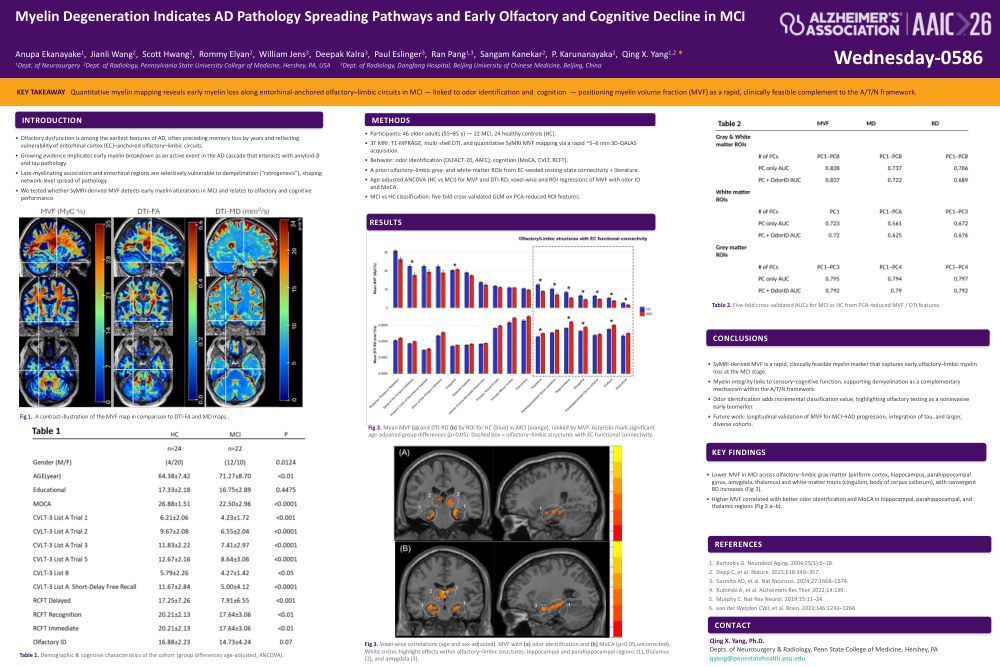
Background: Olfactory impairment is an early marker of Alzheimer's disease (AD) and may reflect vulnerability of entorhinal cortex–anchored olfactory–limbic circuits. We tested whether Synthetic MRI (SyMRI)–derived myelin volume fraction (MVF) detects early myelin alterations in mild cognitive impairment (MCI) and relates to olfactory and cognitive performance, alongside diffusion tensor imaging (DTI).
Methods: 46 older adults (22 MCI, 24 healthy controls) underwent 3T structural MRI, DTI, and SyMRI MVF mapping using a rapid 3D-QALAS acquisition. Odor identification was measured with the OLFACT-20 four-alternative forced-choice test; cognition included MoCA, CVLT, and RCFT. Age-adjusted ANCOVA tested HC–MCI MVF differences in a priori olfactory–limbic gray-matter ROIs and connected white-matter tracts, with parallel analyses of DTI radial diffusivity (RD). Voxel-wise regressions tested MVF associations with odor identification and MoCA controlling for age; GRF correction used voxel p < 0.005 and cluster p < 0.05. Five-fold cross-validated GLMs used PCA-reduced ROI features to classify MCI vs healthy controls.
Results: Compared with controls, MCI showed lower MVF (p < 0.05, uncorrected) in olfactory–limbic regions including primary olfactory cortex (piriform/entorhinal/anterior olfactory nucleus), hippocampus, parahippocampal gyrus, amygdala, and thalamus, and in white-matter pathways including cingulum and posterior thalamic radiation, with convergent RD findings. Higher MVF correlated with better odor identification and MoCA (p < 0.05, uncorrected), with GRF-surviving clusters in posterior left parahippocampal gyrus and bilateral thalamus. For classification, MVF achieved the best MCI–HC discrimination (AUC = 0.828; 0.837 with odor identification) versus diffusion-feature models.
Conclusions: SyMRI-derived MVF is a rapid, clinically feasible myelin marker that captures early olfactory–limbic myelin alterations in MCI and links myelin integrity to sensory–cognitive function—supporting demyelination as a complementary mechanism within the AD A/T/N framework.
Comments
Email is required but is not shown publicly.
Loading comments...