4,068 posters, 219 videos, 101 topics, 69 sessions, 14,365 authors, 6,128 institutions
ePostersLive by SciGen Technologies S.A. All rights reserved.
Alzheimer's Association International Conference 2026
July 12-15, 2026 | London, United Kingdom, and Online

5797
Effect Of Hypertension Treatment On Regional Cerebral Blood Flow In Older Adults
Poster Presenter
Authors
David Zhu, Norman Scheel, Ashley Murillo, Danielle Pittman, John Giacona, Brooke Bates, Anna Tomlinson, Wanpen Vongpatanasin, Rong Zhang
Affiliations
Albert Einstein College of Medicine, Bronx, NY, USA, Michigan State University, East Lansing, MI, USA, UT Southwestern Medical Center, Dallas, TX, USA
Part of Topic
Title:
Effect of Hypertension Treatment on Regional Cerebral Blood Flow in Older Adults
Author list:
David C. Zhu, Norman Scheel, Ashley Murillo, Danielle Pittman, John Giacona, Brooke Bates, Anna Tomlinson, Wanpen Vongpatanasin, Rong Zhang
Background:
In the HIPAC Trial (“Hypertension, Intracranial Pulsatility and Brain Amyloid-beta Accumulation in Older Adults”) (NCT03354143), one aim is to understand the relationships between blood pressure (BP) and regional cerebral blood flow (CBF), as well as the treatment effect of BP medication on CBF.
Methods:
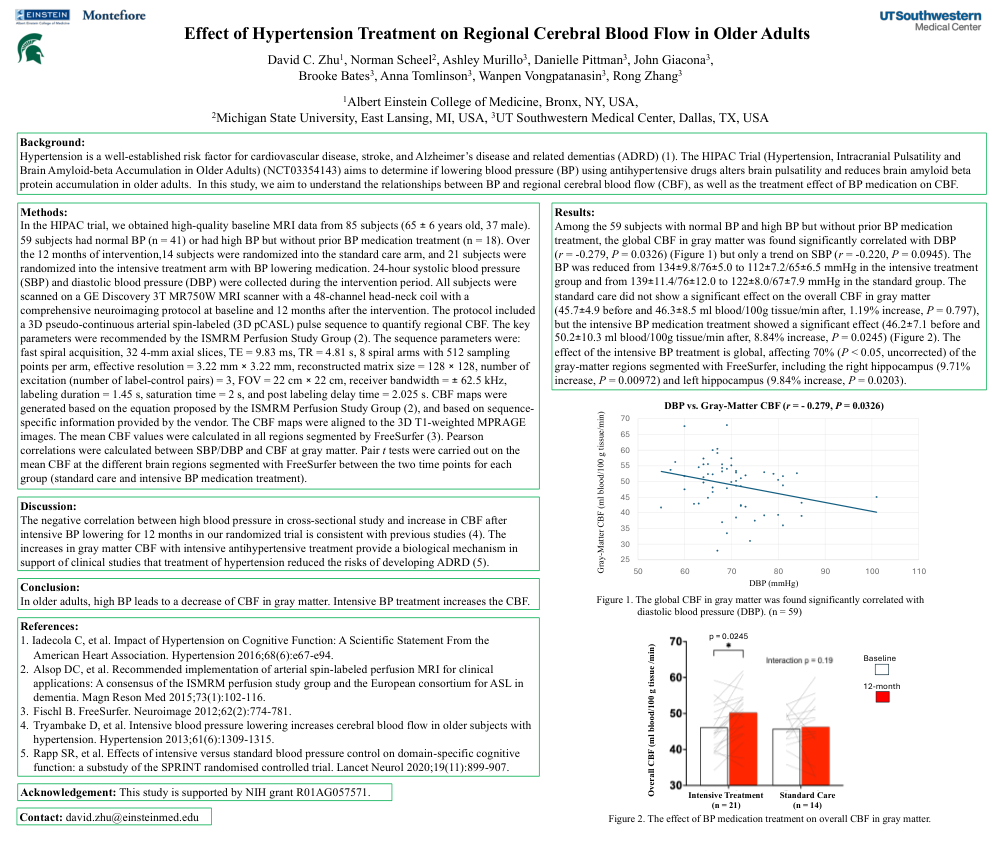
In this trial, we obtained high-quality MRI data from 85 subjects (65±6 years old, 37 males). 59 subjects had normal BP (n=41) or high BP without prior BP medication treatment (n=18). The intervention was 12 months. 14 subjects were randomized into the standard-care group, and 21 subjects into the intensive-treatment group with BP medication. 24-hour systolic BP (SBP) and diastolic BP (DBP) were collected. All subjects were scanned on a GE 3T MR750W MRI scanner at baseline and 12 months post-intervention. A 3D pseudo-continuous arterial spin-labeled pulse sequence was used to quantify regional CBF. The CBF maps were aligned to the 3D T1-weighted MPRAGE images. The mean CBF values were calculated in all regions segmented by FreeSurfer. Pearson correlations were calculated between SBP/DBP and gray-matter CBF. Pair t tests were performed on the mean CBF values at different brain regions between the two time points for each group.
Results:
Among the 59 subjects with normal BP and high BP without prior BP medication treatment, global gray-matter CBF was found significantly correlated with DBP (r = -0.279, P = 0.0326) (Figure 1). BP was reduced from 134±9.8/76±5.0 to 112±7.2/65±6.5 mmHg in the intensive-treatment group and from 139±11.4/76±12.0 to 122±8.0/67±7.9 mmHg in the standard-care group. The standard care did not show a significant effect on the overall gray-matter CBF (increase from 45.7±4.9 to 46.3±8.5 ml blood/100g tissue/min, P = 0.797), but the intensive BP medication treatment showed a significant effect (increase from 46.2±7.1 to 50.2±10.3 ml blood/100g tissue/min, P = 0.0245) (Figure 2). The effect of the intensive treatment is global, affecting 70% (P < 0.05, uncorrected) of the gray-matter regions segmented, including the right (9.71% change, P = 0.00972) and left (9.84% change, P = 0.0203) hippocampi.
Conclusion:
In older adults, high BP leads to a decrease of gray-matter CBF. Intensive BP treatment increases the CBF.
Acknowledgement:
This study is supported by NIH grant R01AG057571.
Comments
Email is required but is not shown publicly.
Loading comments...