4,068 posters, 219 videos, 101 topics, 69 sessions, 14,365 authors, 6,128 institutions
ePostersLive by SciGen Technologies S.A. All rights reserved.
Alzheimer's Association International Conference 2026
July 12-15, 2026 | London, United Kingdom, and Online

3947
Quantifying The Volume Of The Locus Coeruleus In Neurodegenerative Diseases Associated With Dementia
Part of Topic
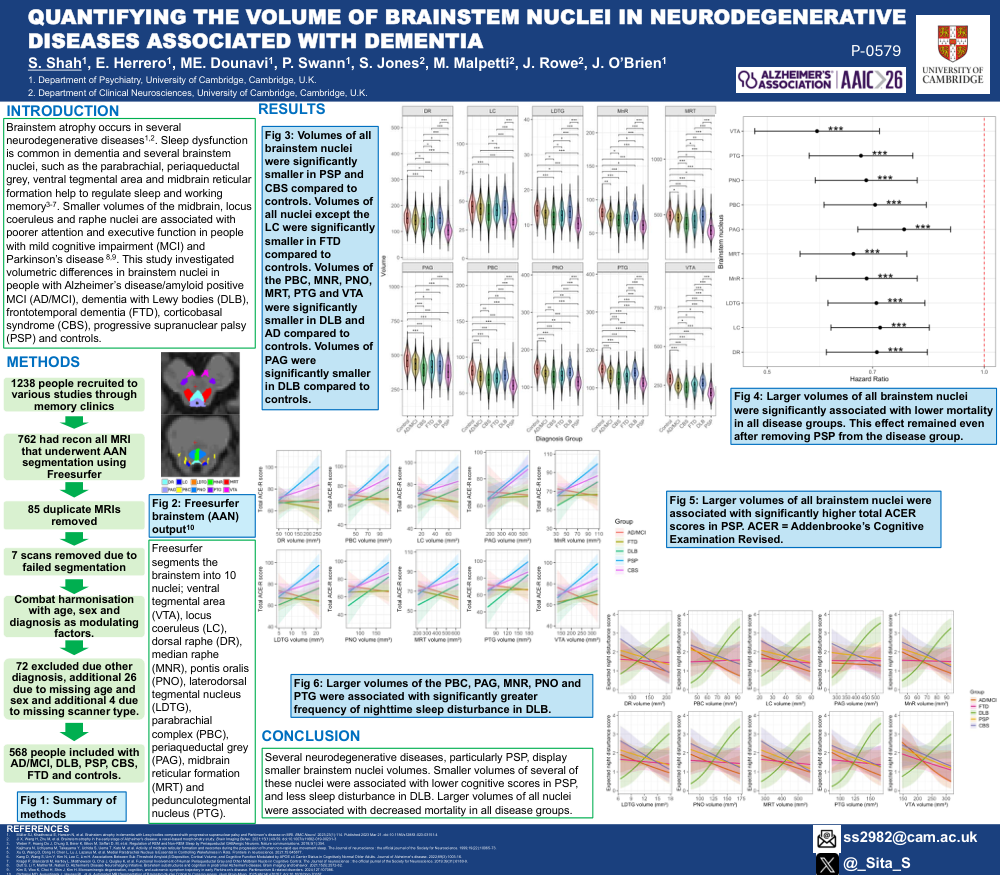
Brainstem atrophy occurs in several neurodegenerative diseases1,2. Sleep dysfunction is common in dementia and several brainstem nuclei, such as the parabrachial, periaqueductal grey, ventral tegmental area and midbrain reticular formation help to regulate sleep and working memory3-7. Smaller volumes of the midbrain, locus coeruleus and raphe nuclei are associated with poorer attention and executive function in people with mild cognitive impairment (MCI) and Parkinson’s disease 8,9. This study investigated volumetric differences in brainstem nuclei in people with Alzheimer’s disease/amyloid positive MCI (AD/MCI), dementia with Lewy bodies (DLB), frontotemporal dementia (FTD), corticobasal syndrome (CBS), progressive supranuclear palsy (PSP) and controls.
586 people were included with AD/MCI, DLB, PSP, CBS, FTD and controls who had MRI brain scans that underwent brainstem nuclei segmentation using the AAN segment pipeline using Freesurfer 8.0.0. Freesurfer segments the brainstem into 10 nuclei; ventral tegmental area (VTA), locus coeruleus (LC), dorsal raphe (DR), median raphe (MNR), pontis oralis (PNO), laterodorsal tegmental nucleus (LDTG), parabrachial complex (PBC), periaqueductal grey (PAG), midbrain reticular formation (MRT) and pedunculotegmental nucleus (PTG).
Volumes of all brainstem nuclei were significantly smaller in PSP and CBS compared to controls. Volumes of all nuclei except the LC were significantly smaller in FTD compared to controls. Volumes of the PBC, MNR, PNO, MRT, PTG and VTA were significantly smaller in DLB and AD compared to controls. Volumes of PAG were significantly smaller in DLB compared to controls.
Larger volumes of all brainstem nuclei were significantly associated with lower mortality in all disease groups. This effect remained even after removing PSP from the disease group.
Larger volumes of all brainstem nuclei were associated with significantly higher total Addenbrooke's Cognitive Examination Revised scores in PSP.
Larger volumes of the PBC, PAG, MNR, PNO and PTG were associated with significantly greater frequency of nighttime sleep disturbance in DLB.
In conclusion, several neurodegenerative diseases, particularly PSP, display smaller brainstem nuclei volumes. Smaller volumes of several of these nuclei were associated with lower cognitive scores in PSP, and less sleep disturbance in DLB. Larger volumes of all nuclei were associated with decreased mortality in all disease groups.
Comments
Email is required but is not shown publicly.
Loading comments...