4,068 posters, 219 videos, 101 topics, 69 sessions, 14,365 authors, 6,128 institutions
ePostersLive by SciGen Technologies S.A. All rights reserved.
Alzheimer's Association International Conference 2026
July 12-15, 2026 | London, United Kingdom, and Online

2672
Florzolotau PET in PSP: visual read method and its clinical diagnostic utilities
Poster Presenter
Authors
Jiaying Lu, Xinyi Li, Kun-Wang Chan, Fengtao Liu, Jian Wang, Chuantao Zuo, the Progressive Supranuclear Palsy Neuroimage Initiative (PSPNI)
Affiliations
Department of Nuclear Medicine & PET Cetner, Huashan Hospital, Fudan University, Shanghai, CHINA, Department of Neurology, Huashan Hospital, Fudan University, Shanghai, CHINA, Huashan Hospital, Fudan University, Shanghai, CHINA
Part of Topic
Background and Objectives
Progressive supranuclear palsy (PSP) presents significant diagnostic challenges due to its phenotypic heterogeneity and symptomatic overlap with other neurodegenerative diseases. Positron emission tomography (PET) imaging with florzolotau (18F), a second-generation tau tracer, enables visualization of tau deposits in vivo, but its role in real-world clinical practice remains unclear. This study aimed to evaluate the diagnostic utility of florzolotau (18F) PET and its impact on therapeutic decision-making in patients with suspected PSP.
Methods
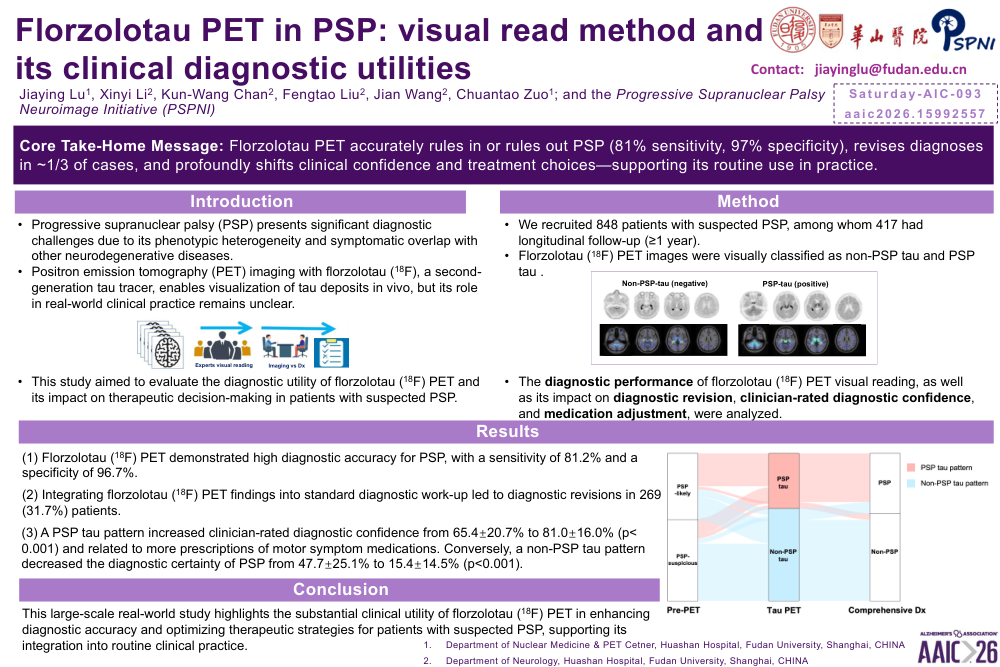
We recruited 848 patients with suspected PSP, among whom 417 had longitudinal follow-up (≥1 year). Florzolotau (18F) PET images were visually classified as PSP tau and non-PSP tau. The diagnostic performance of florzolotau (18F) PET visual reading, as well as its impact on diagnostic revision, clinician-rated diagnostic confidence, and medication adjustment, were analyzed.
Results
Florzolotau (18F) PET demonstrated high diagnostic accuracy for PSP, with a sensitivity of 81.2% and a specificity of 96.7%. Integrating florzolotau (18F) PET findings into standard diagnostic work-up led to diagnostic revisions in 269 (31.7%) patients. A PSP tau pattern increased clinician-rated diagnostic confidence from 65.4±20.7% to 81.0±16.0% (p< 0.001) and related to more prescriptions of motor symptom medications. Conversely, a non-PSP tau pattern decreased the diagnostic certainty of PSP from 47.7±25.1% to 15.4±14.5% (p<0.001).
Discussion
This large-scale real-world study highlights the substantial clinical utility of florzolotau (18F) PET in enhancing diagnostic accuracy and optimizing therapeutic strategies for patients with suspected PSP, supporting its integration into routine clinical practice.
Comments
Email is required but is not shown publicly.
Loading comments...