4,068 posters, 219 videos, 101 topics, 69 sessions, 14,365 authors, 6,128 institutions
ePostersLive by SciGen Technologies S.A. All rights reserved.
Alzheimer's Association International Conference 2026
July 12-15, 2026 | London, United Kingdom, and Online

4652
Benchmarking Thai INDE Cohort With The Alzheimer's Disease Neuroimaging Initiative (ADNI)
Poster Presenter
Authors
Nithit Singtokum, Arp-Arpa Kasemsantitham, Setthanan Jarukasemkit, Phutanik Setasartit, Sasin Treeratana, Dhup Bhukdee, Pharewa Kaewmanee, Sedthapong Chunamchai, Anthipa Chokesuwattanasakul, Poosanu Thanapornsangsuth, Chaipat Chunharas, Thanakit Pongpitakmetha
Affiliations
Department of Physiology, Faculty of Medicine, Chulalongkorn University, Bangkok, Thailand, Cognitive Clinical and Computational Neuroscience Center of Excellence, Faculty of Medicine, Chulalongkorn University, Bangkok, Thailand, Mallinckrodt Institute of Radiology, Washington University School of Medicine, Saint Louis, MO, USA, Chula Neuroscience Center, King Chulalongkorn Memorial Hospital, Bangkok, Thailand, Division of Neurology, Department of Medicine, Faculty of Medicine, King Chulalongkorn Memorial Hospital, Thai Red Cross Society, Bangkok, Thailand, Global Brain Health Institute, University of California, San Francisco, San Francisco, CA, US, Department of Pharmacology, Faculty of Medicine, Chulalongkorn University, Bangkok, Thailand
Part of Topic
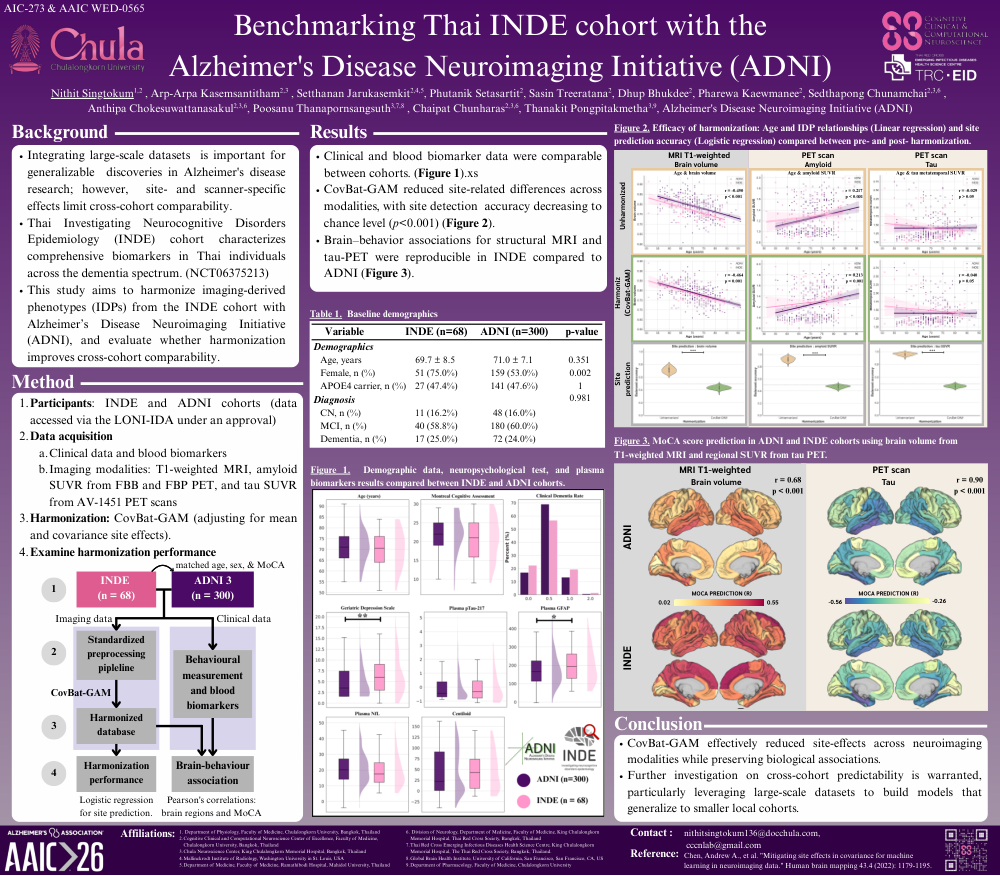
Background: One of the most influential large-scale neuroimaging initiatives in Alzheimer's disease (AD) research is the Alzheimer’s Disease Neuroimaging Initiative (ADNI). However, many biomarkers and subsequent brain-behavior models are derived from Western cohorts, limiting their generalizability to underrepresented populations such as Southeast Asia. Although neuroimaging and blood biomarker datasets are increasingly being collected worldwide, many remain fragmented and underutilized. Integrating these international datasets is important for global generalizable AD discovery, yet site- and scanner-specific effects across countries limit cross-cohort comparability. Therefore, this study aims to harmonize imaging-derived phenotypes (IDPs) from the Thai Investigating Neurocognitive Disorders Epidemiology (INDE) cohort with ADNI and evaluate whether harmonization improves cross-cohort reproducibility and cognitive predictability.
Methods: We selected 300 ADNI participants matched to INDE (N=68) on age, sex, and MoCA scores. IDPs included brain volumes and cortical thicknesses from T1-weighted MRI, amyloid SUVR from FBB and FBP PET, and tau SUVR from AV-1451 PET scans. Harmonization was performed using CovBat-GAM, adjusting for mean and covariance site effects, applied for each modality. The effectiveness of harmonization was assessed with random forest classification to discriminate between the sites. To evaluate the preserved brain-behavior relationships post-harmonization, we examined correlations between brain regions and MoCA scores.
Results: Demographic, neuropsychological, and blood biomarker data were comparable between the two cohorts, with differences observed in sex distribution (χ²=10.071, p=0.002) and the Geriatric Depression Scale scores (t=3.390, p<0.001). After applying CovBat-GAM, site-related differences were reduced across modalities, as indicated by decreased AUC for site detection (p<0.001). INDE data showed increased convergence toward ADNI, with more consistent age-related effects on BPF, meta-temporal tau SUVR, and amyloid burden (standardized with Centiloid units). Brain-behavior associations predicting cognitive scores were reproducible in INDE compared to ADNI for structural and tau-PET modalities.
Conclusion: Our results demonstrated that CovBat-GAM reduced site-effects across neuroimaging modalities. Importantly, biological associations are preserved after harmonization; however, further investigation is warranted given the complexity of site effects and clinical features. Over the long term, harmonization frameworks such as this are crucial for integrating international datasets and enabling scalable, globally representative research in Alzheimer’s disease.
Comments
Email is required but is not shown publicly.
Loading comments...