4,068 posters, 219 videos, 101 topics, 69 sessions, 14,365 authors, 6,128 institutions
ePostersLive by SciGen Technologies S.A. All rights reserved.
Alzheimer's Association International Conference 2026
July 12-15, 2026 | London, United Kingdom, and Online

2585
Implementing Ultra Low Field MRI Neuroimaging For Cognition In A Non-MRI Research Institution In The UK
Poster Presenter
Authors
Joanne Rodda, Richard Weatherall, Elizabeth Barrett, Maria Liljeroth, Welsey Pyke, Amy Hammond, Alison Welfare-Wilson, Sukhi Shergill
Affiliations
Kent and Medway Medical School, Kent and Medway Medical School, Kent and Medway Mental Health NHS Trust, Royal Surrey NHS Foundation Trust, Kent and Medway Mental Health NHS Trust, Dartford and Gravesham NHS Trust, Kent and Medway Medical School, Canterbury Christchurch University
Part of Topic
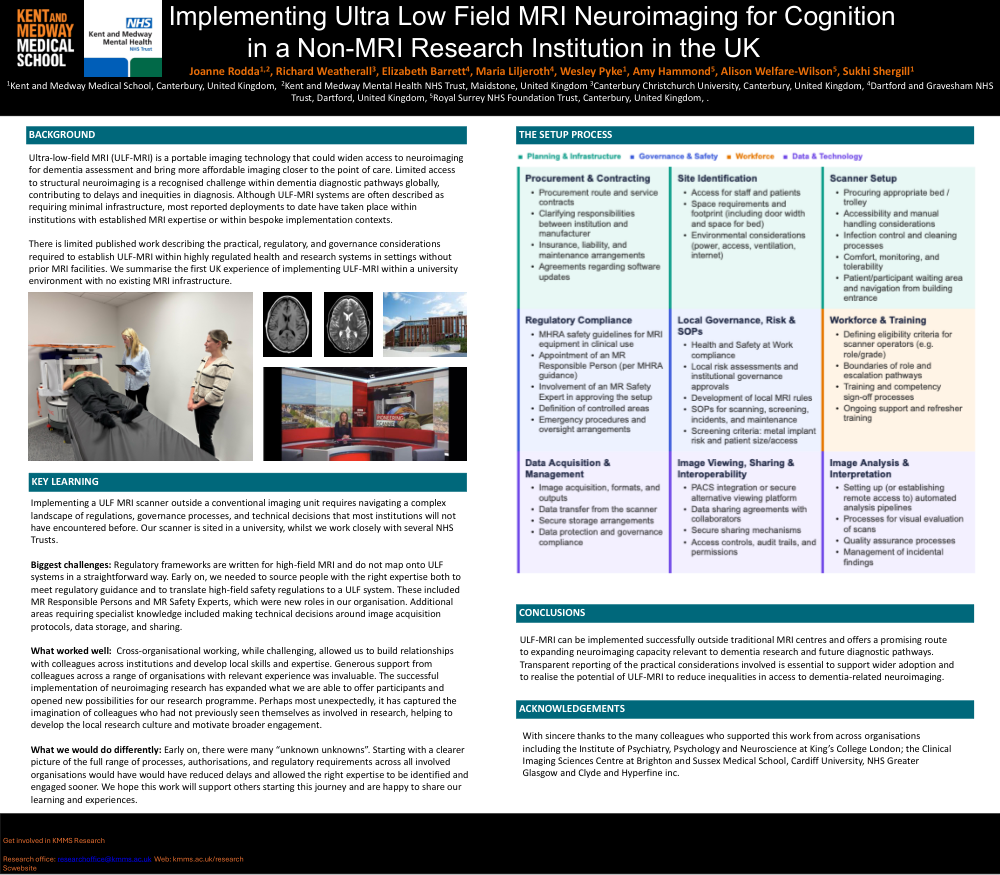
Background: Ultra-low-field MRI (ULF-MRI) is a portable imaging technology that could widen access to neuroimaging for dementia assessment and bring more affordable imaging closer to the point of care. Limited access to structural neuroimaging is a recognised challenge within dementia diagnostic pathways globally, contributing to delays and inequities in diagnosis. Although ULF-MRI systems are often described as requiring minimal infrastructure, most reported deployments to date have taken place within institutions with established MRI expertise or within bespoke implementation contexts. There is limited published work describing the practical, regulatory, and governance considerations required to establish ULF-MRI within highly regulated health and research systems in settings without prior MRI facilities. We report the first UK experience of implementing ULF-MRI within a university environment with no existing MRI infrastructure.
Methods: We describe the establishment of a Hyperfine Swoop 0.064T ULF-MRI system within a UK university with no pre-existing MRI infrastructure, undertaken to support dementia research. We have systematically documented setup processes including procurement, siting, patient support infrastructure, workforce training, regulatory compliance, MRI safety governance, cyber security, data acquisition, storage, sharing, and image analysis.
Results: Successful implementation required coordination across multiple specialist and regulatory domains, including MR physics expertise, health and safety processes, medical device governance, data protection, and institutional approvals. Key considerations included scanner siting and room layout, adaptation of MRI safety guidance designed for high-field systems, manual handling and participant comfort relevant to older adults, training of non-radiographer operators, and establishment of secure data transfer, storage, and analysis pipelines outside standard radiology PACS infrastructure. Despite these complexities, the system was successfully installed and used to acquire high-quality neuroimaging data in a non-MRI institutional environment, with 63 participants scanned to date. Collaboration with experienced academic, clinical, techniand industry partners was central to this process.
Conclusion: ULF-MRI can be implemented successfully outside traditional MRI centres and offers a promising route to expanding neuroimaging capacity relevant to dementia research and future diagnostic pathways. Transparent reporting of the practical considerations involved is essential to support wider adoption and to realise the potential of ULF-MRI to reduce inequalities in access to dementia-related neuroimaging.
Comments
Email is required but is not shown publicly.
Loading comments...