4,068 posters, 219 videos, 101 topics, 69 sessions, 14,365 authors, 6,128 institutions
ePostersLive by SciGen Technologies S.A. All rights reserved.
Alzheimer's Association International Conference 2026
July 12-15, 2026 | London, United Kingdom, and Online

1579
Effects Of Aducanumab On Behavior And MRI Findings In EC-APP770+/AppNL-G-F Mice
Poster Presenter
Authors
Part of Topic
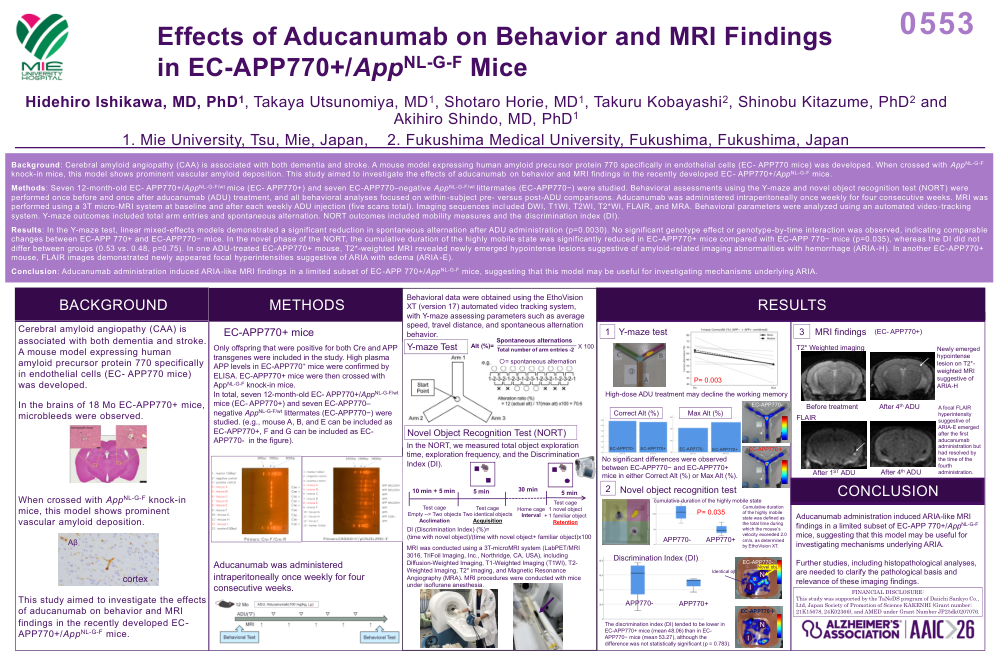
Background: Cerebral amyloid angiopathy (CAA) is associated with both dementia and stroke. A mouse model expressing human amyloid precursor protein 770 specifically in endothelial cells (EC- APP770 mice) was developed. When crossed with AppNL-G-F knock-in mice, this model shows prominent vascular amyloid deposition. This study aimed to investigate the effects of aducanumab on behavior and MRI findings in the recently developed EC- APP770+/AppNL-G-F mice.
Methods: Seven 12-month-old EC- APP770+/AppNL-G-F/wt mice (EC- APP770+) and seven EC-APP770–negative AppNL-G-F/wt littermates (EC-APP770−) were studied. Behavioral assessments using the Y-maze and novel object recognition test (NORT) were performed once before and once after aducanumab (ADU) treatment, and all behavioral analyses focused on within-subject pre- versus post-ADU comparisons. Aducanumab was administered intraperitoneally once weekly for four consecutive weeks. MRI was performed using a 3T micro-MRI system at baseline and after each weekly ADU injection (five scans total). Imaging sequences included DWI, T1WI, T2WI, T2*WI, FLAIR, and MRA. Behavioral parameters were analyzed using an automated video-tracking system. Y-maze outcomes included total arm entries and spontaneous alternation. NORT outcomes included mobility measures and the discrimination index (DI).
Results: In the Y-maze test, linear mixed-effects models demonstrated a significant reduction in spontaneous alternation after ADU administration (p=0.0030). No significant genotype effect or genotype-by-time interaction was observed, indicating comparable changes between EC-APP 770+ and EC-APP770− mice. In the novel phase of the NORT, the cumulative duration of the highly mobile state was significantly reduced in EC-APP770+ mice compared with EC-APP 770− mice (p=0.035), whereas the DI did not differ between groups (0.53 vs. 0.48, p=0.75). In one ADU-treated EC-APP770+ mouse, T2*-weighted MRI revealed newly emerged hypointense lesions suggestive of amyloid-related imaging abnormalities with hemorrhage (ARIA-H). In another EC-APP770+ mouse, FLAIR images demonstrated newly appeared focal hyperintensities suggestive of ARIA with edema (ARIA-E).
Conclusion: Aducanumab administration induced ARIA-like MRI findings in a limited subset of EC-APP 770+/AppNL-G-F mice, suggesting that this model may be useful for investigating mechanisms underlying ARIA.
Comments
Email is required but is not shown publicly.
Loading comments...