4,068 posters, 219 videos, 101 topics, 69 sessions, 14,365 authors, 6,128 institutions
ePostersLive by SciGen Technologies S.A. All rights reserved.
Alzheimer's Association International Conference 2026
July 12-15, 2026 | London, United Kingdom, and Online

1028
Understanding Brain Aging In India: Neuroimaging In The LASI-DAD Study
Poster Presenter
Authors
Leon Aksman, Sophie Martine, Michela Gravina, Georgia Kenyon, Kirsten Lynch, Yingxu Liu, Pranali Khobragade, Joyita Banerjee, Niranjan Khandelwal, James Cole, Jinkook Lee
Affiliations
Mark and Mary Stevens Neuroimaging and Informatics Institute, Keck School of Medicine, University of Southern California, Los Angeles, CA, USA, Center for Economic and Social Research, University of Southern California, Los Angeles, California, USA, Department of Radiodiagnosis, National Institute of Medical Sciences, Jaipur, Rajasthan, India, UCL Hawkes Institute, University College London, London, UK, Department of Electrical Engineering and Information Technology (DIETI), University of Naples Federico II, Italy
Part of Topic
INTRODUCTION
Up to 70% of the 8.8 million dementia cases in India are attributable to modifiable risk factors. These factors may contribute to dementia through accelerated brain aging.
OBJECTIVE
Investigate how older Indians’ modifiable risk factor exposures relate to MRI-based brain age gap (BAG). We hypothesized that these exposures increase BAG.
METHODS
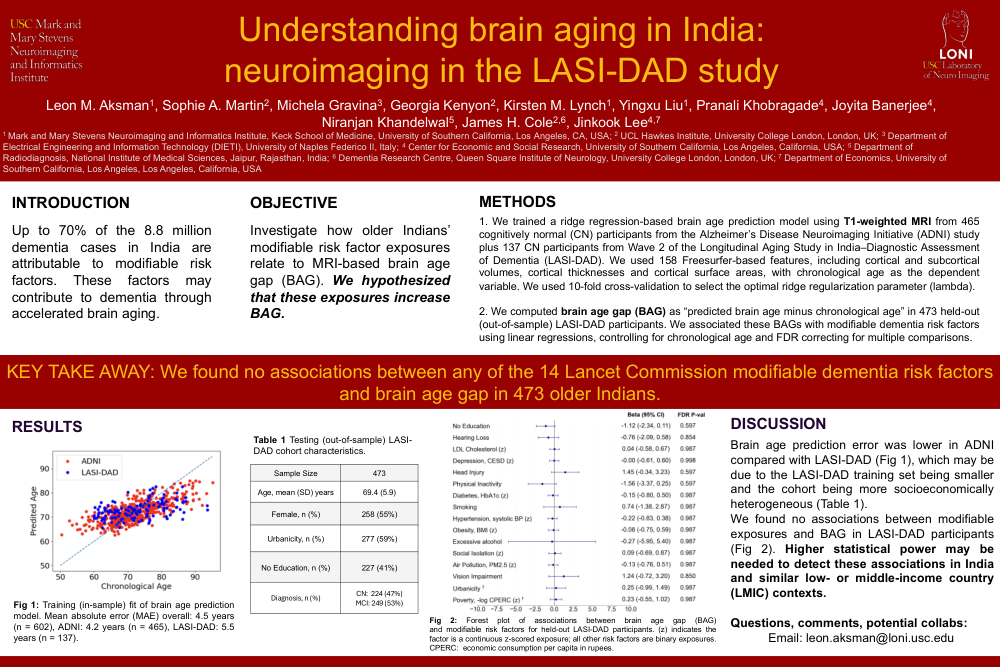
1. We trained a ridge regression-based brain age prediction model using T1-weighted MRI from 465 cognitively normal (CN) participants from the Alzheimer’s Disease Neuroimaging Initiative (ADNI) study plus 137 CN participants from Wave 2 of the Longitudinal Aging Study in India–Diagnostic Assessment of Dementia (LASI-DAD). We used 158 Freesurfer-based features, including cortical and subcortical volumes, cortical thicknesses and cortical surface areas, with chronological age as the dependent variable. We used 10-fold cross-validation to select the optimal ridge regularization parameter (lambda).
2. We computed brain age gap (BAG) as “predicted brain age minus chronological age” in 473 held-out (out-of-sample) LASI-DAD participants. We associated these BAGs with modifiable dementia risk factors using linear regressions, controlling for chronological age and FDR correcting for multiple comparisons.
DISCUSSION
Brain age prediction error was lower in ADNI compared with LASI-DAD (Fig 1), which may be due to the LASI-DAD training set being smaller and the cohort being more socioeconomically heterogeneous (Table 1).
We found no associations between modifiable exposures and BAG in LASI-DAD participants (Fig 2). Higher statistical power may be needed to detect these associations in India and similar low- or middle-income country (LMIC) contexts.
Comments
Email is required but is not shown publicly.
Loading comments...