4,068 posters, 219 videos, 101 topics, 69 sessions, 14,365 authors, 6,128 institutions
ePostersLive by SciGen Technologies S.A. All rights reserved.
Alzheimer's Association International Conference 2026
July 12-15, 2026 | London, United Kingdom, and Online

6839
Genome-wide transcriptome analysis in Alzheimer’s disease continuum in a Korean population: relation to Aß deposition on PET
Poster Presenter
Authors
Part of Topic
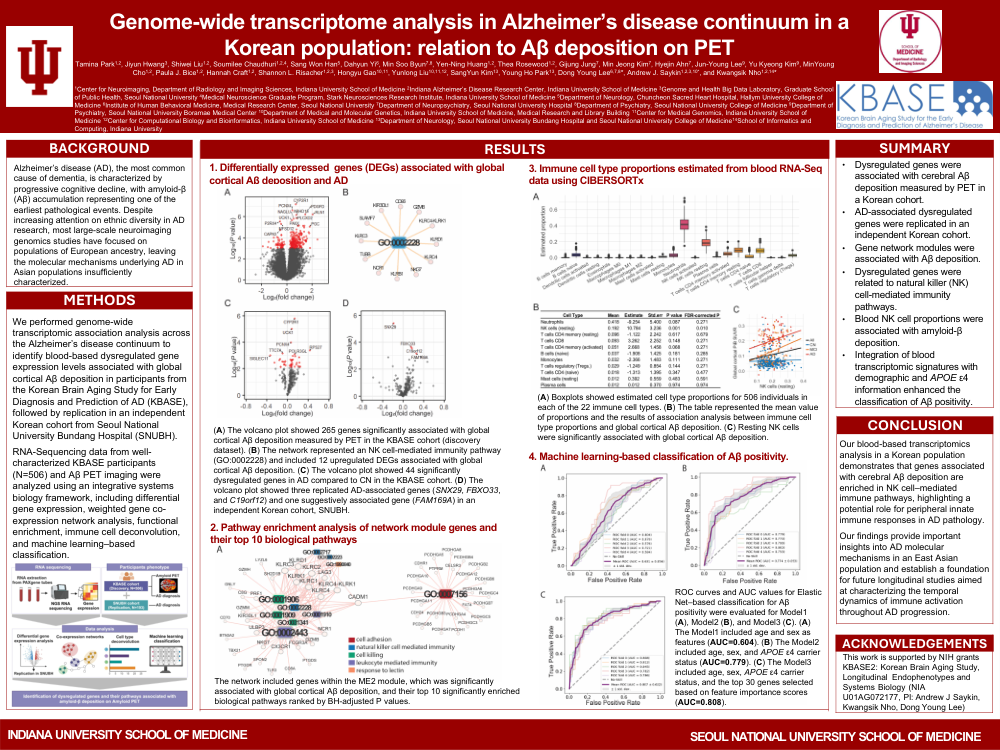
Alzheimer’s disease (AD), the most common cause of dementia, is characterized by progressive cognitive decline, with amyloid-β (Aβ) accumulation representing one of the earliest pathological events. Despite increasing attention on ethnic diversity in AD research, most large-scale neuroimaging genomics studies have focused on populations of European ancestry, leaving the molecular mechanisms underlying AD in Asian populations insufficiently characterized.
We performed genome-wide transcriptomic association analysis across the Alzheimer’s disease continuum to identify blood-based dysregulated gene expression levels associated with global cortical Aβ deposition in participants from the Korean Brain Aging Study for Early Diagnosis and Prediction of AD (KBASE), followed by replication in an independent Korean cohort from Seoul National University Bundang Hospital (SNUBH).
RNA-Sequencing data from well-characterized KBASE participants (N=506) and Aβ PET imaging were analyzed using an integrative systems biology framework, including differential gene expression, weighted gene co-expression network analysis, functional enrichment, immune cell deconvolution, and machine learning–based classification.
1. Differentially expressed genes (DEGs) associated with global cortical Aβ deposition and AD
2. Pathway enrichment analysis of network module genes and their top 10 biological pathways
3. Immune cell type proportions estimated from blood RNA-Seq data using CIBERSORTx
4. Machine learning-based classification of Aβ positivity.
Our blood-based transcriptomics analysis in a Korean population demonstrates that genes associated with cerebral Aβ deposition are enriched in NK cell–mediated immune pathways, highlighting a potential role for peripheral innate immune responses in AD pathology.
Our findings provide important insights into AD molecular mechanisms in an East Asian population and establish a foundation for future longitudinal studies aimed at characterizing the temporal dynamics of immune activation throughout AD progression.
This work is supported by NIH grants KBASE2: Korean Brain Aging Study, Longitudinal Endophenotypes and Systems Biology (NIA U01AG072177, PI: Andrew J Saykin, Kwangsik Nho, Dong Young Lee)
Comments
Email is required but is not shown publicly.
Loading comments...