4,068 posters, 219 videos, 101 topics, 69 sessions, 14,365 authors, 6,128 institutions
ePostersLive by SciGen Technologies S.A. All rights reserved.
Alzheimer's Association International Conference 2026
July 12-15, 2026 | London, United Kingdom, and Online

8933
Scan: Standardized Centralized Alzheimer’s And Related Dementias Neuroimaging
Poster Presenter
Authors
Robel Gebre, Theresa Harrison, Charles DeCarli, Kejal Kantarci, Suzanne Baker, Renaud La Joie, Pauline Maillard, Gil Rabinovici, Arthur Toga, Clifford Jack, William Jagust
Affiliations
University of California, Davis, University of California, San Francisco, University of Southern California, Mayo Clinic, University of California, Berkeley, Lawrence Berkeley National Lab
Part of Topic
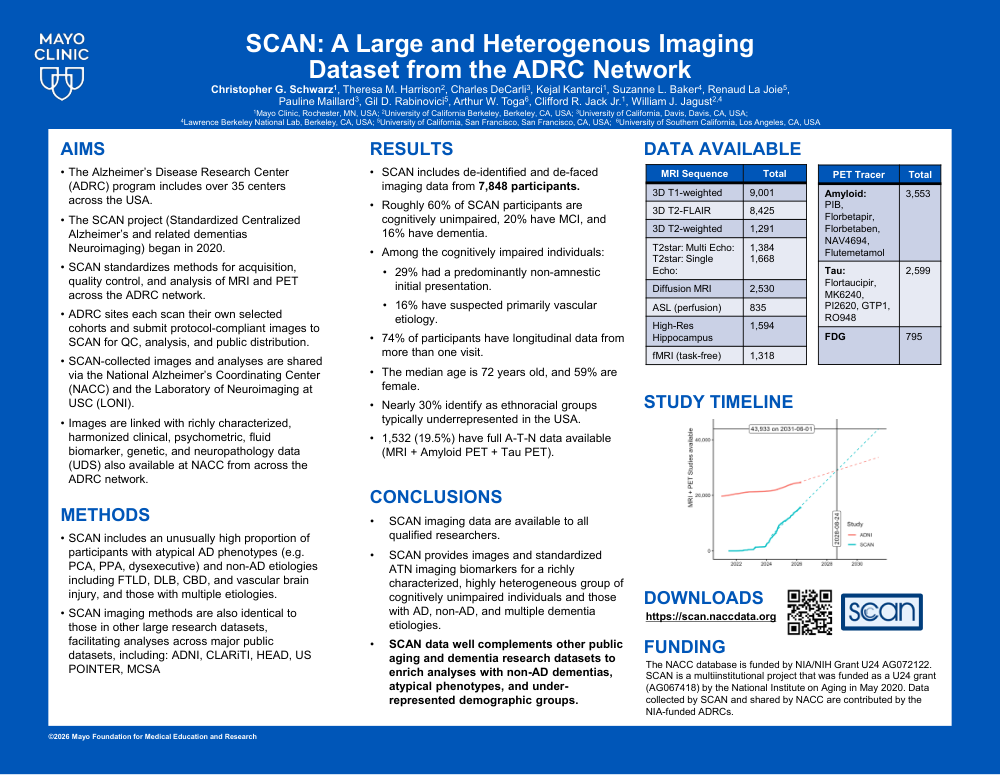
AIMS:
• The Alzheimer’s Disease Research Center (ADRC) program includes over 35 centers across the USA.
• The SCAN project (Standardized Centralized Alzheimer’s and related dementias Neuroimaging) began in 2020.
• SCAN standardizes methods for acquisition, quality control, and analysis of MRI and PET across the ADRC network.
• ADRC sites each scan their own selected cohorts and submit protocol-compliant images to SCAN for QC, analysis, and public distribution.
• SCAN-collected images and analyses are shared via the National Alzheimer’s Coordinating Center (NACC) and the Laboratory of Neuroimaging at USC (LONI).
• Images are linked with richly characterized, harmonized clinical, psychometric, fluid biomarker, genetic, and neuropathology data (UDS) also available at NACC from across the ADRC network.
METHODS:
• SCAN includes an unusually high proportion of participants with atypical AD phenotypes (e.g. PCA, PPA, dysexecutive) and non-AD etiologies including FTLD, DLB, CBD, and vascular brain injury, and those with multiple etiologies.
• SCAN imaging methods are also identical to those in other large research datasets, facilitating analyses across major public datasets, including: ADNI, CLARiTI, HEAD, US POINTER, MCSA
RESULTS:
• SCAN includes de-identified and de-faced imaging data from 7,848 participants.
• Roughly 60% of SCAN participants are cognitively unimpaired, 20% have MCI, and 16% have dementia.
• Among the cognitively impaired individuals:
• 29% had a predominantly non-amnestic initial presentation.
• 16% have suspected primarily vascular etiology.
• 74% of participants have longitudinal data from more than one visit.
• The median age is 72 years old, and 59% are female.
• Nearly 30% identify as ethnoracial groups typically underrepresented in the USA.
• 1,532 (19.5%) have full A-T-N data available (MRI + Amyloid PET + Tau PET).
CONCLUSIONS:
• SCAN imaging data are available to all qualified researchers.
• SCAN provides images and standardized ATN imaging biomarkers for a richly characterized, highly heterogeneous group of cognitively unimpaired individuals and those with AD, non-AD, and multiple dementia etiologies.
• SCAN data well complements other public aging and dementia research datasets to enrich analyses with non-AD dementias, atypical phenotypes, and under-represented demographic groups.
Comments
Email is required but is not shown publicly.
Loading comments...