4,068 posters, 219 videos, 101 topics, 69 sessions, 14,365 authors, 6,128 institutions
ePostersLive by SciGen Technologies S.A. All rights reserved.
Alzheimer's Association International Conference 2026
July 12-15, 2026 | London, United Kingdom, and Online

7173
Central occupancy and peripheral inhibition of cannabinoid signaling by the dual FAAH/MAGL inhibitor irafamdastat (BMS-986368)
Poster Presenter
Authors
Koen van Laere, Thomas Lodeweyckx, Sofie Celen, Michel Koole, Kwinten Porters, Marie Cohilis, Kim Serdons, Min Chen, Jian Chen, Sumit Bansal, Tara Simmons, Yanying Wang, Yongjun Xue, Anthony Krakovich, Joel Schwartz, Kimberly Lentz, Shuyan Du, Kevin Dines, Richard Hargreaves, Michael Thomas, Marc Gleichmann, Jan de Hoon, Ralph Adam Smith
Affiliations
Bristol Myers Squibb, Princeton, NJ, USA, Nuclear Medicine and Molecular Imaging, University Hospitals of Leuven and KU Leuven, Leuven, Belgium, Center for Clinical Pharmacology, University Hospitals of Leuven, Leuven, Belgium, Bristol Myers Squibb, Madison, NJ, USA, Bristol Myers Squibb, Cambridge, MA, USA, Bristol Myers Squibb, San Diego, CA, USA, Bristol Myers Squibb, San Diego, CA, USA (at the time of the study)
Part of Topic
Video
Background:
• Endocannabinoids play a crucial role in modulating various excitatory and inhibitory pathways that drive processes including pain sensation, mood, appetite, and memory1-3
• The primary endocannabinoids, anandamide (AEA) and 2-arachidonoylglycerol (2-AG), are agonists of the cannabinoid type-1 and type-2 receptors4
— Fatty acid amide hydrolase (FAAH) and monoacylglycerol lipase (MAGL) are enzymes responsible for the degradation of AEA and 2-AG, respectively4
— Low levels of AEA and 2-AG can lead to neuronal hyperexcitability, which is observed in many neurological conditions, including Alzheimer's disease agitation5-9
• Irafamdastat (BMS-986368) is a first-in-class, orally administered, centrally penetrant, dual covalent inhibitor of FAAH and MAGL10
— By inhibiting FAAH and MAGL, irafamdastat reduces the breakdown of AEA and 2-AG, thus elevating central and peripheral levels of these endocannabinoids
— Irafamdastat may offer therapeutic benefits for disorders associated with neuronal hyperexcitability, such as agitation in Alzheimer's disease and spasticity in multiple sclerosis, for which there is a lack of safe and effective treatment options
• Here, we present data on central occupancy and peripheral inhibition of endocannabinoid signaling by irafamdastat in nonhuman primates (NHPs)
and humans
Methods:
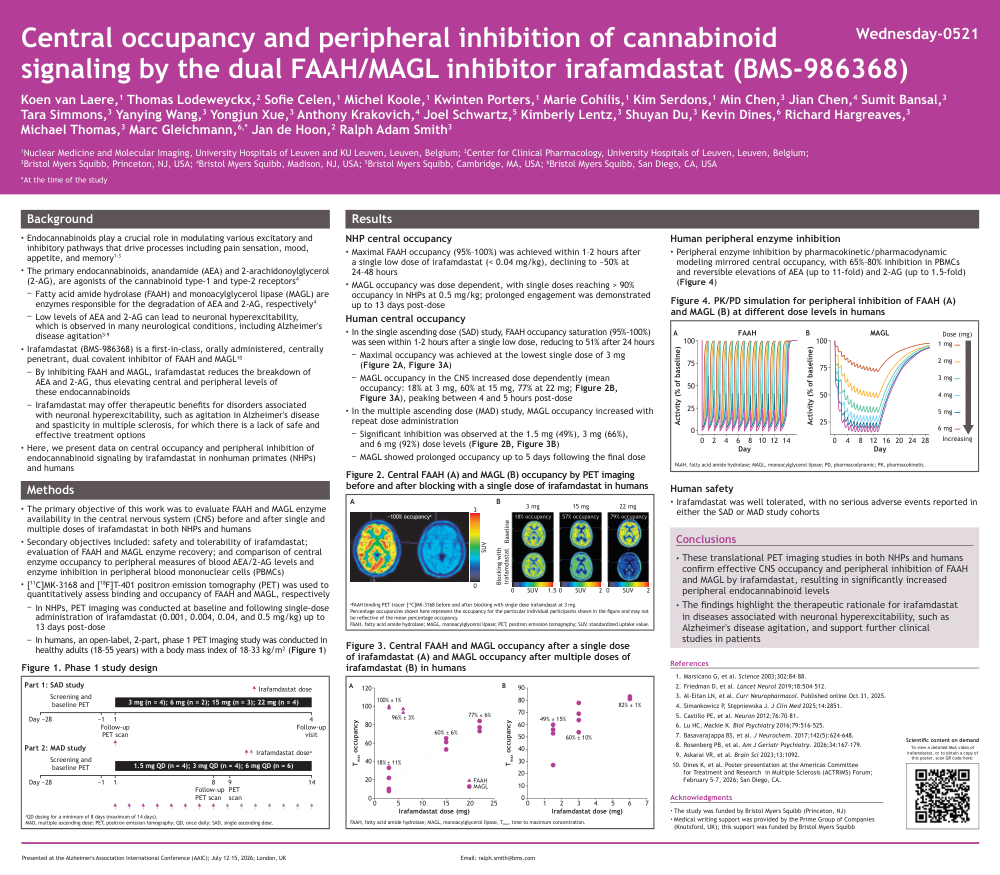
• The primary objective of this work was to evaluate FAAH and MAGL enzyme availability in the central nervous system (CNS) before and after single and multiple doses of irafamdastat in both NHPs and humans
• Secondary objectives included: safety and tolerability of irafamdastat; evaluation of FAAH and MAGL enzyme recovery; and comparison of central enzyme occupancy to peripheral measures of blood AEA/2-AG levels and enzyme inhibition in peripheral blood mononuclear cells (PBMCs)
• [11C]MK-3168 and [18F]T-401 positron emission tomography (PET) was used to quantitatively assess binding and occupancy of FAAH and MAGL, respectively
— In NHPs, PET imaging was conducted at baseline and following single-dose administration of irafamdastat (0.001, 0.004, 0.04, and 0.5 mg/kg) up to 13 days post-dose
— In humans, an open‑label, 2-part, phase 1 PET imaging study was conducted in healthy adults (18–55 years) with a body mass index of 18–33 kg/m² (Figure 1)
Results:
NHP central occupancy
• Maximal FAAH occupancy (95%–100%) was achieved within 1–2 hours after a single low dose of irafamdastat (< 0.04 mg/kg), declining to ~50% at
24–48 hours
• MAGL occupancy was dose dependent, with single doses reaching > 90% occupancy in NHPs at 0.5 mg/kg; prolonged engagement was demonstrated up to 13 days post-dose
Human central occupancy
• In the single ascending dose (SAD) study, FAAH occupancy saturation (95%-100%) was seen within 1-2 hours after a single low dose, reducing to 51% after 24 hours
— Maximal occupancy was achieved at the lowest single dose of 3 mg (Figure 2A, Figure 3A)
— MAGL occupancy in the CNS increased dose dependently (mean occupancy: 18% at 3 mg, 60% at 15 mg, 77% at 22 mg; Figure 2B, Figure 3A), peaking between 4 and 5 hours post-dose
• In the multiple ascending dose (MAD) study, MAGL occupancy increased with repeat dose administration
— Significant inhibition was observed at the 1.5 mg (49%), 3 mg (66%), and 6 mg (92%) dose levels (Figure 2B, Figure 3B)
— MAGL showed prolonged occupancy up to 5 days following the final dose
Human peripheral enzyme inhibition
• Peripheral enzyme inhibition by pharmacokinetic/pharmacodynamic modeling mirrored central occupancy, with 65%–80% inhibition in PBMCs
and reversible elevations of AEA (up to 11‑fold) and 2‑AG (up to 1.5‑fold) (Figure 4)
Human safety
• Irafamdastat was well tolerated, with no serious adverse events reported in either the SAD or MAD study cohorts
Conclusions
• These translational PET imaging studies in both NHPs and humans confirm effective CNS occupancy and peripheral inhibition of FAAH and MAGL by irafamdastat, resulting in significantly increased peripheral endocannabinoid levels
• The findings highlight the therapeutic rationale for irafamdastat in diseases associated with neuronal hyperexcitability, such as Alzheimer's disease agitation, and support further clinical studies in patients
Comments
Email is required but is not shown publicly.
Loading comments...