Loading...

4,068 posters, 219 videos, 101 topics, 69 sessions, 14,365 authors, 6,128 institutions

ePostersLive by SciGen Technologies S.A. All rights reserved.

Alzheimer's Association International Conference 2026

July 12-15, 2026 | London, United Kingdom, and Online

Alzheimer's Association International Conference 2026 banner

3922

Genetically Predicted Lung Function Is Associated With Dementia Risk Through Glymphatic-related Imaging Markers
Part of Topic

Genetically Predicted Lung Function Is Associated With Dementia Risk Through Glymphatic-related Imaging Markers

Jie Zhang1, Haonan Xie1, Kaisi Ren1, Luxi Jiang2
1Department of Rehabilitation, Zhejiang Provincial People’s Hospital, Hangzhou Medical College, Hangzhou, China;
2Department of Respiratory Medicine, Zhejiang Provincial People’s Hospital, Hangzhou Medical College, Hangzhou, China

Key Points:

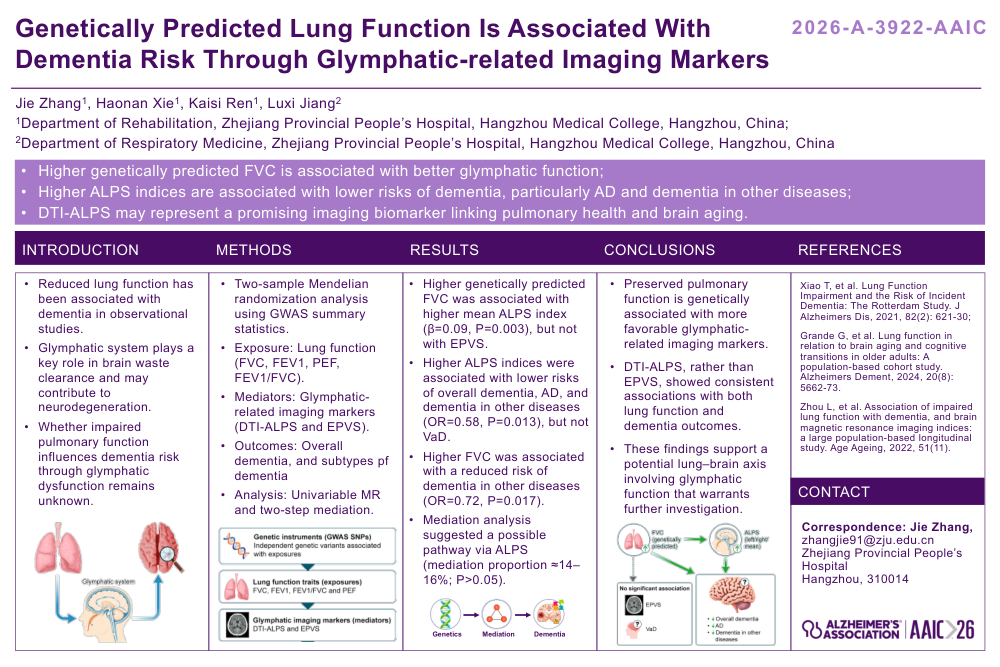
•Higher genetically predicted FVC is associated with better glymphatic function;
•Higher ALPS indices are associated with lower risks of dementia, particularly AD and dementia in other diseases;
•DTI-ALPS may represent a promising imaging biomarker linking pulmonary health and brain aging.
 
 
Introduction:
•Reduced lung function has been associated with dementia in observational studies.
•Glymphatic system plays a key role in brain waste clearance and may contribute to neurodegeneration.
•Whether impaired pulmonary function influences dementia risk through glymphatic dysfunction remains unknown.
 
Methods:
•Two-sample Mendelian randomization analysis using GWAS summary statistics.
•Exposure: Lung function (FVC, FEV1, PEF, FEV1/FVC).
•Mediators: Glymphatic-related imaging markers (DTI-ALPS and EPVS).
•Outcomes: Overall dementia, and subtypes pf dementia
•Analysis: Univariable MR and two-step mediation.
 
Results:
•Higher genetically predicted FVC was associated with higher mean ALPS index (β=0.09, P=0.003), but not with EPVS.
•Higher ALPS indices were associated with lower risks of overall dementia, AD, and dementia in other diseases (OR=0.58, P=0.013), but not VaD.
•Higher FVC was associated with a reduced risk of dementia in other diseases (OR=0.72, P=0.017).
•Mediation analysis suggested a possible pathway via ALPS (mediation proportion ≈14–16%; P>0.05).
 
Conclusions:
•Preserved pulmonary function is genetically associated with more favorable glymphatic-related imaging markers.
•DTI-ALPS, rather than EPVS, showed consistent associations with both lung function and dementia outcomes.
•These findings support a potential lung–brain axis involving glymphatic function that warrants further investigation.
 

References:
•Xiao T, et al. Lung Function Impairment and the Risk of Incident Dementia: The Rotterdam Study. J Alzheimers Dis, 2021, 82(2): 621-30;
•Grande G, et al. Lung function in relation to brain aging and cognitive transitions in older adults: A population-based cohort study. Alzheimers Dement, 2024, 20(8): 5662-73.
•Zhou L, et al. Association of impaired lung function with dementia, and brain magnetic resonance imaging indices: a large population-based longitudinal study. Age Ageing, 2022, 51(11).

Correspondence:Jie Zhang,
zhangjie91@zju.edu.cn
Zhejiang Provincial People’s Hospital
Hangzhou, 310014


Comments

Email is required but is not shown publicly.

Loading comments...

aaic2026 banner
Copyright © 2015-2026, ePostersLive® SciGen is a registered trademark of SciGen Technologies S.A. Patent pending.

This website and third-party tools we use rely on cookies for the best user experience. By selecting "I agree", you agree to cookie usage as described in our Privacy Policy.