4,068 posters, 219 videos, 101 topics, 69 sessions, 14,365 authors, 6,128 institutions
ePostersLive by SciGen Technologies S.A. All rights reserved.
Alzheimer's Association International Conference 2026
July 12-15, 2026 | London, United Kingdom, and Online

1229
From Saliva to Systems Biology: A Multiomics Framework for Early Alzheimer’s Disease Biomarkers
Poster Presenter
Authors
Affiliations
USP - University of Sao Paulo; UNICAMP - University of Campinas
Part of Topic
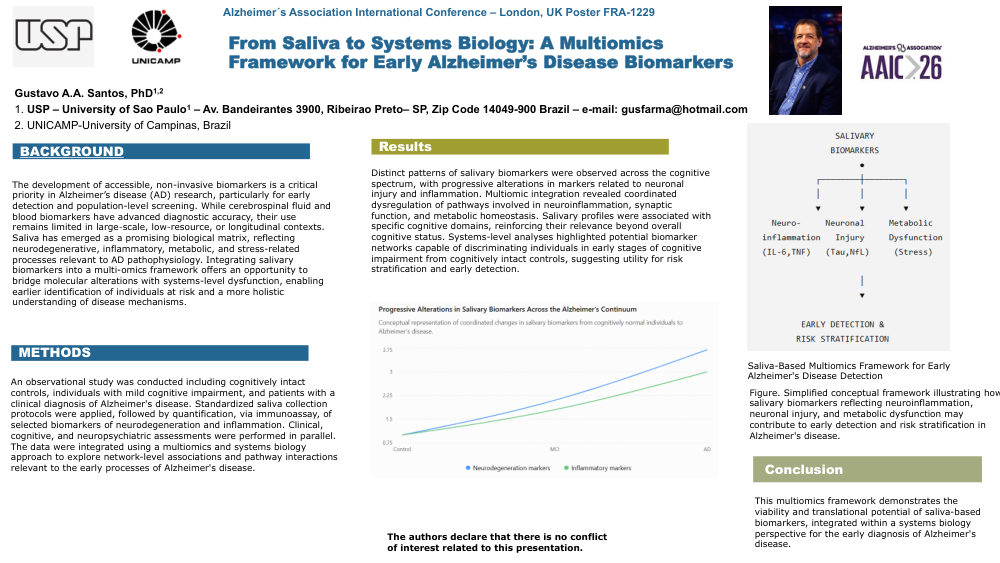
The development of accessible, scalable, and non-invasive biomarkers remains one of the greatest challenges in Alzheimer's disease (AD) research, particularly for early diagnosis and population-based screening strategies. Although cerebrospinal fluid and blood biomarkers have significantly improved diagnostic accuracy, their widespread implementation remains limited in longitudinal studies, large-scale screening programs, and resource-constrained settings. In this context, saliva has emerged as a promising biological matrix, reflecting multiple pathophysiological processes associated with AD, including neurodegeneration, neuroinflammation, metabolic dysfunction, and stress-related responses. The integration of salivary biomarkers within a multiomics and systems biology framework offers a unique opportunity to bridge molecular alterations with systems-level dysfunction, potentially enabling earlier identification of individuals at risk and a more comprehensive understanding of disease mechanisms.
In this observational study, we evaluated cognitively normal controls, individuals with mild cognitive impairment (MCI), and patients with clinically diagnosed Alzheimer's disease. Saliva samples were collected using standardized procedures and analyzed using immunoassay-based techniques to quantify biomarkers associated with neuronal injury and inflammation. Clinical, cognitive, and neuropsychiatric assessments were performed in parallel. Subsequently, a multiomics and systems biology approach was applied to investigate biological interactions and pathway-level alterations relevant to the early stages of Alzheimer's disease.
Our findings revealed distinct salivary biomarker profiles across the Alzheimer's continuum, characterized by progressive alterations in markers associated with neurodegeneration and inflammatory processes. Multiomic integration demonstrated coordinated dysregulation of pathways involved in neuroinflammation, synaptic dysfunction, and metabolic homeostasis. Moreover, salivary biomarker signatures were associated with specific cognitive domains, suggesting their potential utility beyond measures of global cognitive performance. Systems-level analyses further identified biomarker networks capable of distinguishing individuals with early cognitive impairment from cognitively intact controls, supporting their potential application in risk stratification and early disease detection.
Collectively, these findings demonstrate the biological plausibility, feasibility, and translational potential of saliva-based biomarkers integrated within a multiomics and systems biology framework. This approach represents a promising strategy for developing accessible, scalable, and non-invasive tools for the early diagnosis, biological characterization, and precision medicine management of Alzheimer's disease.
Comments
Email is required but is not shown publicly.
Loading comments...