4,068 posters, 219 videos, 101 topics, 69 sessions, 14,365 authors, 6,128 institutions
ePostersLive by SciGen Technologies S.A. All rights reserved.
Alzheimer's Association International Conference 2026
July 12-15, 2026 | London, United Kingdom, and Online

9697
Independent Effects Of Apoe e4 And Amyloid-ί On Inner Retinal Thickness Revealed By Retinal Imaging In Older Adults
Poster Presenter
Authors
Part of Topic
Introduction
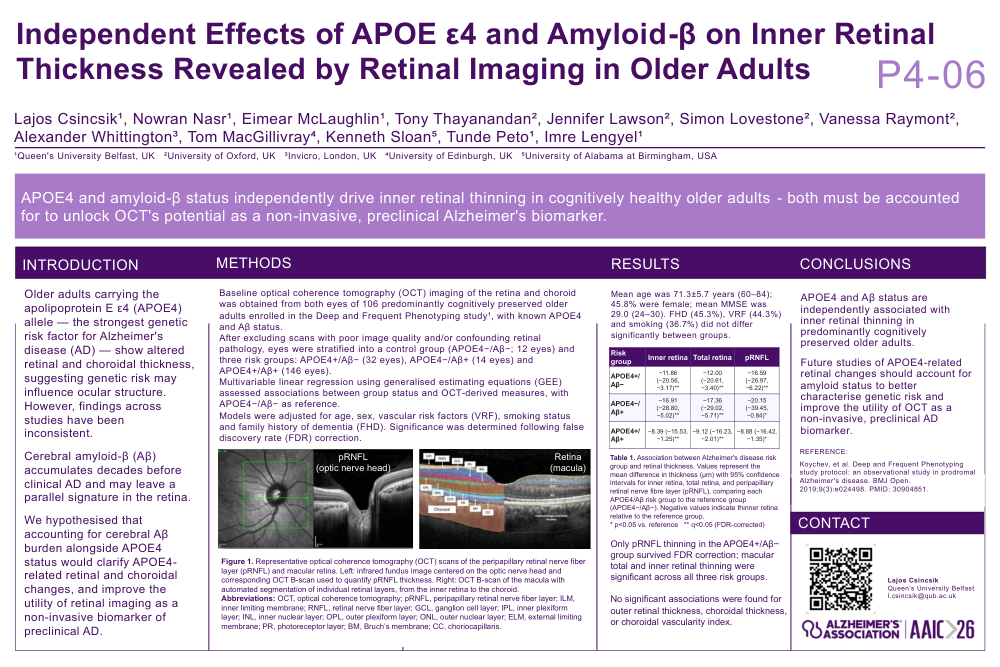
Growing evidence suggests that older adults at increased risk of dementia, defined by apolipoprotein E ε4 (APOE4) carriage, exhibit alterations in retinal and choroidal thickness, indicating a potential influence of genetic risk on ocular structure. However, findings remain inconsistent. Cerebral amyloid-β (Aβ) accumulation occurs decades before clinical Alzheimer’s disease (AD) and may be mirrored in the retina. We hypothesised that accounting for cerebral Aβ burden alongside APOE4 status would clarify APOE4-related retinal and choroidal changes and improve understanding of the utility of retinal imaging as a non-invasive biomarker in preclinical AD.
Methods
Baseline optical coherence tomography (OCT) imaging of the retina and choroid was obtained from both eyes of 106 predominantly cognitively preserved older adults enrolled in the Deep and Frequent Phenotyping study (PMID:30904851) with available APOE4 and Aβ-status. After excluding scans with poor image quality and/or confounding retinal pathology, eyes were stratified into a control group (APOE4−/Aβ−; 12 eyes) and three risk groups: APOE4+/Aβ− (32 eyes), APOE4−/Aβ+ (14 eyes), and APOE4+/Aβ+ (146 eyes). Multivariable linear regression models using generalised estimating equations assessed associations between group status and OCT-derived measures, using the APOE4−/Aβ− group as reference. Models were adjusted for age, sex, vascular risk factors (VRF), smoking status, and family history of dementia (FHD). Significance was determined following false discovery rate correction.
Results
Mean age was 71.3±5.7 years (range 60–84), 45.8% were female, and mean MMSE score was 29.0 (range 24–30). Overall, 45.3% had FHD, 44.3% had VRF, and 36.7% were current or former smokers, with no significant between-group differences. Peripapillary-retinal-nerve-fibre layer thickness was significantly reduced only in the APOE4+/Aβ− group compared with controls (β=−16.59μm; p=0.002). In contrast, macular total and inner retinal thickness showed significant thinning across all risk groups (β range: −8.39 to −17.36μm; p<0.02). No significant associations were observed for outer retinal thickness, choroidal thickness, or choroidal vascularity index.
Conclusion
APOE4 and Aβ-status are independently associated with inner retinal thinning in predominantly cognitively preserved older adults. Future studies of APOE4-related retinal changes should account for amyloid status to better characterise genetic risk and improve the utility of OCT as a non-invasive preclinical AD biomarker.
Learning points:
Demonstrate the independent effects of APOE4 and amyloid‑β status on retinal structure in predominantly cognitively healthy older adults.
Illustrate the importance of accounting for APOE4 and amyloid‑β status in retinal studies to improve understanding of retinal imaging as a non‑invasive early biomarker for Alzheimer’s disease.
Comments
Email is required but is not shown publicly.
Loading comments...