4,068 posters, 219 videos, 101 topics, 69 sessions, 14,365 authors, 6,128 institutions
ePostersLive by SciGen Technologies S.A. All rights reserved.
Alzheimer's Association International Conference 2026
July 12-15, 2026 | London, United Kingdom, and Online

8903
Predicting Future Cognitive Decline With Smartphone-Based Episodic Memory Tasks
Poster Presenter
Authors
Sarah Polk, Lindsay Clark, Robert Perneczky, Katharina Buerger, Christoph Laske, Annika Spottke, Anja Schneider, Jens Wiltfang, Stefan Teipel, Frederic Brosseron, Michael Wagner, Sterling Johnson, Frank Jessen, Emrah Düzel, David Berron
Affiliations
German Center for Neurodegenerative Diseases (DZNE), Magdeburg, DE, Division of Geriatrics, Department of Medicine, University of Wisconsin School of Medicine and Public Health, Madison, Wisconsin, USA; Wisconsin Alzheimer’s Disease Research Center, Madison, Wisconsin, USA; Geriatric Research, Education and Clinical Center, William S. Middleton Memorial Veterans Hospital, Madison, Wisconsin, USA, German Center for Neurodegenerative Diseases (DZNE), Bonn, DE; Department of Psychiatry and Psychotherapy, University Hospital, LMU Munich, Munich, DE; Munich Cluster for Systems Neurology (SyNergy), Munich, DE; Ageing Epidemiology Research Unit (AGE), School of Public Health, Imperial College London, London, GB, German Center for Neurodegenerative Diseases (DZNE), Munich, DE; Institute for Stroke and Dementia Research (ISD), University Hospital, LMU Munich, Munich, DE, German Center for Neurodegenerative Diseases (DZNE), Tübingen, DE; Section for Dementia Research, Hertie Institute for Clinical Brain Research and Department of Psychiatry and Psychotherapy, University of Tübingen, Tübingen, DE, German Center for Neurodegenerative Diseases (DZNE), Bonn, DE; Department of Neurology, University of Bonn, Bonn, DE, German Center for Neurodegenerative Diseases (DZNE), Bonn, DE; Department of Old Age Psychiatry and Cognitive Disorders, University Hospital Bonn and University of Bonn, Bonn, DE, German Center for Neurodegenerative Diseases (DZNE), Goettingen, DE; Department of Psychiatry and Psychotherapy, University Medical Center Goettingen, University of Goettingen, Goettingen, DE; Neurosciences and Signaling Group, Institute of Biomedicine (iBiMED), Department of Medical Sciences, University of Aveiro, Aveiro, PT, German Center for Neurodegenerative Diseases (DZNE), Rostock, DE; Department of Psychosomatic Medicine, Rostock University Medical Center, Rostock, DE, German Center for Neurodegenerative Diseases (DZNE), Bonn, DE, Division of Geriatrics, Department of Medicine, University of Wisconsin School of Medicine and Public Health, Madison, Wisconsin, US, German Center for Neurodegenerative Diseases (DZNE), Bonn, DE; Department of Psychiatry, University of Cologne, Medical Faculty, Cologne, DE; Excellence Cluster on Cellular Stress Responses in Aging-Associated Diseases (CECAD), University of Cologne, Cologne, DE, German Center for Neurodegenerative Diseases (DZNE), Magdeburg, DE; Institute of Cognitive Neurology and Dementia Research (IKND), Otto-von-Guericke University, Magdeburg, DE, German Center for Neurodegenerative Diseases (DZNE), Magdeburg, DE; Center for Behavioral Brain Sciences, Otto-von-Guericke University Magdeburg, Magdeburg, DE; Clinical Memory Research Unit, Department of Clinical Sciences, Lund University, Lund, SE
Part of Topic
Predicting Future Cognitive Decline with Smartphone-Based Episodic Memory Tasks
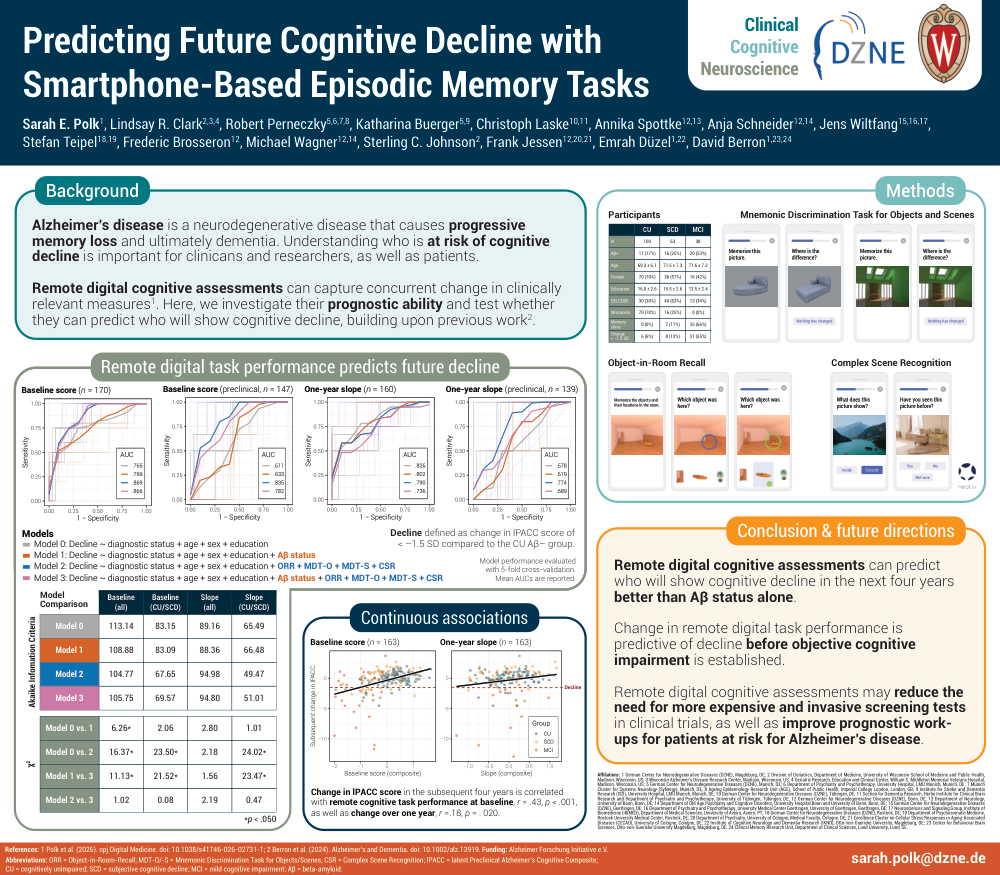
Alzheimer’s disease is a neurodegenerative disease that causes progressive memory loss and ultimately dementia. Understanding who is at risk of cognitive decline is important for clinicans and researchers, as well as patients. Remote digital cognitive assessments can capture concurrent change in clinically relevant measures. Here, we investigate their prognostic ability and test whether they can predict who will show cognitive decline, building upon previous work.
Remote digital cognitive assessments can predict who will show cognitive decline in the next four years better than Aβ status alone. Change in remote digital task performance is predictive of decline before objective cognitive impairment is established. Remote digital cognitive assessments may reduce the need for more expensive and invasive screening tests in clinical trials, as well as improve prognostic work- ups for patients at risk for Alzheimer’s disease.
Comments
Email is required but is not shown publicly.
Loading comments...