4,068 posters, 219 videos, 101 topics, 69 sessions, 14,365 authors, 6,128 institutions
ePostersLive by SciGen Technologies S.A. All rights reserved.
Alzheimer's Association International Conference 2026
July 12-15, 2026 | London, United Kingdom, and Online

2587
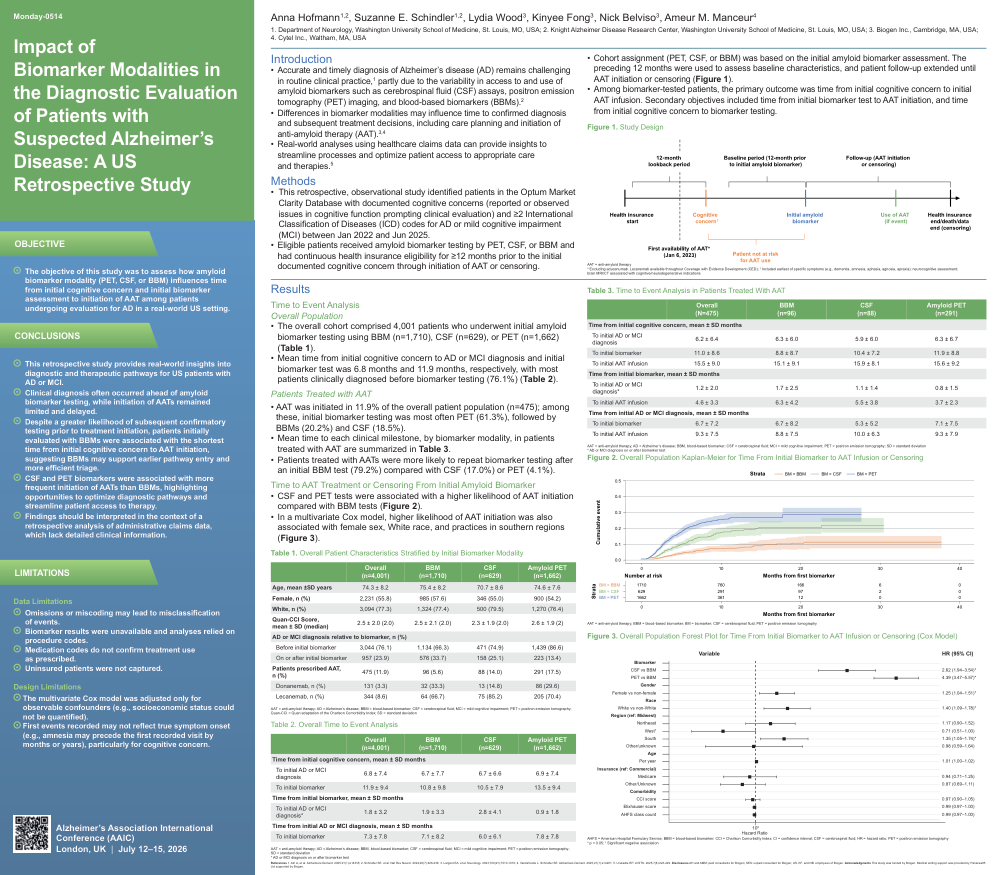
Impact Of Biomarker Modalities In The Diagnostic Evaluation Of Patients With Suspected Alzheimer’s Disease: A US Retrospective Study
Poster Presenter
Authors
Anna Hofmann, Suzanne E. Schindler, Lydia Wood, Kinyee Fong, Nick Belviso, Ameur M. Manceur
Affiliations
Department of Neurology, Washington University School of Medicine, St. Louis, MO, USA, Knight Alzheimer Disease Research Center, Washington University School of Medicine, St. Louis, MO, USA, Biogen Inc., Cambridge, MA, USA, Cytel Inc., Waltham, MA, USA
Part of Topic
This retrospective real-world study evaluated the impact of amyloid biomarker modality on diagnostic and treatment pathways among US patients with suspected Alzheimer’s disease (AD) or mild cognitive impairment (MCI) undergoing assessment for amyloid pathology. Using the Optum Market Clarity Database, patients with documented cognitive concern, at least two ICD-coded diagnoses of AD or MCI, and subsequent amyloid biomarker testing between January 2022 and June 2025 were identified. Patients were categorized according to their initial biomarker modality: blood-based biomarkers (BBMs), cerebrospinal fluid (CSF) biomarkers, or amyloid positron emission tomography (PET) imaging.
The study assessed time from initial cognitive concern to anti-amyloid therapy (AAT) initiation, time from initial biomarker testing to treatment initiation, and time from cognitive concern to biomarker testing. Among 4,001 patients, most received BBM or amyloid PET testing, and clinical diagnosis frequently preceded biomarker assessment. Only a minority of patients initiated AAT, highlighting ongoing challenges in treatment access and care pathways.
Patients initially evaluated with BBMs demonstrated the shortest time from initial cognitive concern to AAT initiation, suggesting that blood-based biomarker testing may facilitate earlier entry into the Alzheimer’s disease diagnostic pathway and improve patient triage. However, patients undergoing CSF or amyloid PET testing were more likely to ultimately receive anti-amyloid therapy. These findings provide important real-world evidence on the role of amyloid biomarkers, Alzheimer’s disease diagnosis, early detection, disease-modifying therapy, and treatment access, and may help inform optimization of diagnostic pathways for patients with suspected Alzheimer’s disease.
Keywords: Alzheimer’s disease, AD, mild cognitive impairment, MCI, cognitive impairment, cognitive concern, amyloid biomarkers, blood-based biomarkers, BBM, plasma biomarkers, cerebrospinal fluid, CSF biomarkers, amyloid PET, positron emission tomography, biomarker testing, diagnostic pathway, diagnostic evaluation, early diagnosis, real-world evidence, claims database, retrospective study, anti-amyloid therapy, AAT, disease-modifying therapy, treatment initiation, patient access, care pathways, amyloid pathology, dementia.
Comments
Email is required but is not shown publicly.
Loading comments...