4,068 posters, 219 videos, 101 topics, 69 sessions, 14,365 authors, 6,128 institutions
ePostersLive by SciGen Technologies S.A. All rights reserved.
Alzheimer's Association International Conference 2026
July 12-15, 2026 | London, United Kingdom, and Online

10792
Combining ADRD Risk Factors Of Brain, Lifestyle, And Genetics Into A Multimodal Signature For Menopause Classification
Poster Presenter
Authors
Elizabeth Haddad, Ravi R Bhatt, Claudia Barth, Talia M Nir, Neda Jahanshad
Affiliations
Imaging Genetics Center, Mark and Mary Stevens Neuroimaging and Informatics Institute, Keck School of Medicine, University of Southern California, Los Angeles, CA, USA, Department of Psychiatry and Neuroscience (CCM) & Institute of Gender in Medicine, Charité - Universitätsmedizin Berlin, Berlin, Germany
Part of Topic
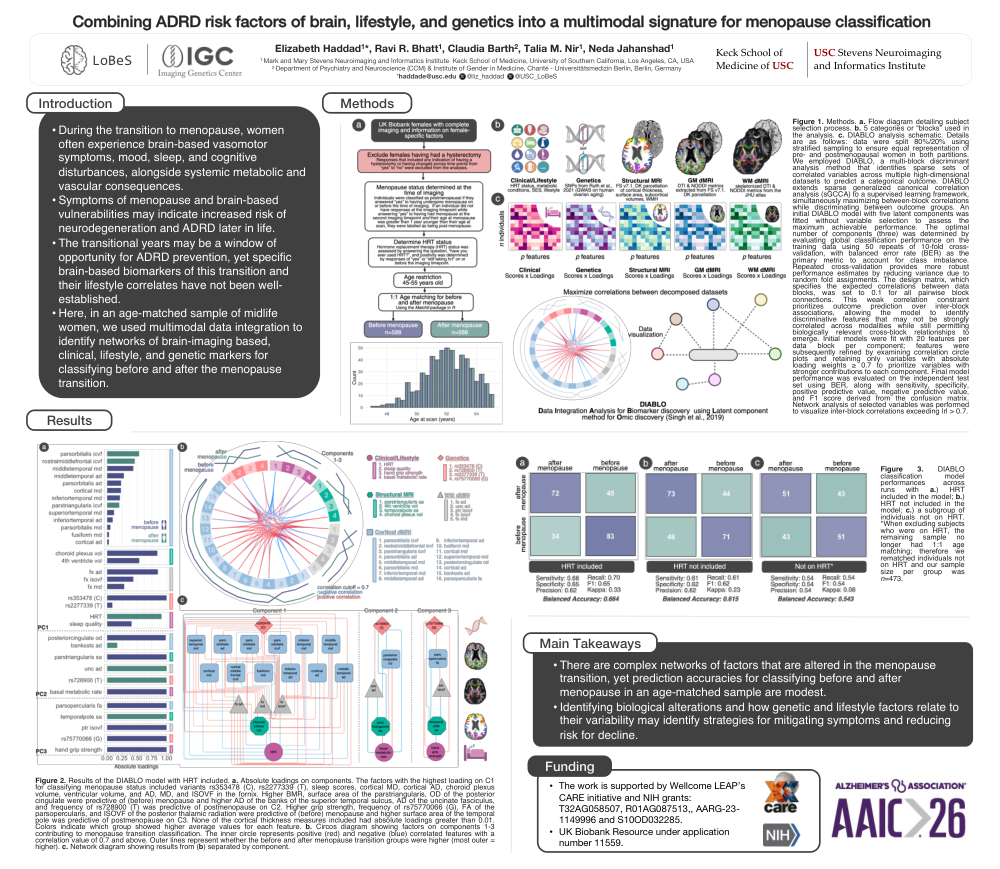
Background: During the transition to menopause, women often experience brain-based vasomotor symptoms, mood, sleep, and cognitive disturbances, alongside systemic metabolic and vascular consequences. Symptoms of menopause and brain-based vulnerabilities may indicate increased risk of neurodegeneration and ADRD later in life. The transitional years may be a window of opportunity for ADRD prevention, yet specific brain-based biomarkers of this transition and their lifestyle correlates have not been well-established. Here, in an age-matched sample of midlife women, we used multimodal data integration to identify networks of brain-imaging based, clinical, lifestyle, and genetic markers for classifying before and after the menopause transition.
Methods: We analyzed multimodal MRI data from a subset of women aged 45-55 from the UK Biobank. Individuals were classified as postmenopausal if they answered “yes” to having undergone menopause on or before the time of imaging. Age was restricted and matched between groups to focus on the menopausal transition period and reduce age-related confounding. Using data from 588 women before and 588 women after the menopause transition, a data integration analysis for biomarker discovery using latent components (Singh, 2019) was conducted using five blocks containing variables from 1.) clinical and lifestyle measures 2.) genetic variants associated with ovarian aging (Ruth, 2021) 3.) structural MRI 4.) white matter, and 5.) grey matter microstructure metrics.
Results: Three components were best at classifying menopause. Factors with the highest loading on C1 included a variant on the UIMC1 gene, sleep scores, volumes of choroid plexus and 4th ventricles, and diffusivity in the fornix and cortex. BMR and grip strength had the highest loadings in C2 and C3, respectively (Figure 2, colors indicate the group with higher values). Models excluding and restricting analyses to those not on HRT had lower balanced accuracies compared to the model with HRT included (Figure 3).
Conclusions: There are complex networks of factors that are altered in the menopause transition, yet prediction accuracies for classifying before and after menopause in an age-matched sample are modest. Identifying biological alterations and how genetic and lifestyle factors relate to their variability may identify strategies for mitigating symptoms and reducing risk for decline.
Comments
Email is required but is not shown publicly.
Loading comments...