4,068 posters, 219 videos, 101 topics, 69 sessions, 14,365 authors, 6,128 institutions
ePostersLive by SciGen Technologies S.A. All rights reserved.
Alzheimer's Association International Conference 2026
July 12-15, 2026 | London, United Kingdom, and Online

6566
The Multi-Dementia Panel Provides Biological Insights And Robust Diagnostic And Prognostic Value In Alzheimer’s Disease
Poster Presenter
Authors
Part of Topic
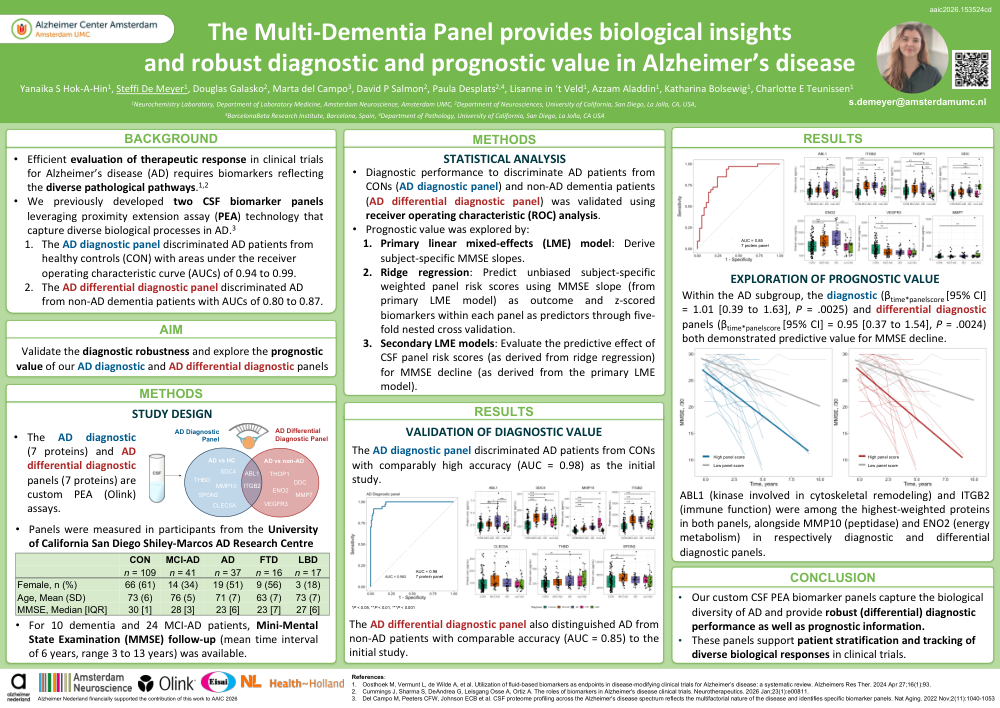
Background: Efficient evaluation of therapeutic response in clinical trials for Alzheimer’s disease (AD) requires biomarkers reflecting the diverse pathological pathways. We previously developed two CSF biomarker panels leveraging proximity extension assay (PEA) technology that capture diverse biological processes in AD.
1.The AD diagnostic panel discriminated AD patients from healthy controls (CON) with areas under the receiver operating characteristic curve (AUCs) of 0.94 to 0.99.
2.The AD differential diagnostic panel discriminated AD from non-AD dementia patients with AUCs of 0.80 to 0.87.
Aim: Validate the diagnostic robustness and explore the prognostic value of our AD diagnostic and differential diagnostic panels
Methods: The AD diagnostic (7 proteins) and AD differential diagnostic panels (7 proteins) are custom PEA (Olink) assays. Panels were measured in participants from the University of California San Diego Shiley-Marcos AD Research Centre. For 10 dementia and 24 MCI-AD patients, Mini-Mental State Examination (MMSE) follow-up (mean time interval of 6 years, range 3 to 13 years) was available. Diagnostic performance to discriminate AD patients from CONs (diagnostic panel) and non-AD dementia patients (differential diagnostic panel) was validated using receiver operating characteristic (ROC) analysis. Prognostic value was explored by:
1.Primary linear mixed-effects (LME) model: Derive subject-specific MMSE slopes.
2.Ridge regression: Predict unbiased subject-specific weighted panel risk scores using MMSE slope (from primary LME model) as outcome and z-scored biomarkers within each panel as predictors through five-fold nested cross validation.
3.Secondary LME models: Evaluate the predictive effect of CSF panel risk scores (as derived from ridge regression) for MMSE decline (as derived from the primary LME model).
Results: The AD diagnostic panel discriminated AD patients from CONs with comparably high accuracy (AUC = 0.98) as the initial study. The AD differential diagnostic panel also distinguished AD from non-AD patients with comparable accuracy (AUC = 0.85) to the initial study. Within the AD subgroup, the diagnostic (βtime*panelscore [95% CI] = 1.01 [0.39 to 1.63], P = .0025) and differential diagnostic panels (βtime*panelscore [95% CI] = 0.95 [0.37 to 1.54], P = .0024) both demonstrated predictive value for MMSE decline. ABL1 (kinase involved in cytoskeletal remodeling) and ITGB2 (immune function) were among the highest-weighted proteins in both panels, alongside MMP10 (peptidase) and ENO2 (energy metabolism) in respectively the diagnostic and differential diagnostic panel.
Conclusion: Our custom CSF PEA biomarker panels capture the biological diversity of AD and provide robust (differential) diagnostic performance as well as prognostic information. These panels support patient stratification and tracking of diverse biological responses in clinical trials.
Comments
Email is required but is not shown publicly.
Loading comments...