4,068 posters, 219 videos, 101 topics, 69 sessions, 14,365 authors, 6,128 institutions
ePostersLive by SciGen Technologies S.A. All rights reserved.
Alzheimer's Association International Conference 2026
July 12-15, 2026 | London, United Kingdom, and Online

1585
Serum Immune-related Molecules In Relation To Hippocampal Atrophy: The Northern Manhattan Study
Poster Presenter
Authors
Mohammad Nafeli Shahrestani, MD, Hannah Gardener, ScD, Christian Agudelo, MD, Mitchell S Elkind, MD, MS, Jose Gutierrez MD, MPH, Mady Hornig, MD, Sarah Tom PhD, MPH, Tatjana Rundek. MD, PhD
Affiliations
Evelyn F. McKnight Brain Institute, Department of Neurology, University of Miami Miller School of Medicine, Miami, Florida, USA, Feinstein Institutes for Medical Research, Manhasset, NY, USA, Department of Neurology, Vagelos College of Physicians and Surgeons, Columbia University, New York, NY, USA, Department of Epidemiology, Mailman School of Public Health, Columbia University, New York, NY, USA
Part of Topic
Plasma Immune Markers Associated with Hippocampal Volume in The Northern Manhattan Study
BACKGROUND & METHODS
• Hippocampal atrophy is an early biomarker of Alzheimer's disease and accelerated brain aging.
• Peripheral inflammatory molecules may inform structural brain health.
• Prior immune marker studies have been limited by small marker panels and ethnically homogeneous or clinical samples.
Objective: To identify plasma immune markers associated with age-related total hippocampal volume on MRI through large-scale immune profiling in a multiethnic, urban-dwelling Northern Manhattan Study (NOMAS) cohort.
Methods:
Population: MRI NOMAS subcohort; stroke-free, dementia-free; aged ≥50
Outcomes:
1. HV: log-transformed ratio of total hippocampal volumes (L and R) to total cranial volume (TCV) on T2-MRI;
2. Age-standardized HV: HV residualized for age (z-score)
Exposure: Concentrations of 60 plasma immune-related molecules via multiplex immunoassay (Luminex).
Statistics: Data reduction (LASSO regression) selected candidate markers. Selected markers were modeled in quartiles using multivariable linear regression.
Adjustment: Global vascular risk score which incorporates demographic, clinical, and lifestyle factors and APOE ε4
RESULTS
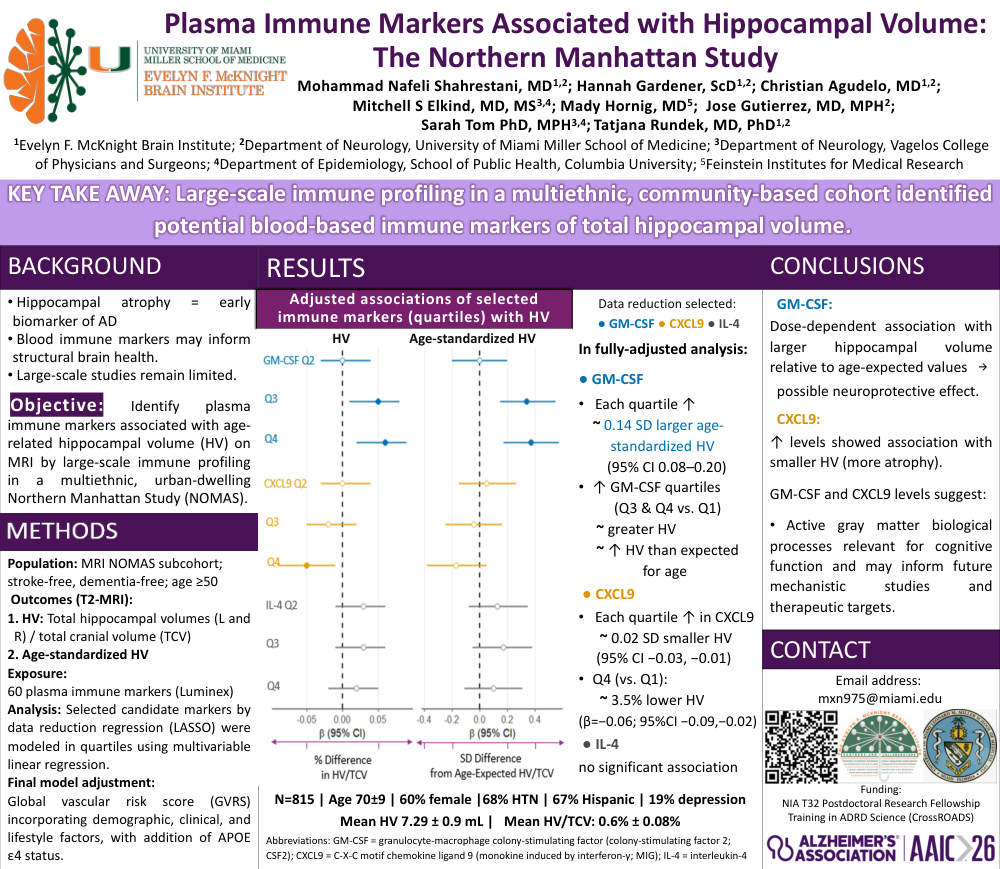
N=815 | Age 70±9 | 60% female | 67% Hispanic | 68% HTN | 30% smoker | 19% depression
Mean HV 7.29 ± 0.9 mL; Mean HV/TCV: 0.6% ± 0.08%
Data reduction selected:
● GM-CSF ● CXCL9 ● IL-4
In fully-adjusted analysis:
1. Granulocyte-macrophage colony stimulating factor (GM-CSF; CSF2)
• Each quartile increase in GM-CSF ~ 0.14 SD larger age-standardized HV (95% CI 0.08–0.20)
• Greater GM-CSF quartiles (Q3 & Q4 vs. Q1) ~ greater HV, and ↑ HV than expected for age (plot).
2. C-X-C motif chemokine ligand 9 (CXCL9; MIG)
• Each quartile increase in CXCL9 ~ 0.02 SD smaller HV (95% CI −0.03, −0.01)
• CXCL9 Q4 (vs. Q1) ~ −3.5% lower HV (β = −0.06; 95% CI −0.09, −0.02)
3. Interleukin-4 (IL-4)
IL-4 showed no significant association with HV across quartiles.
CONCLUSIONS:
• GM-CSF showed a dose-dependent association with larger hippocampal volume relative to age-expected values, suggesting a possible neuroprotective effect.
• Higher CXCL9 levels showed a graded association with smaller HV (more atrophy). The association with age-standardized HV was directionally consistent but did not reach statistical significance.
• Immune-related markers may inform subclinical gray matter biological processes relevant for future mechanistic studies and therapeutic interventions.
Comments
Email is required but is not shown publicly.
Loading comments...