4,068 posters, 219 videos, 101 topics, 69 sessions, 14,365 authors, 6,128 institutions
ePostersLive by SciGen Technologies S.A. All rights reserved.
Alzheimer's Association International Conference 2026
July 12-15, 2026 | London, United Kingdom, and Online

1235
Systemic Inflammation And Blood-based Biomarkers Of Alzheimer's Disease
Poster Presenter
Authors
Grace Austin, Shaun Eslick, Jessica Ferguson, Christopher Oldmeadow, Manohar Garg, Ralph Martins
Affiliations
Part of Topic
Systemic inflammation and blood-based biomarkers of Alzheimer's Disease
Grace Austin¹, Shaun Eslick¹, Jessica J.A. Ferguson², Christopher Oldmeadow³, Manohar L. Garg¹, Ralph Martins¹
¹ Macquarie Medical School, Macquarie University, Macquarie Park, NSW, Australia
² School of Biomedical Sciences & Pharmacy, University of Newcastle, Callaghan, NSW, Australia
³ Clinical Research Design, Information Technology and Statistical Support Unit, HMRI, New Lambton, NSW, Australia
INTRODUCTION
- Systemic inflammation is increasingly implicated in Alzheimer's disease (AD) pathogenesis.¹
- Chronic low-grade inflammation may contribute to neuroinflammation, neuronal injury and early AD pathology.²
- The relationship between inflammation markers and blood-based AD biomarkers remains less established, particularly in midlife adults.
AIM
This study examined associations between systemic inflammation markers and blood-based AD biomarkers in dementia-free adults.
METHODS
- 237-person cross-sectional cohort study.
- Stored plasma (−80°C) samples were analysed for hs-CRP, IL-6 and TNF-α using enzyme-linked immunosorbent assays (ELISA).
- Plasma AD biomarkers Aβ1–40, Aβ1–42, GFAP, NfL and pTau181 were measured using the ultra-sensitive Single Molecule Array (SIMOA) platform.
- Multivariable regression analyses were used to adjust for age and sex.
RESULTS
Participant characteristics
- Mean age: 54 ± 10.2 years
- Female: 78%
- Mean BMI: 24.4 kg/m²
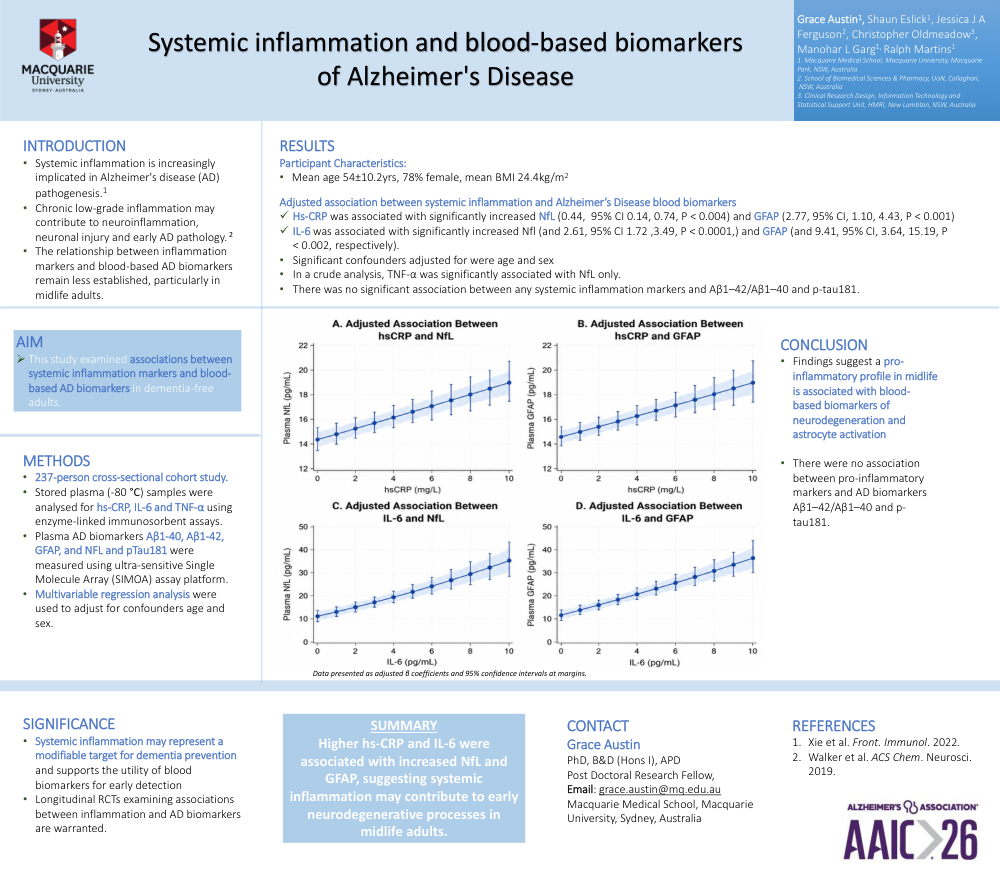
Adjusted associations between systemic inflammation and Alzheimer's disease blood biomarkers
- hs-CRP was significantly associated with increased:
- NfL: β = 0.44 (95% CI 0.14–0.74), P = 0.004
- GFAP: β = 2.77 (95% CI 1.10–4.43), P < 0.001
- IL-6 was significantly associated with increased:
- NfL: β = 2.61 (95% CI 1.72–3.49), P < 0.0001
- GFAP: β = 9.41 (95% CI 3.64–15.19), P = 0.002
- Significant confounders adjusted for were age and sex.
- In crude analyses, TNF-α was significantly associated with NfL only.
- No significant associations were observed between systemic inflammation markers and Aβ1–42/Aβ1–40 or pTau181.
Data presented as adjusted β coefficients and 95% confidence intervals at margins.
CONCLUSION
- Findings suggest a pro-inflammatory profile in midlife is associated with blood-based biomarkers of neurodegeneration and astrocyte activation.
- No associations were observed between pro-inflammatory markers and AD biomarkers Aβ1–42/Aβ1–40 or pTau181.
SIGNIFICANCE
- Systemic inflammation may represent a modifiable target for dementia prevention and supports the utility of blood biomarkers for early detection.
- Longitudinal randomised controlled trials examining associations between inflammation and AD biomarkers are warranted.
SUMMARY
Higher hs-CRP and IL-6 were associated with increased NfL and GFAP, suggesting systemic inflammation may contribute to early neurodegenerative processes in midlife adults.
CONTACT
Grace Austin
PhD, B&D (Hons I), APD
Postdoctoral Research Fellow
Macquarie Medical School
Macquarie University, Sydney, Australia
Email: grace.austin@mq.edu.au
Comments
Email is required but is not shown publicly.
Loading comments...