4,068 posters, 219 videos, 101 topics, 69 sessions, 14,365 authors, 6,128 institutions
ePostersLive by SciGen Technologies S.A. All rights reserved.
Alzheimer's Association International Conference 2026
July 12-15, 2026 | London, United Kingdom, and Online

2963
Sleep Duration And Mental Well-being Are Associated With Delayed Memory In A 12-week Digital And Remote Community-sample Study
Poster Presenter
Authors
Part of Topic
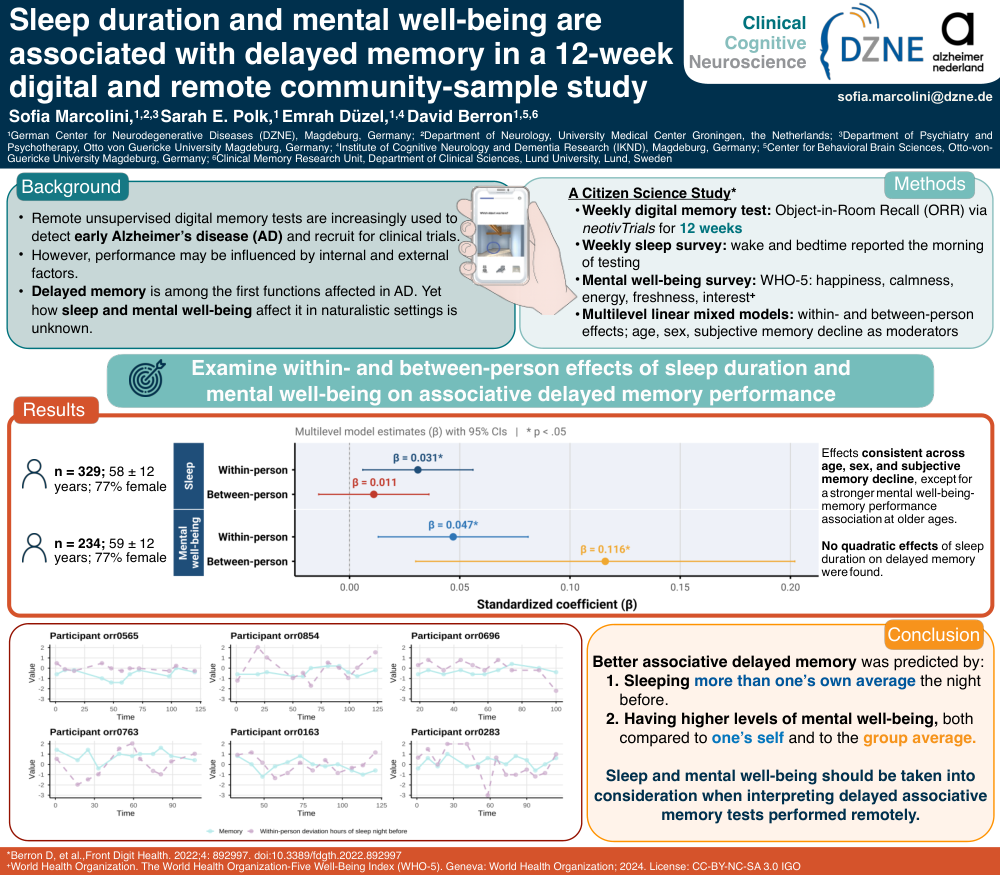
Background: Unsupervised digital memory assessments are increasingly used in the field of Alzheimer’s disease to detect cognitive changes, recruit for clinical trials, and monitor cognitive changes longitudinally. However, the impact of factors such as sleep and mental well-being on delayed memory task performance remains unclear.
Methods: Adults aged 18 and older from a community sample across Germany (19-85 years) completed weekly a delayed memory task (Object-in-Room Recall, ORR) via the neotivTrials platform over 12 weeks. Alongside, they completed brief surveys on wake and bedtime, and on mental well-being (total score created from happiness, calmness, energy, freshness, and interest items). Multilevel linear mixed models examined within- and between-person effects of sleep duration the night before testing (n = 329) and mental well-being over the preceding eight days (n = 234) on delayed memory performance. A quadratic term for sleep was also included to test a hypothesized U-shape relationship, and interactions with centered age, gender, and subjective memory decline were analyzed.
Results: Sleeping more than one’s usual average the night before testing was associated with better delayed memory (β = 0.03, p = 0.02), while no between-person sleep effects emerged. Better mental well-being, both relative to one’s own average (β = 0.05, p = 0.01) and the sample average (β = 0.12, p = 0.01), was also linked to better delayed memory performance. These effects were consistent across age, gender, and subjective memory decline, except for a stronger well-being-performance association at older ages. No quadratic effects of within- or between-person sleep duration on delayed memory were found.
Conclusions: These findings suggest that participants’ sleep duration the night before testing and mental well-being should be considered when interpreting remote digital memory assessments. Additionally, by enabling frequent assessments, remote testing designs allow the examination of within-person associations between predictors and cognitive performance, unlike cross-sectional assessments, which rely on potentially noisy one-time estimates.
Comments
Email is required but is not shown publicly.
Loading comments...