4,068 posters, 219 videos, 101 topics, 69 sessions, 14,365 authors, 6,128 institutions
ePostersLive by SciGen Technologies S.A. All rights reserved.
Alzheimer's Association International Conference 2026
July 12-15, 2026 | London, United Kingdom, and Online

6483
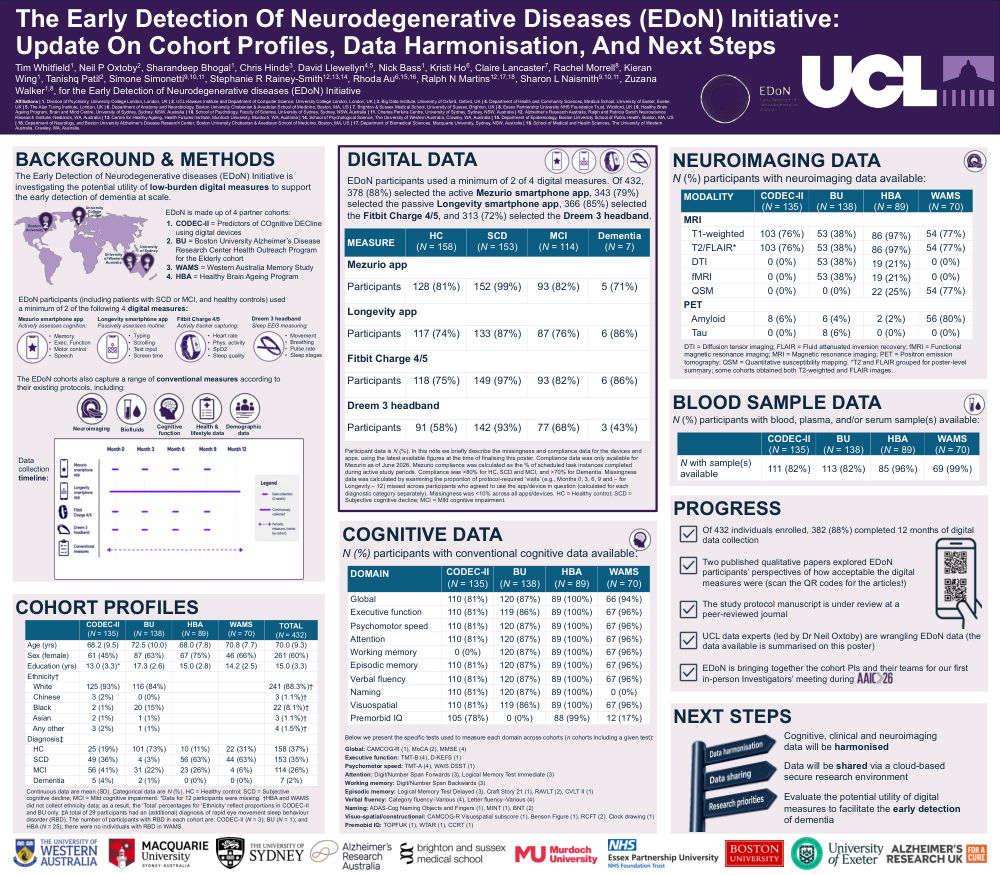
The Early Detection Of Neurodegenerative Diseases (EDoN) Initiative: Update On Cohort Profiles, Data Harmonisation, And Next Steps
Poster Presenter
Authors
Tim Whitfield, Neil P Oxtoby, Sharandeep Bhogal, Chris Hinds, David Llewellyn, Nick Bass, Kristi Ho, Claire Lancaster, Rachel Morrell, Kieran Wing, Tanishq Patil, Simone Simonetti, Stephanie R Rainey-Smith, Rhoda Au, Ralph N Martins, Sharon L Naismith, Zuzana Walker, Early Detection of Neurodegenerative diseases (EDoN) Initiative
Affiliations
Part of Topic
Background: Conventional diagnostic tests for dementia are invasive, expensive, and/or not
scalable, hampering early detection. Whilst blood-based biomarkers are beginning to enter
clinical practice, their utility for determining which individuals will develop clinically
expressed disease is limited. The Early Detection of Neurodegenerative diseases (EDoN)
Initiative is investigating the potential utility of digital measures to support the early
detection of dementia at scale.
Methods: EDoN formed partnerships with four international cohorts: Predictors of COgnitive
DECline using digital devices (CODEC-II; UK); Boston University Alzheimer’s Disease Research
Center Health Outreach Program for the Elderly (BU ADRC-HOPE; USA); Western Australia
Memory Study (WAMS; Australia); and Healthy Brain Aging Program cohort (HBA; Australia).
Cohorts collected standard clinical, biofluid, and neuroimaging data alongside EDoN digital
measures from healthy controls, and participants with subjective cognitive decline (SCD) or
mild cognitive impairment (MCI). Participants used two or more of the EDoN wearables/apps
for 12 months: electroencephalographic sleep headband, wrist-worn activity tracker,
cognitive testing smartphone app, and passive smartphone monitoring app.
Results: The four cohorts enrolled a total of 432 individuals (n=261 female; 60%), of whom
202 (47%) were healthy controls, 109 (25%) had SCD, and 114 (26%) had MCI. Participants’
mean (SD) age was 70.0 (9.3) years, with 15.0 (3.3) years of education. Sixteen participants
withdrew; the remaining 416 (96%) completed data collection. The numbers of participants
using the wearables/apps were: sleep headband (n=313; 72%); wrist-worn activity tracker
(n=366; 85%); cognitive testing app (n=342; 79%); and passive app (n=374; 87%). Qualitative
interviews explored the acceptability of wearables/apps and identified future priorities.
Details of investigations (e.g., neuroimaging, blood-based biomarkers) included in the
dataset will be presented at the conference.
Conclusion: Ongoing data harmonisation and feature extraction will maximise the
interoperability of data across cohorts. Data will be made available to the research
community via a cloud-based trusted research environment. Raw data will be (minimally)
processed to extract useful signals and ensure ease of use for researchers to conduct further
analyses. Digital measures have the potential to detect dementia symptoms early and show
promise as a frontline screening tool to support remote identification of candidates for
further pathology-specific biomarker testing.
Comments
Email is required but is not shown publicly.
Loading comments...