4,068 posters, 219 videos, 101 topics, 69 sessions, 14,365 authors, 6,128 institutions
ePostersLive by SciGen Technologies S.A. All rights reserved.
Alzheimer's Association International Conference 2026
July 12-15, 2026 | London, United Kingdom, and Online

3305
Using Digital Twins To Improve Statistical Efficiency In Alzheimer’S Disease Trials With P-tau217
Poster Presenter
Authors
Affiliations
null,
Part of Topic
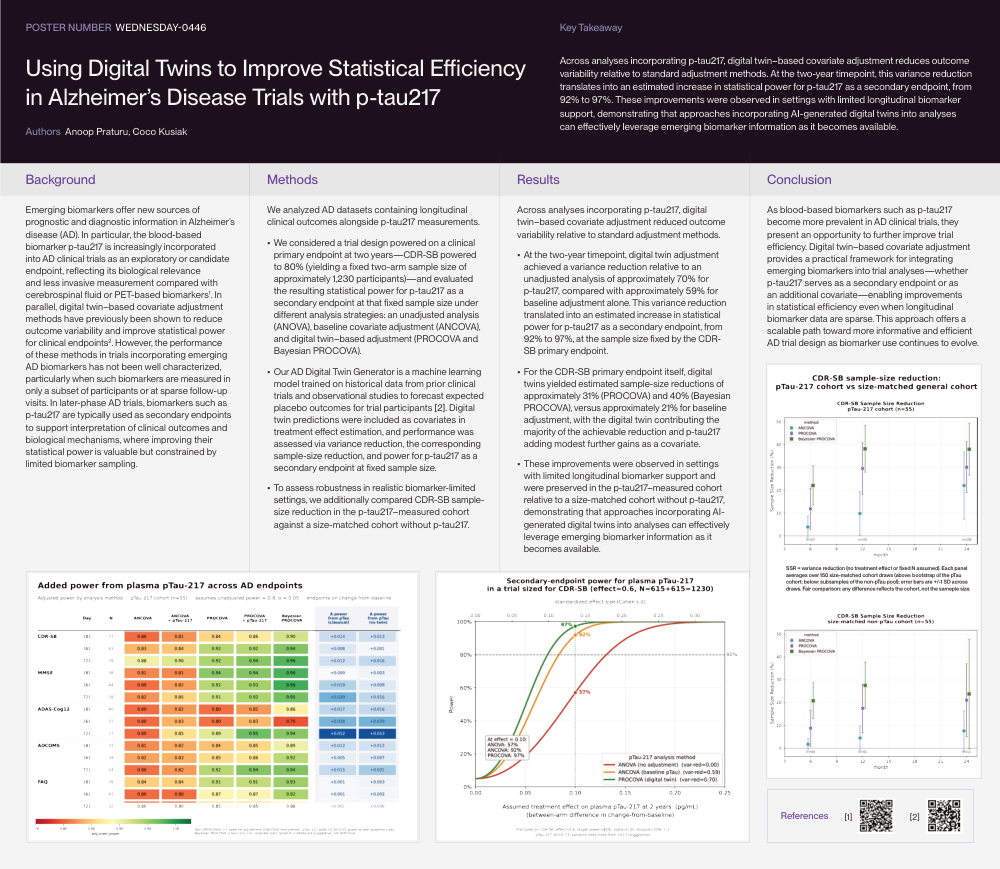
Across analyses incorporating p-tau217, digital twin–based covariate adjustment reduces outcome
variability relative to standard adjustment methods. At the two-year timepoint, this variance reduction
translates into an estimated increase in statistical power for p-tau217 as a secondary endpoint, from
92% to 97%. These improvements were observed in settings with limited longitudinal biomarker
support, demonstrating that approaches incorporating AI-generated digital twins into analyses
can effectively leverage emerging biomarker information as it becomes available.
Emerging biomarkers offer new sources of
prognostic and diagnostic information in Alzheimer’s
disease (AD). In particular, the blood-based
biomarker p-tau217 is increasingly incorporated
into AD clinical trials as an exploratory or candidate
endpoint, reflecting its biological relevance
and less invasive measurement compared with
cerebrospinal fluid or PET-based biomarkers1. In
parallel, digital twin–based covariate adjustment
methods have previously been shown to reduce
outcome variability and improve statistical power
for clinical endpoints2. However, the performance
of these methods in trials incorporating emerging
AD biomarkers has not been well characterized,
particularly when such biomarkers are measured in
only a subset of participants or at sparse follow-up
visits. In later-phase AD trials, biomarkers such as
p-tau217 are typically used as secondary endpoints
to support interpretation of clinical outcomes and
biological mechanisms, where improving their
statistical power is valuable but constrained by
limited biomarker sampling.
We analyzed AD datasets containing longitudinal
clinical outcomes alongside p-tau217 measurements.
•
•
•
We considered a trial design powered on a clinical
primary endpoint at two years—CDR-SB powered
to 80% (yielding a fixed two-arm sample size of
approximately 1,230 participants)—and evaluated
the resulting statistical power for p-tau217 as a
secondary endpoint at that fixed sample size under
different analysis strategies: an unadjusted analysis
(ANOVA), baseline covariate adjustment (ANCOVA),
and digital twin–based adjustment (PROCOVA and
Bayesian PROCOVA).
Our AD Digital Twin Generator is a machine learning
model trained on historical data from prior clinical
trials and observational studies to forecast expected
placebo outcomes for trial participants [2]. Digital
twin predictions were included as covariates in
treatment effect estimation, and performance was
assessed via variance reduction, the corresponding
sample-size reduction, and power for p-tau217 as a
secondary endpoint at fixed sample size.
To assess robustness in realistic biomarker-limited
settings, we additionally compared CDR-SB sample-
size reduction in the p-tau217–measured cohort
against a size-matched cohort without p-tau217.
Across analyses incorporating p-tau217, digital
twin–based covariate adjustment reduced outcome
variability relative to standard adjustment methods.
•
•
•
At the two-year timepoint, digital twin adjustment
achieved a variance reduction relative to an
unadjusted analysis of approximately 70% for
p-tau217, compared with approximately 59% for
baseline adjustment alone. This variance reduction
translated into an estimated increase in statistical
power for p-tau217 as a secondary endpoint, from
92% to 97%, at the sample size fixed by the CDR-
SB primary endpoint.
For the CDR-SB primary endpoint itself, digital
twins yielded estimated sample-size reductions of
approximately 31% (PROCOVA) and 40% (Bayesian
PROCOVA), versus approximately 21% for baseline
adjustment, with the digital twin contributing the
majority of the achievable reduction and p-tau217
adding modest further gains as a covariate.
These improvements were observed in settings
with limited longitudinal biomarker support and
were preserved in the p-tau217–measured cohort
relative to a size-matched cohort without p-tau217,
demonstrating that approaches incorporating AI-
generated digital twins into analyses can effectively
leverage emerging biomarker information as it
becomes available.
As blood-based biomarkers such as p-tau217
become more prevalent in AD clinical trials, they
present an opportunity to further improve trial
efficiency. Digital twin–based covariate adjustment
provides a practical framework for integrating
emerging biomarkers into trial analyses—whether
p-tau217 serves as a secondary endpoint or as
an additional covariate—enabling improvements
in statistical efficiency even when longitudinal
biomarker data are sparse. This approach offers a
scalable path toward more informative and efficient
AD trial design as biomarker use continues to evolve.
Comments
Email is required but is not shown publicly.
Loading comments...