4,068 posters, 219 videos, 101 topics, 69 sessions, 14,365 authors, 6,128 institutions
ePostersLive by SciGen Technologies S.A. All rights reserved.
Alzheimer's Association International Conference 2026
July 12-15, 2026 | London, United Kingdom, and Online

780
Impact Of Plasma Centrifugation On Lumipulse Alzheimer’s Disease Biomarkers
Poster Presenter
Authors
Alexandra Antenen, Janice Emmanuella, Iona Cairns, Demarko Flanagan, Agata Shamis, Micheal Sonson, MD, Christina Quach, NP, Golnaz Yadollahikhales, Taina M. Marques, PhD, Nicholas J. Ashton, PhD, Sarah Kremen, MD, Mitzi Gonzales
Affiliations
Neurology, Cedars-Sinai, Beverly Hills, CA, USA, Banner Health, Sun City, AZ, USA
Part of Topic
Video
Background
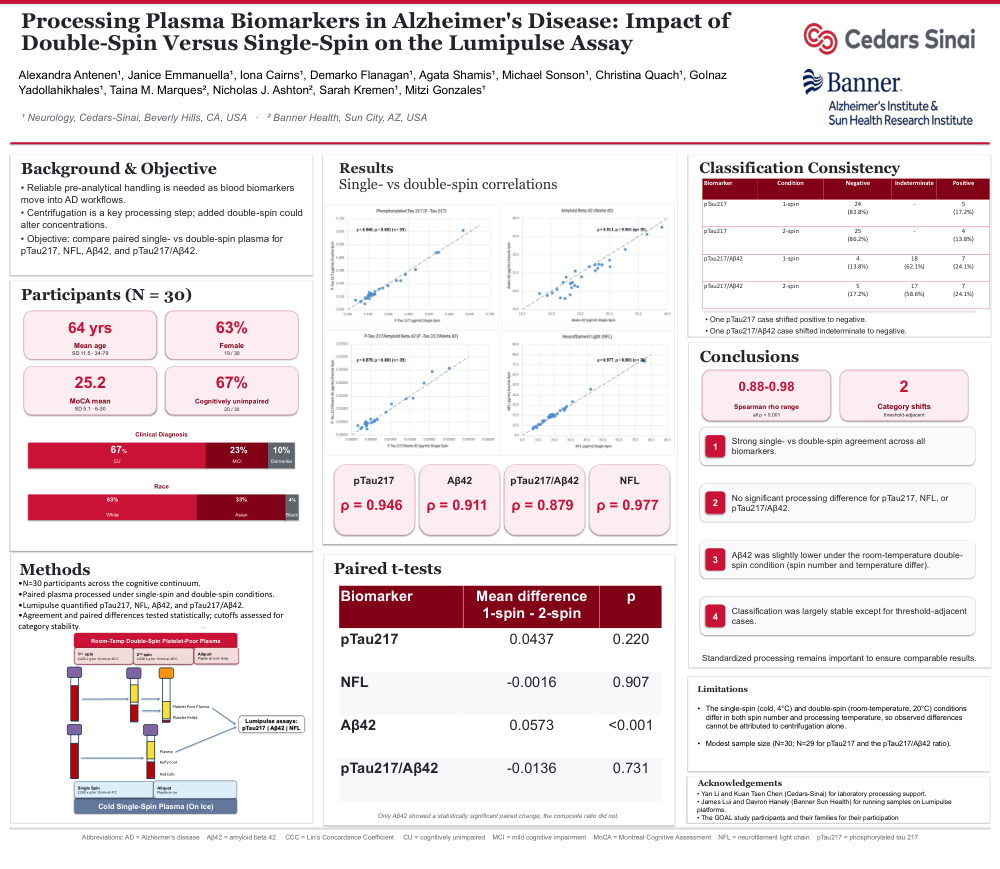
With the FDA approval of the Lumipulse G pTau217/β-amyloid 1-42 ratio for early detection of amyloid plaques, there is growing need to standardize pre-analytical procedures in clinical and research settings. Centrifugation is a key processing step, but it is unclear whether an additional centrifugation (“double-spin”) alters plasma biomarker concentrations. This study examined whether double-spin processing affects levels of phosphorylated tau-217 (pTau217), neurofilament light chain (NFL), amyloid-β42 (Aβ42), and the pTau217/Aβ42 ratio.
Methods
Plasma from 30 participants across the cognitive continuum (mean age 63.9 ± 11.5 years; 63% female, Table 1) was processed under single- and double-spin conditions. Biomarkers were quantified using the Lumipulse platform. Associations between single- and double-spin values were assessed using Spearman rank correlations. Paired t-tests evaluated within-subject differences in ln-transformed concentrations. Established clinical cut-offs were used to assess consistency in negative, indeterminate, and positive pTau217 and pTau217/Aβ42 categories.
Results
Biomarker concentrations measured in single- and double-spun plasma were strongly correlated (pTau217 r= 0.946, p=0.001; NFL r=0.97, p<0.001; Aβ42 r=0.911, p<0.001;pTau217/Aβ42 r=0.879, p<0.001; Figure 1). Paired t-tests indicated no significant differences between single- and double-spin conditions for pTau217, NFL, or the pTau217/Aβ42 ratio (all p > 0.05). Aβ42 concentrations were slightly but significantly lower after double centrifugation (t(29) = 4.34, p <0.001). Classification categories remained largely consistent across processing conditions (Table 2). Only one participant shifted from positive to negative on pTau217, and one shifted from indeterminate to negative on the pTau217/Aβ42 ratio.
Conclusions
Single- and double-spin plasma samples produced highly correlated biomarker values, suggesting that an additional centrifugation step does not meaningfully alter concentrations of pTau217, NFL, or the pTau217/Aβ42 ratio. Although Aβ42 values were reduced by double centrifugation, this difference did not cause widespread shifts in biomarker classification. Small changes near clinical decision thresholds highlight the importance of standardized processing protocols, particularly when biomarker values are close to cut-offs. Overall, these findings support the reliability of Alzheimer’s disease plasma biomarkers across commonly used centrifugation procedures and emphasize the need for consistent pre-analytical handling to minimize variability.
Comments
Email is required but is not shown publicly.
Loading comments...