4,068 posters, 219 videos, 101 topics, 69 sessions, 14,365 authors, 6,128 institutions
ePostersLive by SciGen Technologies S.A. All rights reserved.
Alzheimer's Association International Conference 2026
July 12-15, 2026 | London, United Kingdom, and Online

1074
Early Neuromuscular Junction (NMJ) Denervation In A TDP-43?NLS Mouse Model
Poster Presenter
Authors
Robin Guay-Lord, Pasquale Esposito, Lionel Breuillaud, Kristina DeDuck, Barry Bedell
Affiliations
Part of Topic
Introduction:
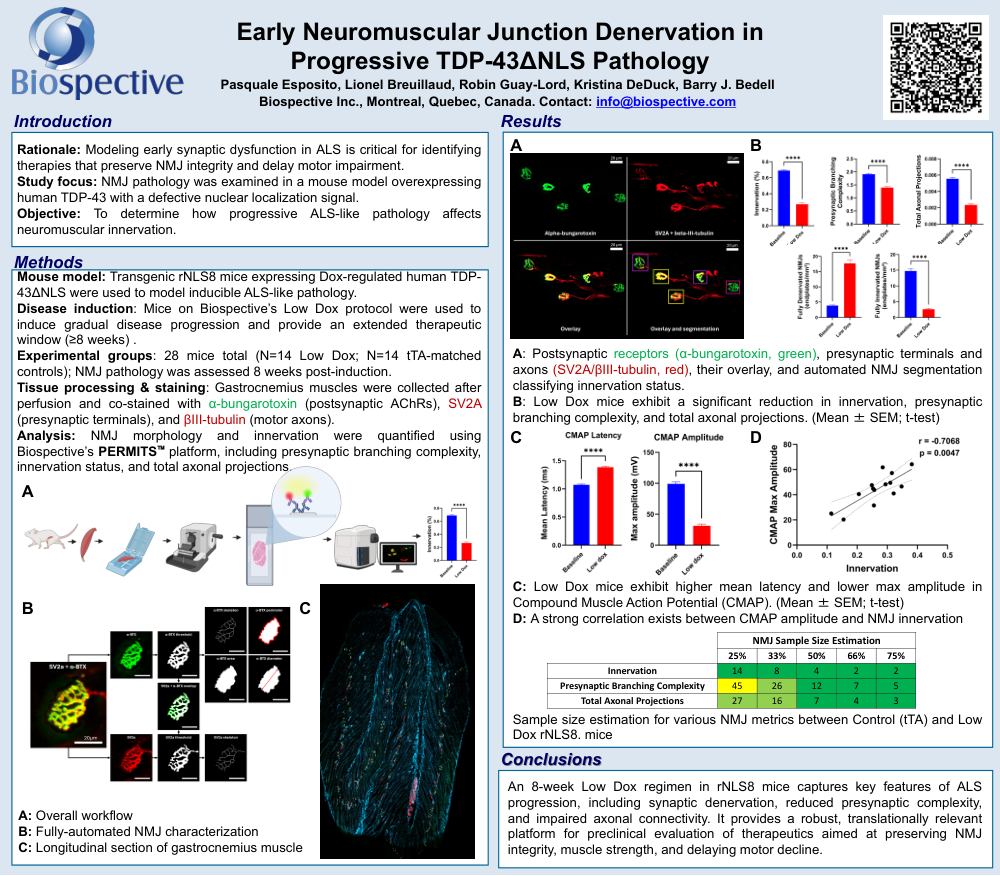
Rationale: Modeling early synaptic dysfunction in ALS is critical for identifying therapies that preserve NMJ integrity and delay motor impairment.
Study focus: NMJ pathology was examined in a mouse model overexpressing human TDP-43 with a defective nuclear localization signal.
Objective: To determine how progressive ALS-like pathology affects neuromuscular innervation
Methods:
Mouse model: Transgenic rNLS8 mice expressing Dox-regulated human TDP-43ΔNLS were used to model inducible ALS-like pathology.
Disease induction: Mice on Biospective’s Low Dox protocol were used to induce gradual disease progression and provide an extended therapeutic window (≥8 weeks) .
Experimental groups: 28 mice total (N=14 Low Dox; N=14 tTA-matched controls); NMJ pathology was assessed 8 weeks post-induction.
Tissue processing & staining: Gastrocnemius muscles were collected after perfusion and co-stained with α-bungarotoxin (postsynaptic AChRs), SV2A (presynaptic terminals), and βIII-tubulin (motor axons).
Analysis: NMJ morphology and innervation were quantified using Biospective’s PERMITS™ platform, including presynaptic branching complexity, innervation status, and total axonal projections
Results:
A: Postsynaptic receptors (α-bungarotoxin, green), presynaptic terminals and axons (SV2A/βIII-tubulin, red), their overlay, and automated NMJ segmentation classifying innervation status.
B: Low Dox mice exhibit a significant reduction in innervation, presynaptic branching complexity, and total axonal projections. (Mean ± SEM; t-test)
C: Low Dox mice exhibit higher mean latency and lower max amplitude in Compound Muscle Action Potential (CMAP). (Mean ± SEM; t-test)
D: A strong correlation exists between CMAP amplitude and NMJ innervation
Sample size estimation for various NMJ metrics between Control (tTA) and Low Dox rNLS8. mice
Conclusion:
An 8-week Low Dox regimen in rNLS8 mice captures key features of ALS progression, including synaptic denervation, reduced presynaptic complexity, and impaired axonal connectivity. It provides a robust, translationally relevant platform for preclinical evaluation of therapeutics aimed at preserving NMJ integrity, muscle strength, and delaying motor decline.
Comments
Email is required but is not shown publicly.
Loading comments...