4,068 posters, 219 videos, 101 topics, 69 sessions, 14,365 authors, 6,128 institutions
ePostersLive by SciGen Technologies S.A. All rights reserved.
Alzheimer's Association International Conference 2026
July 12-15, 2026 | London, United Kingdom, and Online

7319
Performance Of Plasma Amyloid ί Assay Using A Benchtop MALDI-TOF Mass Spectrometer
Poster Presenter
Part of Topic
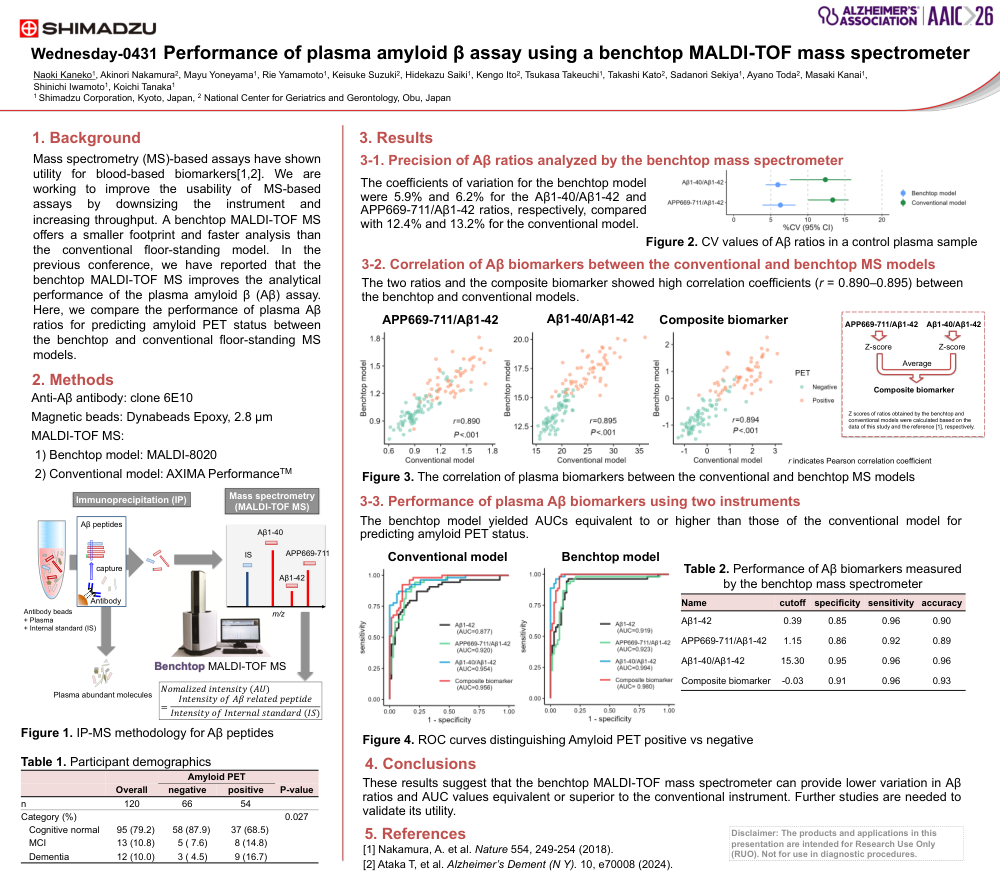
Background: Studies have shown the utility of mass spectrometry (MS)-based assay for blood-based biomarkers. However, there are some challenging issues in the use of MS for clinical practice. One of them is usability of the mass spectrometer in clinical settings. Therefore, we are working to improve it by downsizing the instrument and enhancing throughput. A benchtop MALDI-TOF mass spectrometer realizes smaller size and faster analysis compared to a conventional floor-standing model. We have reported that the benchtop MALDI-TOF MS improved analytical performance of plasma amyloid β (Aβ) assay. Here, we present the performance of plasma Aβ ratios in predicting amyloid PET status between the benchtop and the conventional floor-standing model of MALDI-TOF MS.
Method: Plasma samples (N120) were obtained from cognitively normal (CN), mild cognitive impairment (MCI) and Alzheimer’s disease (AD) subjects in National Center for Geriatrics and Gerontology. These subjects were classified as amyloid positive and negative based on amyloid PET test. Plasma Aβs were immunoprecipitated from the samples using anti- Aβ antibody beads. The Aβs eluted from the antibody beads were applied on the MALDI plate and then analyzed using the benchtop model (MALDI-8020) and the conventional floor-standing model (AXIMA PerformanceTM). Composite biomarker was calculated by averaging the z-scores of Aβ1-40/Aβ1-42 ratio and APP669-711/Aβ1-42 ratio.
Result: We measured the same plasma samples using two MALDI-TOF MS instruments. Coefficients of variation of the benchtop model were 5.9% and 6.2% in Aβ1-40/Aβ1-42 ratio and APP669-711/Aβ1-42 ratio, respectively, while those of the conventional model were 12.4% and 13.2%. These two ratios and composite biomarker indicated high correlation coefficients from 0.879 to 0.895 between the benchtop and the conventional model. Furthermore, the benchtop model showed equal or improved AUCs compared to the conventional model in predicting amyloid PET status.
Conclusion: These results suggested that the benchtop MALDI-TOF mass spectrometer could provide better performance in both analytical and clinical evaluation than the conventional instrument. Further studies were needed to validate its utility in the clinical practice.
Comments
Email is required but is not shown publicly.
Loading comments...