4,068 posters, 219 videos, 101 topics, 69 sessions, 14,365 authors, 6,128 institutions
ePostersLive by SciGen Technologies S.A. All rights reserved.
Alzheimer's Association International Conference 2026
July 12-15, 2026 | London, United Kingdom, and Online

2240
Genetic Architecture Of Alzheimer’s Disease-related Plasma Biomarkers
Poster Presenter
Authors
Aino Aaltonen, Teemu Palviainen, Sami Heikkinen, Sanna-Kaisa Herukka, Mikko Hiltunen, Tarja Kokkola, Sari Kärkkäinen, FinnGen Consortium, Aarno Palotie, Heiko Runz, Valtteri Julkunen, Jaakko Kaprio, Toni T Saari, Eero Vuoksimaa
Affiliations
Institute for Molecular Medicine Finland (FIMM), HiLIFE, University of Helsinki, Helsinki, Finland, Institute of Biomedicine, University of Eastern Finland, Kuopio, Finland, Department of Neurology, Neurocenter, Kuopio University Hospital, Kuopio, Finland, Institute of Clinical Medicine/Neurology, University of Eastern Finland, Kuopio, Finland
Part of Topic
Genetic architecture of Alzheimer’s disease–related plasma biomarkers: Estimating unique and shared genetic effects using a multivariate twin design
1. Introduction
Plasma biomarkers offer a scalable and affordable way to assess pathological changes. Alzheimer's disease–related plasma biomarkers have been investigated in relation to other biomarkers, such as amyloid PET, but their interrelationships and the factors underlying these associations have received less attention.
Family designs allow disentangling genetic and environmental contributions to phenotypic variance, and a multivariate approach enables decomposition of phenotypic correlations into genetic and environmental components. Despite the relevance of phosphorylated tau in AD, only one previous study estimating the multivariate heritability of AD-related plasma biomarkers has included ptau217, along with our previous study on the univariate heritability of p-tau2171,2. These studies have yielded heritability estimates of 0.56 and 0.41–0.42.
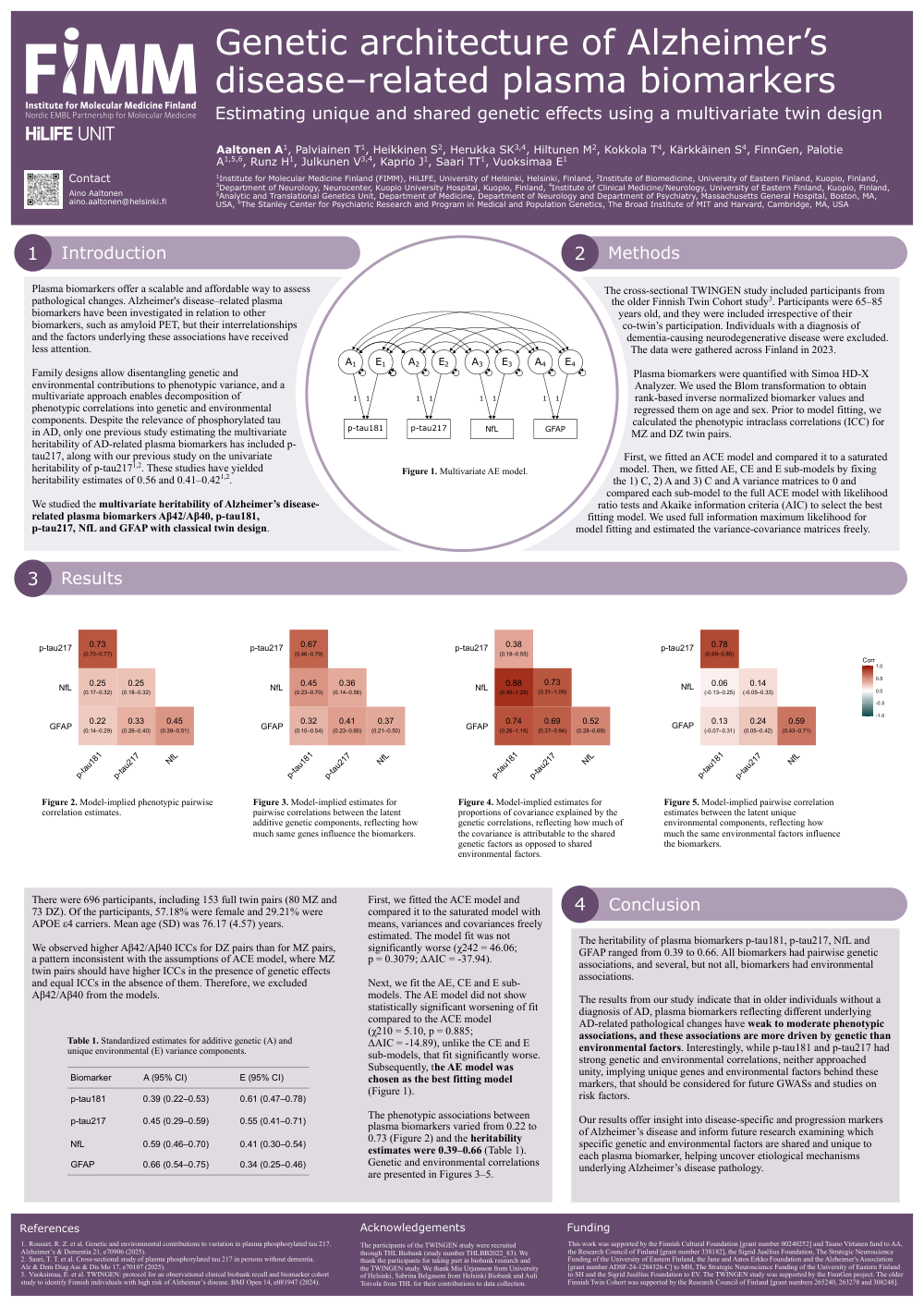
We studied the multivariate heritability of Alzheimer’s diseaserelated plasma biomarkers Aβ42/Aβ40, p-tau181, p-tau217, NfL and GFAP with classical twin design.
2. Methods
The cross-sectional TWINGEN study included participants from the older Finnish Twin Cohort study. Participants were 65–85 years old, and they were included irrespective of their co-twin’s participation. Individuals with a diagnosis of dementia-causing neurodegenerative disease were excluded. The data were gathered across Finland in 2023.
Plasma biomarkers were quantified with Simoa HD-X Analyzer. We used the Blom transformation to obtain rank-based inverse normalized biomarker values and regressed them on age and sex. Prior to model fitting, we calculated the phenotypic intraclass correlations (ICC) for MZ and DZ twin pairs.
First, we fitted an ACE model and compared it to a saturated model. Then, we fitted AE, CE and E sub-models by fixing the 1) C, 2) A and 3) C and A variance matrices to 0 and compared each sub-model to the full ACE model with likelihood ratio tests and Akaike information criteria (AIC) to select the best fitting model. We used full information maximum likelihood for model fitting and estimated the variance-covariance matrices freely.
3. Results
There were 696 participants, including 153 full twin pairs (80 MZ and 73 DZ). Of the participants, 57.18% were female and 29.21% were APOE ε4 carriers. Mean age (SD) was 76.17 (4.57) years.
We observed higher Aβ42/Aβ40 ICCs for DZ pairs than for MZ pairs, a pattern inconsistent with the assumptions of ACE model, where MZ twin pairs should have higher ICCs in the presence of genetic effects and equal ICCs in the absence of them. Therefore, we excluded Aβ42/Aβ40 from the models.
First, we fitted the ACE model and compared it to the saturated model with means, variances and covariances freely estimated. The model fit was not significantly worse (χ242 = 46.06; p = 0.3079; ΔAIC = -37.94).
Next, we fit the AE, CE and E submodels. The AE model did not show statistically significant worsening of fit compared to the ACE model (χ210 = 5.10, p = 0.885; ΔAIC = -14.89), unlike the CE and E sub-models, that fit significantly worse. Subsequently, the AE model was chosen as the best fitting model (Figure 1).
The phenotypic associations between plasma biomarkers varied from 0.22 to 0.73 (Figure 2) and the heritability estimates were 0.39–0.66 (Table 1). Genetic and environmental correlations are presented in Figures 3–5.
4. Conclusion
The heritability of plasma biomarkers p-tau181, p-tau217, NfL and GFAP ranged from 0.39 to 0.66. All biomarkers had pairwise genetic associations, and several, but not all, biomarkers had environmental associations.
The results from our study indicate that in older individuals without a diagnosis of AD, plasma biomarkers reflecting different underlying AD-related pathological changes have weak to moderate phenotypic associations, and these associations are more driven by genetic than environmental factors. Interestingly, while p-tau181 and p-tau217 had strong genetic and environmental correlations, neither approached unity, implying unique genes and environmental factors behind these markers, that should be considered for future GWASs and studies on risk factors.
Our results offer insight into disease-specific and progression markers of Alzheimer’s disease and inform future research examining which specific genetic and environmental factors are shared and unique to each plasma biomarker, helping uncover etiological mechanisms underlying Alzheimer’s disease pathology.
References
1. Rousset, R. Z. et al. Genetic and environmental contributions to variation in plasma phosphorylated tau 217. Alzheimer’s & Dementia 21, e70906 (2025).
2. Saari, T. T. et al. Cross‐sectional study of plasma phosphorylated tau 217 in persons without dementia. Alz & Dem Diag Ass & Dis Mo 17, e70107 (2025).
3. Vuoksimaa, E. et al. TWINGEN: protocol for an observational clinical biobank recall and biomarker cohort study to identify Finnish individuals with high risk of Alzheimer’s disease. BMJ Open 14, e081947 (2024).
Acknowledgements
The participants of the TWINGEN study were recruited through THL Biobank (study number THLBB2022_83). We thank the participants for taking part in biobank research and the TWINGEN study. We thank Mia Urjansson from University of Helsinki, Sabrina Belgasem from Helsinki Biobank and Auli
Toivola from THL for their contributions to data collection.
Funding
This work was supported by the Finnish Cultural Foundation [grant number 00240252] and Tauno Virtanen fund to AA, the Research Council of Finland [grant number 338182], the Sigrid Jusélius Foundation, The Strategic Neuroscience Funding of the University of Eastern Finland, the Jane and Aatos Erkko Foundation and the Alzheimer's Association [grant number ADSF-24-1284326-C] to MH, The Strategic Neuroscience Funding of the University of Eastern Finland to SH and the Sigrid Jusélius Foundation to EV. The TWINGEN study was supported by the FinnGen project. The older Finnish Twin Cohort was supported by the Research Council of Finland [grant numbers 265240, 263278 and 308248].
Comments
Email is required but is not shown publicly.
Loading comments...