4,068 posters, 219 videos, 101 topics, 69 sessions, 14,365 authors, 6,128 institutions
ePostersLive by SciGen Technologies S.A. All rights reserved.
Alzheimer's Association International Conference 2026
July 12-15, 2026 | London, United Kingdom, and Online

6883
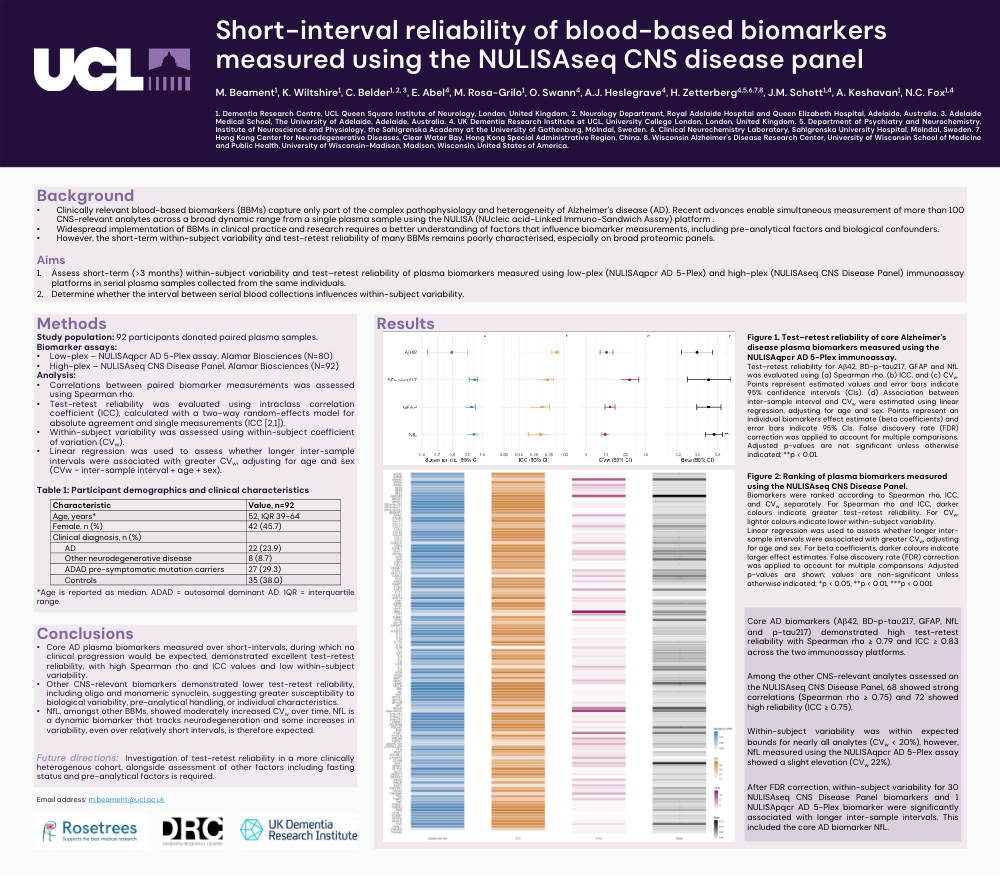
Short-interval Reliability Of Blood-based Biomarkers Measured Using The Nulisaseq CNS Disease Panel
Poster Presenter
Authors
Millie Beament, Katharine Wiltshire, Christopher Belder, Emily Abel, Miguel Rosa-Grilo, Owen Swann, Amanda Heslegrave, Henrik Zetterberg, Jonathan Schott, Ashvini Keshavan, Nick Fox
Affiliations
Dementia Research Centre, UCL Queen Square Institute of Neurology, London, United Kingdom, Dementia Research Centre, UCL Queen Square Institute of Neurology, London, United Kingdom. Neurology Department, Royal Adelaide Hospital and Queen Elizabeth Hospital, Adelaide, Australia. Adelaide Medical School, The University of Adelaide, Adelaide, Australia., Dementia Research Centre, UCL Queen Square Institute of Neurology, London, United Kingdom. UK Dementia Research Institute at UCL, University College London, London, United Kingdom, UK Dementia Research Institute at UCL, University College London, London, United Kingdom, UK Dementia Research Institute at UCL, University College London, London, United Kingdom. Department of Psychiatry and Neurochemistry, Institute of Neuroscience and Physiology, the Sahlgrenska Academy at the University of Gothenburg, Mölndal, Sweden. Clinical Neurochemistry Laboratory, Sahlgrenska University Hospital, Mölndal, Sweden. Hong Kong Center for Neurodegenerative Diseases, Clear Water Bay, Hong Kong Special Administrative Region, China. Wisconsin Alzheimer's Disease Research Center, University of Wisconsin School of Medicine and Public Health, University of Wisconsin-Madison, Madison, Wisconsin, United States of America
Part of Topic
Background
Blood-based biomarkers (BBMs) are emerging as accessible, non-invasive and cost-effective tools for the diagnosis and prognosis of neurodegenerative diseases. However, the susceptibility of various protein biomarkers to variation when re-sampled within the same individual is not well understood. In this study we assessed the test-retest reliability of plasma measurements analysed on the NULISAseq CNS disease panel from two serial samples taken from the same individuals.
Methods
Paired plasma samples collected within 3 months from 93 participants enrolled in studies at the Dementia Research Centre, UCL, were tested in singlicate using the NULISAseq CNS kit (Alamar). Both cognitively impaired and unimpaired participants were included. 41 sample pairs were tested using a previous panel version lacking seven analytes (BD-MAPT, BD-ptau181, BD-ptau217, BD-ptau231, DDC, UBB and YWHAG). Test-retest reliability was assessed using Spearman’s correlation coefficient (ρ). Agreement and subsequent disagreement reflecting potential systematic or proportional bias were evaluated using Passing–Bablok regression, with 95% confidence intervals estimated using a bootstrap (quantile) method.
Results
Participants had a mean age of 52 years (SD = 15.7); 43 were female. The cohort comprised 22 individuals with Alzheimer’s disease (AD), 8 with other dementias, 27 presymptomatic autosomal dominant AD mutation carriers, and 36 controls. The median inter-sampling interval was 85 mins (range: 30mins-92 days). Strong correlations (ρ ≥ 0.6) were observed for 104 of 131 analytes, moderate correlations (ρ = 0.4–0.6) for 20 analytes, and low correlations (ρ ≤ 0.4) for 7 analytes (Figure 1). Passing-Bablok regression demonstrated no evidence of disagreement or bias for 120 analytes. Core AD biomarkers showed high correlations (ρ ≥ 0.8); however, NfL and GFAP demonstrated evidence of systematic differences between timepoints despite strong correlation (Table 1, Figure 2).
Conclusion
Core AD biomarkers measured using the NULISAseq CNS disease panel demonstrated excellent short-interval test-retest reliability. However, NfL and GFAP showed slight disagreement across timepoints, highlighting the importance of assessing agreement in addition to correlation. Several analytes, including YWHAG, had low test-retest correlation, suggesting greater susceptibility to biological variability, pre-analytical handling, or individual characteristics, requiring further study. These findings emphasise the importance of reliability assessments for highly multiplex proteomic platforms.
Comments
Email is required but is not shown publicly.
Loading comments...