4,068 posters, 219 videos, 101 topics, 69 sessions, 14,365 authors, 6,128 institutions
ePostersLive by SciGen Technologies S.A. All rights reserved.
Alzheimer's Association International Conference 2026
July 12-15, 2026 | London, United Kingdom, and Online

4021
A Large-scale Proteomics Study Reveals Biomarkers And Potential Therapeutic Targets For Alzheimer's Disease
Poster Presenter
Authors
Yue-Ting Deng, Jia You, Yu He, Yi Zhang, Hai-Yun Li, Xin-Rui Wu, Ji-Yun Cheng, Yu Guo, Zi-Wen Long, Yi-Lin Chen, Ying Mao, Jian-Feng Feng, Wei Cheng, Jin-Tai Yu
Affiliations
Department of Neurology and National Center for Neurological Disorders, Huashan Hospital, State Key Laboratory of Medical Neurobiology and MOE Frontiers Center for Brain Science, Shanghai Medical College, Fudan University, Shanghai, China, Institute of Science and Technology for Brain-Inspired Intelligence, Fudan University, Shanghai, China, Department of Gastric Cancer Surgery, Fudan University Shanghai Cancer Center, Building 3, No. 270 Dongan Road, Shanghai 200032, China, Department of Neurosurgery, Huashan Hospital Fudan University, Shanghai, China, Institute of Science and Technology for Brain-Inspired Intelligence, Fudan University, Shanghai, China; Department of Computer Science, University of Warwick, Coventry, United Kingdom
Part of Topic
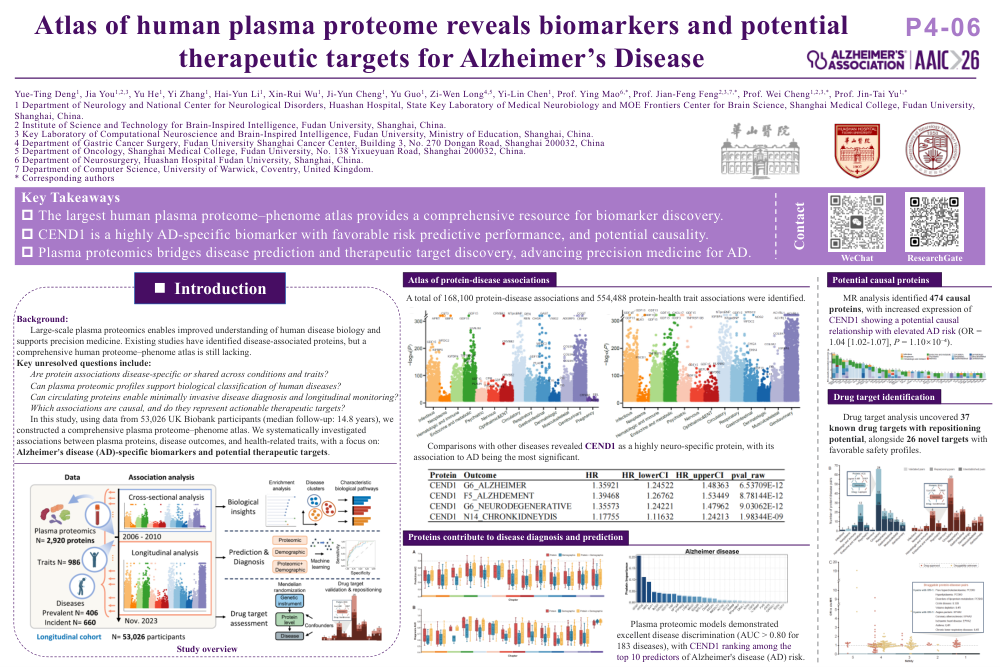
Background: Large-scale proteomic studies enhance our understanding of both health and disease, paving the way for precision medicine. This study, leveraging data from 53,026 participants of the UK Biobank (median follow-up: 14.8 years), presents the most comprehensive plasma proteome-phenotype association map to date. We aim to uncover the associations between plasma proteins and disease- and health-related traits, with a particular focus on identifying Alzheimer’s disease (AD)-specific biomarkers and potential therapeutic targets.
Method: The study analyzed 2,920 plasma proteins, establishing protein-disease associations through both cross-sectional and longitudinal analyses, encompassing 406 prevalent diseases, 660 incident diseases, and 986 health-related traits. Shared and disease-specific proteins were identified. The diagnostic and predictive power of these proteins for diseases was evaluated using machine learning models, with the area under the curve (AUC) as the performance metric. In addition, protein quantitative trait loci (pQTL) data were integrated to perform Mendelian randomization (MR) analysis for identifying causal proteins. Drug repositioning opportunities and novel targets were explored based on drug target databases. All data are publicly available via the open-access platform (https://proteome-phenome-atlas.com/) to facilitate further disease mechanism research and biomarker development.
Result: A total of 168,100 protein-disease associations and 554,488 protein-health trait associations were identified. Notably, proteins such as GFAP, NEFL, APOE, MENT, GDF15, and CEND1 were significantly associated with AD. Comparisons with other diseases revealed CEND1 as a highly neuro-specific protein, with its association to AD being the most significant (Cox HR = 1.36 [1.25-1.48], P = 6.54×10⁻¹²) (Figure 1), suggesting that elevated plasma levels of CEND1 significantly accelerate the risk of incidence of AD. In terms of disease prediction, 183 diseases showed an AUC > 0.80, demonstrating the strong diagnostic capability of plasma proteins. Furthermore, CEND1 ranked among the top 10 in AD risk prediction. MR analysis identified 474 causal proteins, with increased expression of CEND1 showing a potential causal relationship with elevated AD risk (OR = 1.04 [1.02-1.07], P = 1.10×10⁻⁴), consistent with the association results. Finally, drug target analysis uncovered 37 known drug targets with repositioning potential, alongside 26 novel targets with favorable safety profiles.
Conclusion: This study constructs the largest global plasma proteome-phenotype association map, revealing AD-specific diagnostic biomarkers and potential therapeutic targets, such as CEND1. The findings highlight the powerful potential of proteomics in disease prediction and mechanistic understanding, providing a valuable resource for precision medicine. Future studies are needed to further validate the clinical applicability of these biomarkers and explore their role in drug development.
Comments
Email is required but is not shown publicly.
Loading comments...