4,068 posters, 219 videos, 101 topics, 69 sessions, 14,365 authors, 6,128 institutions
ePostersLive by SciGen Technologies S.A. All rights reserved.
Alzheimer's Association International Conference 2026
July 12-15, 2026 | London, United Kingdom, and Online

8762
Sex Differences In Resilience To Alzheimer’s Disease Pathology: Preliminary Results Of A CSF Proteomics Study
Poster Presenter
Authors
Jolien van der Velden, Aurore Delvenne, Stephanie Vos, Johan Gobom, Betty Tijms, Suzanne Schindler, Inez Ramakers, Ehsan Pishva, Henrik Zetterberg, Pieter Jelle Visser, Willemijn Jansen
Affiliations
Alzheimer Center Limburg, Department of Psychiatry and Neuropsychology, School for Mental Health and Neuroscience, Maastricht University, Maastricht, the Netherlands, Clinical Neurochemistry Laboratory, Sahlgrenska University Hospital, Mölndal, Sweden; Department of Psychiatry and Neurochemistry, Institute of Neuroscience and Physiology, Sahlgrenska Academy at the University of Gothenburg, Mölndal, Sweden, Alzheimer Center Amsterdam, Department of Neurology, Amsterdam Neuroscience, Vrije Universiteit Amsterdam, Amsterdam University Medical Center (UMC), Amsterdam, the Netherlands, Department of Neurology, Washington University School of Medicine, St. Louis, USA; Knight Alzheimer's Disease Research Center, Washington University School of Medicine, St. Louis, USA, Alzheimer Center Limburg, Department of Psychiatry and Neuropsychology, School for Mental Health and Neuroscience, Maastricht University, Maastricht, the Netherlands; Alzheimer Center Amsterdam, Department of Neurology, Amsterdam Neuroscience, Vrije Universiteit Amsterdam, Amsterdam University Medical Center (UMC), Amsterdam, the Netherlands
Part of Topic
Introduction
Up to 25% of individuals with amyloid-β and tau pathology remain cognitively healthy throughout life, showing resilience to AD. Literature shows there may be sex differences in resilience to AD. Understanding underlying mechanisms of sex differences in resilience to AD, using CSF proteomics, could aid development of personalised preventive interventions.
Methods
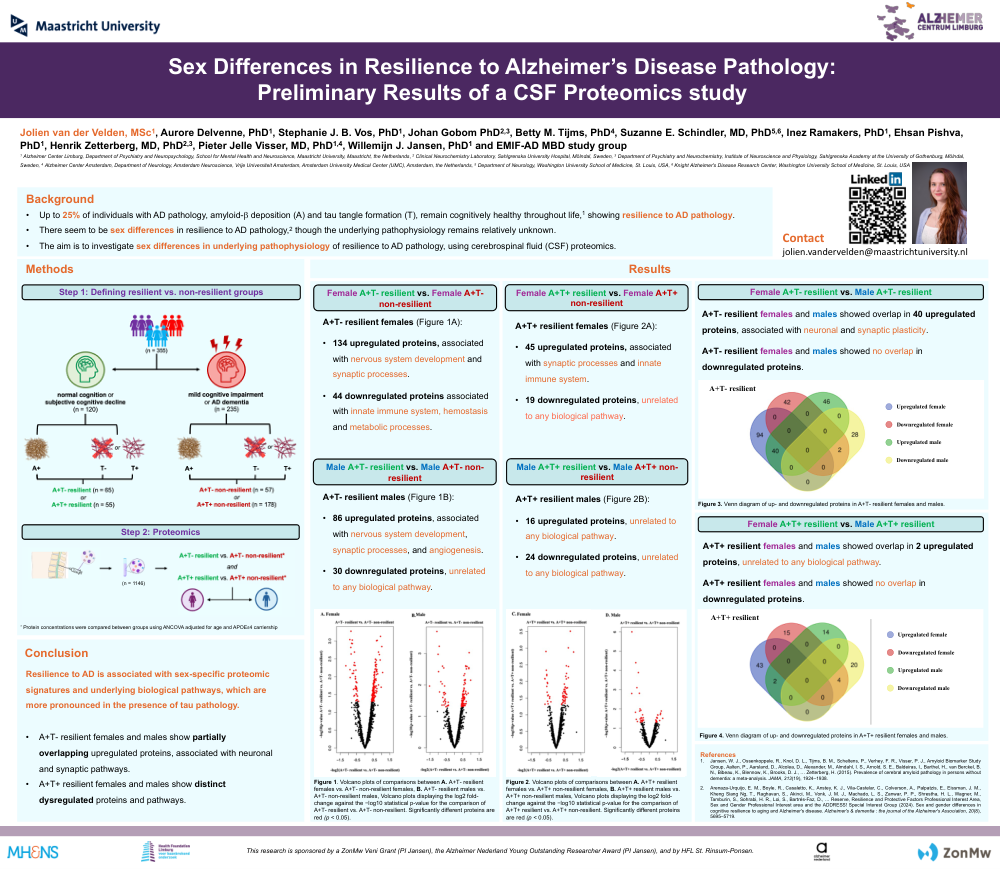
355 participants from EMIF-AD MBD, Washington University Knight ADRC and Maastricht BB-ACL studies were included (Table 1). Cognitively healthy participants with abnormal CSF amyloid-b42 (A+) and (ab)normal p-tau181 (T+/-) were considered A+T-/A+T+ resilient (33/29 females, 32/26 males, respectively). Participants with MCI or AD dementia were considered A+T-/A+T+ non-resilient (29/97 females, 28/81 males, respectively). ANOVA, adjusted for age and APOEε4 carriership, compared protein concentrations between resilient and non-resilient groups stratified for pathological profile and sex. GO enrichment analyses were performed to uncover associated biological pathways.
Results
Figure 1 shows dysregulated proteins per group. In the A+T- group, resilient females primarily showed upregulated proteins (n=134) associated with nervous system development and synaptic processes, compared to non-resilient females. Resilient males similarly showed predominantly upregulated proteins (n=86) associated with nervous system development, synaptic processes, and angiogenesis, compared to non-resilient males, that partially overlapped with resilient females (n=40). Downregulated proteins in resilient females (n=44) were related to innate immune system, hemostasis and metabolic processes, while downregulated proteins in resilient males (n=30) were unrelated to any biological pathways and did not overlap with resilient females (Figure 2A).
In the A+T+ group, resilient females primarily showed upregulated proteins (n=45) associated with synaptic processes and innate immune system, while resilient males primarily showed downregulated proteins (n=24) without associated biological pathways. Downregulated proteins in resilient females (n=19) and upregulated proteins in resilient males (n=16) were unrelated to any biological pathways. Overlap in dysregulated proteins between resilient females and males was minimal (Figure 2B).
Conclusion
A+T- resilient females and males showed partially overlapping upregulated proteins related to neuronal and synaptic plasticity, while A+T+ resilient females and males showed distinct dysregulated proteins and biological pathways. Overall, resilience to AD is associated with sex-specific proteomic signatures and underlying biological pathways, which are more pronounced in the presence of tau pathology.
Comments
Email is required but is not shown publicly.
Loading comments...