4,068 posters, 219 videos, 101 topics, 69 sessions, 14,365 authors, 6,128 institutions
ePostersLive by SciGen Technologies S.A. All rights reserved.
Alzheimer's Association International Conference 2026
July 12-15, 2026 | London, United Kingdom, and Online

4024
Plasma P-tau217 And Gfap For Classification Of Cognitively Normal, Mild Cognitive Impairment And Alzheimer’S Disease Dementia
Poster Presenter
Authors
Jiayuan Xu, Andrew Doig, Sofia Michopoulou, Petroula Proitsi, Fumie Costen
Affiliations
Electrical and Electronic Engineering, University of Manchester, Manchester, United Kingdom, Division of Neuroscience, School of Biological Sciences, University of Manchester, Manchester, United Kingdom, Medical Physics University Hospital Southampton NHS Foundation Trust, University of Southampton, Southampton, United Kingdom, Centre for Preventive Neurology, Wolfson Institute of Population Health, Queen Mary’s University of London, London, United Kingdom
Part of Topic
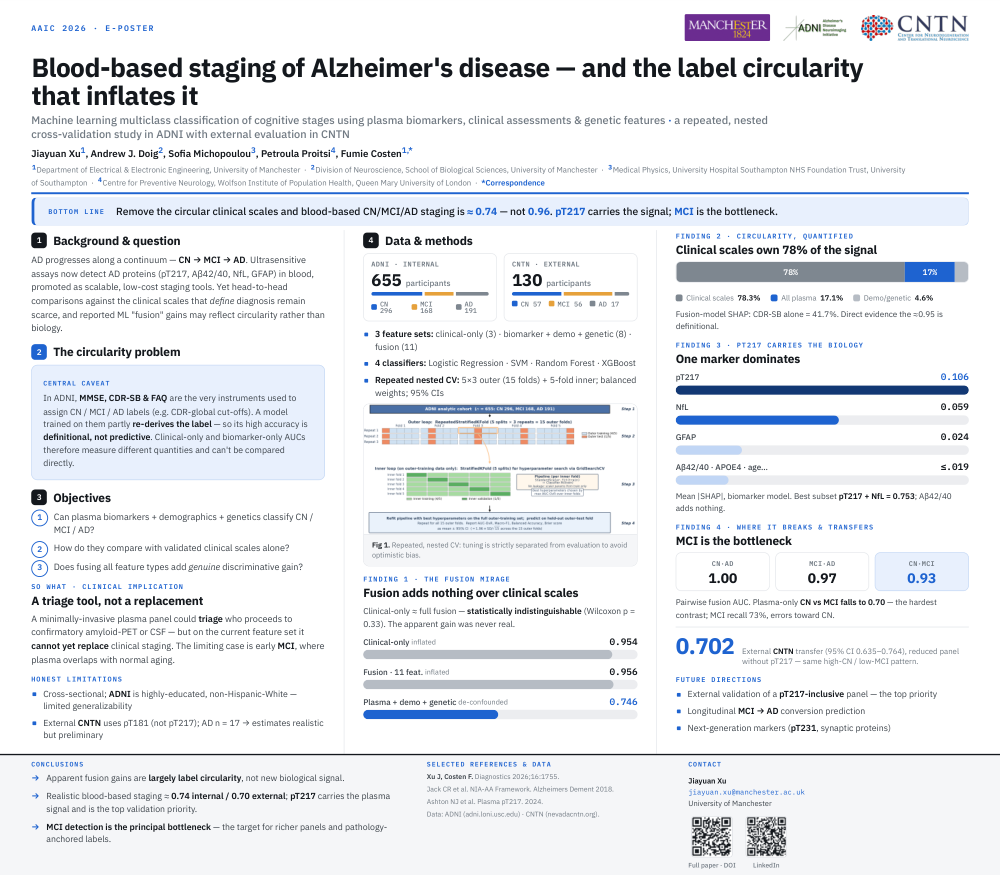
Blood-based staging of Alzheimer's disease — and the label circularity that inflates it. Machine-learning multiclass classification of cognitive stages using plasma biomarkers, clinical assessments and genetic features: a repeated, nested cross-validation study in ADNI with external evaluation in CNTN.
Jiayuan Xu, Andrew J. Doig, Sofia Michopoulou, Petroula Proitsi, Fumie Costen.
Background: Plasma biomarkers are promoted as scalable tools for staging Alzheimer's disease (AD), but head-to-head comparisons against the clinical scales used to define diagnostic labels are scarce, and reported machine-learning "fusion" gains may reflect label circularity rather than biological signal.
Methods: From ADNI we assembled 655 participants (CN=296, MCI=168, AD=191) with concurrent plasma biomarkers (pT217, Aβ42/40, NfL, GFAP), clinical scales (MMSE, CDR-SB, FAQ), APOE genotype and demographics. Three pre-specified feature sets (clinical-only; biomarker + demographic–genetic; full fusion) were compared across four classifiers (Logistic Regression, SVM, Random Forest, XGBoost) using repeated, nested cross-validation (5-fold × 3 outer, 5-fold inner). External evaluation used the CNTN cohort (n=130) on a reduced shared panel (NfL, GFAP, APOE, age, sex, education).
Results: Clinical scales alone reached three-class AUC-OVR 0.954 and fusion 0.956 — statistically indistinguishable (Wilcoxon p=0.33). Because MMSE, CDR-SB and FAQ partly define the ADNI labels, both estimates are circularity-inflated. The de-confounded plasma + demographic–genetic model achieved AUC-OVR 0.746, with pT217 dominant (mean|SHAP| 0.106, 1.8× NfL; best subset pT217+NfL 0.753); SHAP attributed 78% of the fusion model's importance to the clinical scales. Pairwise discrimination: CN vs AD ≈1.00, MCI vs AD 0.97, CN vs MCI 0.93 (0.70 plasma-only). The reduced panel transferred to CNTN at AUC-OVR 0.702 (95% CI 0.635–0.764).
Conclusions: Apparent fusion gains are largely label circularity. Realistic blood-based CN/MCI/AD staging is ≈0.74 (internal) / 0.70 (external); pT217 carries the plasma signal; MCI detection is the principal bottleneck.
Keywords: Alzheimer's disease; mild cognitive impairment; plasma biomarkers; pT217; machine learning; nested cross-validation; multiclass classification; ADNI; CNTN; SHAP; label circularity.
Comments
Email is required but is not shown publicly.
Loading comments...