4,068 posters, 219 videos, 101 topics, 69 sessions, 14,365 authors, 6,128 institutions
ePostersLive by SciGen Technologies S.A. All rights reserved.
Alzheimer's Association International Conference 2026
July 12-15, 2026 | London, United Kingdom, and Online

746
Synaptic, Axonal Damage Mediates The Correlation Between The Complement System And Alzheimer's Disease Pathology
Poster Presenter
Authors
Part of Topic
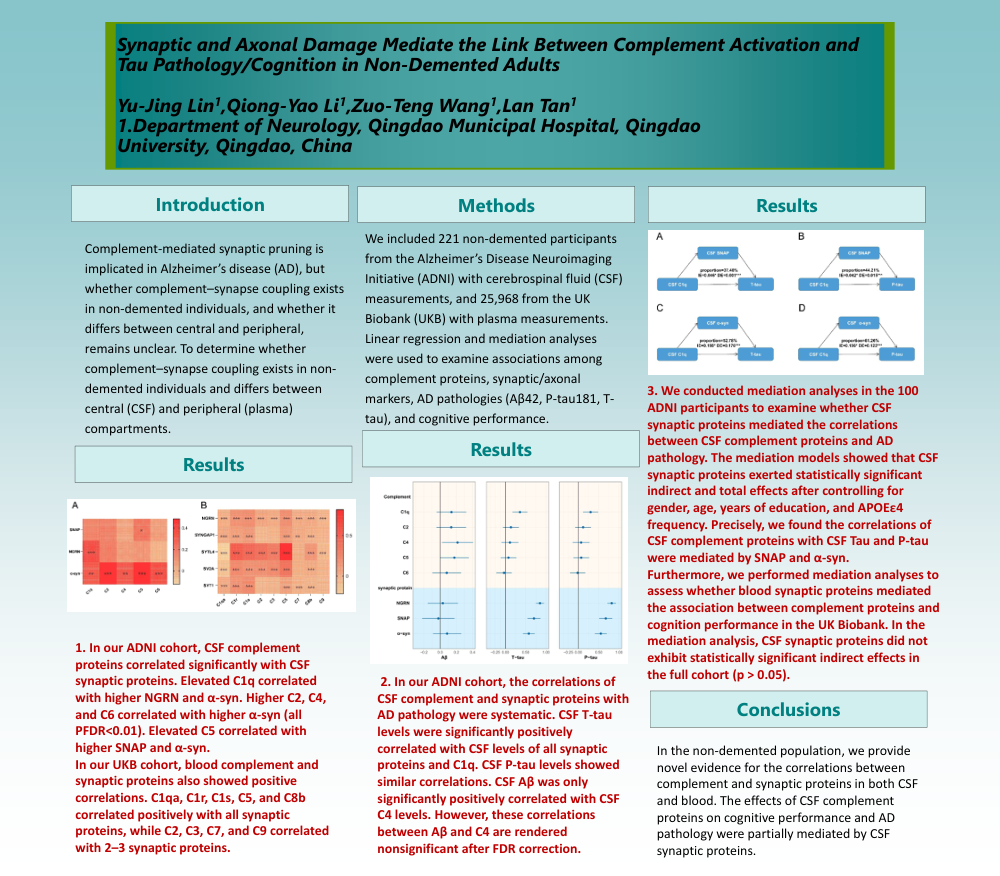
Synaptic and Axonal Damage Mediate the Link Between Complement Activation and Tau Pathology/Cognition in Non-Demented Adults
Introduction
Complement-mediated synaptic pruning is implicated in Alzheimer’s disease (AD), but whether complement–synapse coupling exists in non-demented individuals, and whether it differs between central and peripheral, remains unclear. To determine whether complement–synapse coupling exists in non-demented individuals and differs between central (CSF) and peripheral (plasma) compartments.
Methods
We included 221 non-demented participants from the Alzheimer's Disease Neuroimaging Initiative (ADNI) with cerebrospinal fluid (CSF) measurements, and 25,968 from the UK Biobank (UKB) with plasma measurements. Linear regression and mediation analyses were used to examine associations among complement proteins, synaptic/axonal markers, AD pathologies (Aβ42, P-tau181, T-tau), and cognitive performance.
Results
1. In our ADNI cohort, CSF complement proteins correlated significantly with CSF synaptic proteins. Elevated C1q correlated with higher NGRN and α-syn. Higher C2, C4, and C6 correlated with higher α-syn (all PFDR<0.01). Elevated C5 correlated with higher SNAP and α-syn. In our UKB cohort, blood complement and synaptic proteins also showed positive correlations. C1qa, C1r, C1s, C5, and C8b correlated positively with all synaptic proteins, while C2, C3, C7, and C9 correlated with 2–3 synaptic proteins.
2. In our ADNI cohort, the correlations of CSF complement and synaptic proteins with AD pathology were systematic. CSF T-tau levels were significantly positively correlated with CSF levels of all synaptic proteins and C1q. CSF P-tau levels showed similar correlations. CSF Aβ was only significantly positively correlated with CSF C4 levels. However, these correlations between Aβ and C4 are rendered nonsignificant after FDR correction.
3. We conducted mediation analyses in the 100 ADNI participants to examine whether CSF synaptic proteins mediated the correlations between CSF complement proteins and AD pathology. The mediation models showed that CSF synaptic proteins exerted statistically significant indirect and total effects after controlling for gender, age, years of education, and APOEε4 frequency. Precisely, we found the correlations of CSF complement proteins with CSF Tau and P-tau were mediated by SNAP and α-syn.
Furthermore, we performed mediation analyses to assess whether blood synaptic proteins mediated the association between complement proteins and cognition performance in the UK Biobank. In the mediation analysis, CSF synaptic proteins did not exhibit statistically significant indirect effects in the full cohort (p > 0.05).
Conclusions
In the non-demented population, we provide novel evidence for the correlations between complement and synaptic proteins in both CSF and blood. The effects of CSF complement proteins on cognitive performance and AD pathology were partially mediated by CSF synaptic proteins.
Comments
Email is required but is not shown publicly.
Loading comments...