4,068 posters, 219 videos, 101 topics, 69 sessions, 14,365 authors, 6,128 institutions
ePostersLive by SciGen Technologies S.A. All rights reserved.
Alzheimer's Association International Conference 2026
July 12-15, 2026 | London, United Kingdom, and Online

10244
Socioculturally Generalizable Speech Biomarkers Of Alzheimer’S And Frontotemporal Dementia In Latinos
Poster Presenter
Authors
Franco J. Ferrante, Agustina Birba, Jeremias Inchauspe, Gonzalo Perez, Lucas Golombek, Alejandro Sosa-Welford, Matias Caccia, Nicolas Pelella, Lucas Sterpin, Claudio Estienne, Eugenia Hesse, Lucía Amoruso, Agustín Ibañez, Adolfo M. García
Affiliations
Cognitive Neuroscience Center, Department of Behavioral and Life Sciences, Universidad de San Andrés, Vito Dumas 284 (B1644BID), Victoria, Buenos Aires, Argentina, Cognitive Neuroscience Center, Department of Behavioral and Life Sciences, Universidad de San Andrés, Vito Dumas 284 (B1644BID), Victoria, Buenos Aires, Argentina; National Scientific and Technical Research Council (CONICET), Godoy Cruz 2290, Piso 9 (C1425FQB), Buenos Aires, Argentina; School of Engineering, University of Buenos Aires, Avenida Paseo Colón 850 (C1063), Buenos Aires, Argentina, Cognitive Neuroscience Center, Department of Behavioral and Life Sciences, Universidad de San Andrés, Vito Dumas 284 (B1644BID), Victoria, Buenos Aires, Argentina; National Scientific and Technical Research Council (CONICET), Godoy Cruz 2290, Piso 9 (C1425FQB), Buenos Aires, Argentina, Instituto de Ingeniería Biomédica, Universidad de Buenos Aires, Buenos Aires, Argentina, Cognitive Neuroscience Center, Department of Behavioral and Life Sciences, Universidad de San Andrés, Vito Dumas 284 (B1644BID), Victoria, Buenos Aires, Argentina; Departamento de Matemática y Ciencias, Universidad de San Andrés, Buenos Aires, Argentina., Cognitive Neuroscience Center, Department of Behavioral and Life Sciences, Universidad de San Andrés, Vito Dumas 284 (B1644BID), Victoria, Buenos Aires, Argentina; Basque Center on Cognition, Brain, and Language (BCBL), San Sebastian, Spain; Ikerbasque, Basque Foundation for Science, Bilbao, Spain, Cognitive Neuroscience Center, Department of Behavioral and Life Sciences, Universidad de San Andrés, Vito Dumas 284 (B1644BID), Victoria, Buenos Aires, Argentina; Latin American Brain Health Institute (BrainLat), Universidad Adolfo Ibáñez, Santiago, Chile; Global Brain Health Institute, Trinity College Dublin, Dublin, Ireland; Department of Biophysics, School of Medicine, Istanbul Medipol University, 34815, Istanbul, Türkiye; Barcelonaβeta Brain Research Center (BBRC), Pasqual Maragall Foundation, 08005, Barcelona, Spain, Cognitive Neuroscience Center, Department of Behavioral and Life Sciences, Universidad de San Andrés, Vito Dumas 284 (B1644BID), Victoria, Buenos Aires, Argentina; Latin American Brain Health Institute (BrainLat), Universidad Adolfo Ibáñez, Santiago, Chile; Global Brain Health Institute, University of California, San Francisco, 505 Parnassus Ave, San Francisco, CA, 94143, USA; Departamento de Lingüística y Literatura, Facultad de Humanidades, Universidad de Santiago de Chile, Santiago, Chile
Part of Topic
Background
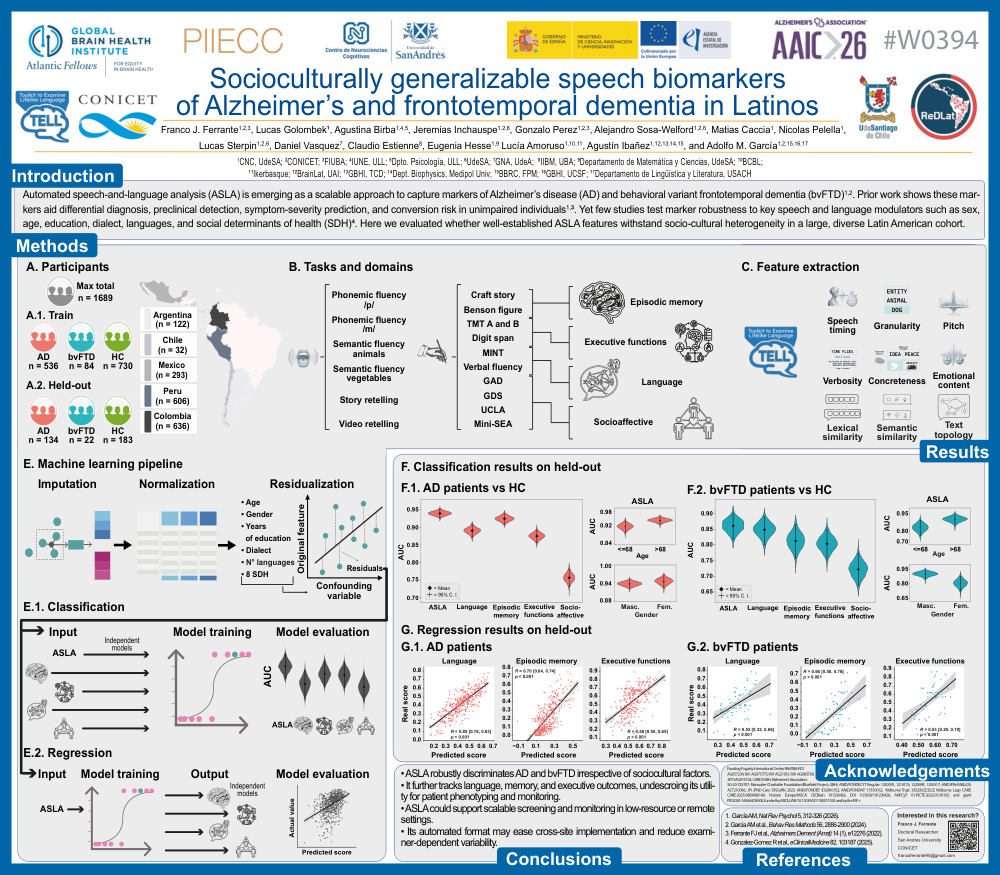
Automated speech-and-language analysis (ASLA) is emerging as a scalable approach to capture markers of Alzheimer’s disease (AD) and behavioral variant frontotemporal dementia (bvFTD). Prior work shows these markers aid differential diagnosis, preclinical detection, symptom-severity prediction, and conversion risk in unimpaired individuals. Yet few studies test marker robustness to key speech and language modulators such as sex, age, education, dialect, languages, and social determinants of health (SDH). Here we evaluated whether well-established ASLA features withstand socio-cultural heterogeneity in a large, diverse Latin American cohort.
Methods
We evaluated whether well-established ASLA features discriminate AD and bvFTD from healthy controls (HC) and predict cognitive outcomes in a large Latin American cohort. The sample included up to 1,689 Spanish-speaking participants from Argentina, Chile, Mexico, Peru, and Colombia, comprising 670 AD patients, 106 bvFTD patients, and 913 HC. Participants completed two phonemic fluency, two semantic fluency, story retelling, and video retelling tasks. ASLA features captured speech timing, pitch, verbosity, concreteness, emotional content, granularity, lexical similarity, semantic similarity, and text topology. Machine-learning models included residualization for age, sex, education, dialect, number of languages, and eight social determinants of health. Performance is reported in the hold-out dataset.
Results
Residualized ASLA features showed strong hold-out discrimination for both AD-vs-HC and bvFTD-vs-HC. For AD-vs-HC, ASLA achieved AUC = 0.938 [0.926–0.950], nominally exceeding cognitive-domain models based on episodic memory, AUC = 0.924 [0.908–0.939]; language, AUC = 0.890 [0.874–0.905]; executive functions, AUC = 0.874 [0.856–0.891]; and socioaffective measures, AUC = 0.757 [0.731–0.780]. For bvFTD-vs-HC, ASLA achieved AUC = 0.860 [0.818–0.901], also exceeding cognitive-domain models based on language, AUC = 0.848 [0.804–0.887]; episodic memory, AUC = 0.813 [0.760–0.861]; executive functions, AUC = 0.804 [0.758–0.849]; and socioaffective measures, AUC = 0.721 [0.669–0.775].
ASLA performance remained high across the age and sex strata shown in the poster. For AD-vs-HC, AUCs were 0.913 [0.888–0.937] in participants aged ≤68 and 0.940 [0.922–0.955] in those aged >68; and 0.936 [0.922–0.949] in males and 0.945 [0.922–0.963] in females. For bvFTD-vs-HC, AUCs were 0.825 [0.755–0.889] in participants aged ≤68 and 0.899 [0.846–0.941] in those aged >68; and 0.899 [0.852–0.939] in males and 0.803 [0.724–0.874] in females.
ASLA also tracked cognitive-domain composites. In AD, correlations were significant for language, R = 0.795 [0.742–0.837]; episodic memory, R = 0.692 [0.635–0.742]; and executive functions, R = 0.583 [0.506–0.653]. In bvFTD, correlations were significant with values: R = 0.524 [0.244–0.701], R = 0.625 [0.442–0.777], and R = 0.548 [0.346–0.696], respectively. Socioaffective correlations were not shown because they were not significant.
Conclusions
These findings suggest that ASLA markers can support socioculturally robust detection and phenotyping of AD and bvFTD in Latin American populations. Automated speech-based tools may facilitate scalable screening and monitoring in low-resource or remote settings while reducing examiner-dependent variability.
Comments
Email is required but is not shown publicly.
Loading comments...