4,068 posters, 219 videos, 101 topics, 69 sessions, 14,365 authors, 6,128 institutions
ePostersLive by SciGen Technologies S.A. All rights reserved.
Alzheimer's Association International Conference 2026
July 12-15, 2026 | London, United Kingdom, and Online

4803
Linking Plasma Gfap To Olfactory Dysfunction In Early Ad: The Mediating Role Of Free Water In Olfactory-related Brain Regions
Poster Presenter
Authors
Affiliations
Department of Psychology, Nanjing Drum Tower Hospital, Affiliated Hospital of Medical School,Nanjing University, Nanjing, China, Department of Radiology, Nanjing Drum Tower Hospital, Affiliated Hospital of Medical School, Nanjing University, Nanjing, China, Department of Radiology, NanjingDrum Tower Hospital Clinical College of Nanjing Medical University, Nanjing, China
Part of Topic
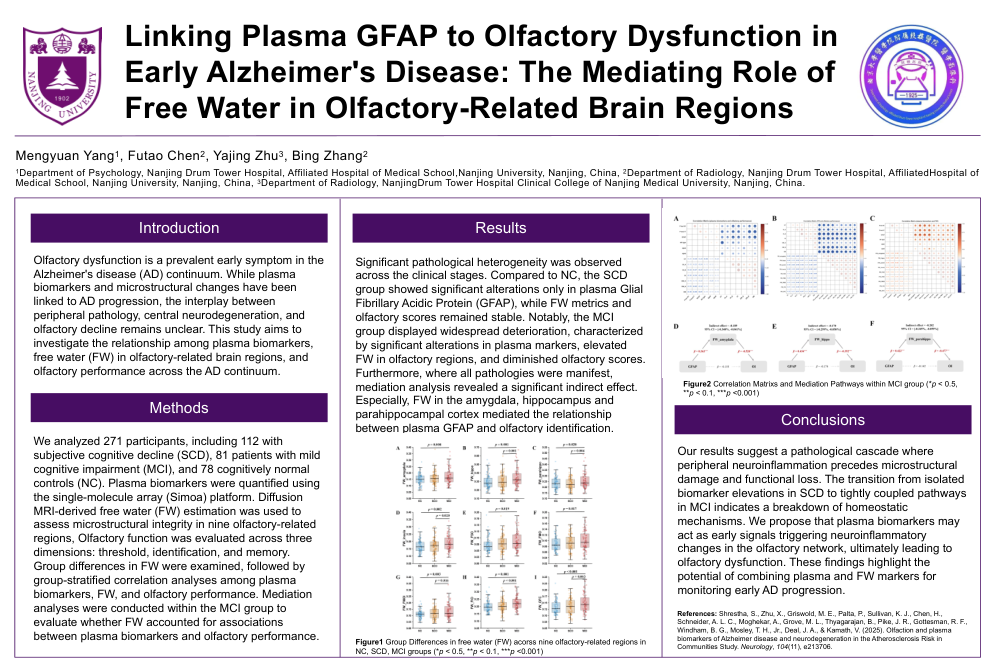
Linking Plasma GFAP to Olfactory Dysfunction in Early Alzheimer's Disease: The Mediating Role of Free Water in Olfactory-Related Brain Regions
Introduction: Olfactory dysfunction is a prevalent early symptom in the Alzheimer's disease (AD) continuum. While plasma biomarkers and microstructural changes have been linked to AD progression, the interplay between peripheral pathology, central neurodegeneration, and olfactory decline remains unclear. This study aims to investigate the relationship among plasma biomarkers, free water (FW) in olfactory-related brain regions, and olfactory performance across the AD continuum.
Methods: We analyzed 271 participants, including 112 with subjective cognitive decline (SCD), 81 patients with mild cognitive impairment (MCI), and 78 cognitively normal controls (NC). Plasma biomarkers were quantified using the single-molecule array (Simoa) platform. Diffusion MRI-derived free water (FW) estimation was used to assess microstructural integrity in nine olfactory-related regions, Olfactory function was evaluated across three dimensions: threshold, identification, and memory. Group differences in FW were examined, followed by group-stratified correlation analyses among plasma biomarkers, FW, and olfactory performance. Mediation analyses were conducted within the MCI group to evaluate whether FW accounted for associations between plasma biomarkers and olfactory performance.
Results: Significant pathological heterogeneity was observed across the clinical stages. Compared to NC, the SCD group showed significant alterations only in plasma Glial Fibrillary Acidic Protein (GFAP), while FW metrics and olfactory scores remained stable. Notably, the MCI group displayed widespread deterioration, characterized by significant alterations in plasma markers, elevated FW in olfactory regions, and diminished olfactory scores. Furthermore, where all pathologies were manifest, mediation analysis revealed a significant indirect effect. Especially, FW in the amygdala, hippocampus and parahippocampal cortex mediated the relationship between plasma GFAP and olfactory identification.
Conclusions: Our results suggest a pathological cascade where peripheral neuroinflammation precedes microstructural damage and functional loss. The transition from isolated biomarker elevations in SCD to tightly coupled pathways in MCI indicates a breakdown of homeostatic mechanisms. We propose that plasma biomarkers may act as early signals triggering neuroinflammatory changes in the olfactory network, ultimately leading to olfactory dysfunction. These findings highlight the potential of combining plasma and FW markers for monitoring early AD progression.
Comments
Email is required but is not shown publicly.
Loading comments...